Paints, varnishes, stains, wood preservatives, oils and waxes for wood: Complete guide and buying advisor
Whether you’re renovating old furniture, building a new deck, or just want your wooden fencing to look great, you’re facing the same challenge: How do you protect the wood properly and what should you actually use on it? Wood is a beautiful but vulnerable material that, without the right care, quickly succumbs to time and weather. Untreated wood loses both function and appearance, so protection against moisture, UV radiation and pests is absolutely essential.
This guide walks you through the world of wood finishes. From solid paints and opaque coatings, through clear varnishes, to natural oils and waxes. You’ll learn what the differences are, how they work, and how to choose the right product for your specific project. The main categories of products we’ll cover are: opaque, semi-opaque and transparent.
Basic types of wood finishes: Definitions and key differences
Your choice of product depends on whether you want the wood grain to be completely hidden (opaque), highlighted (semi-opaque), or just lightly sealed while letting it breathe (transparent).
Wood paints (opaque coatings)
Paint is an opaque coating that creates a non-transparent film on the surface and completely covers the wood grain. Its main advantage is maximum protection against UV radiation and weather, because it fully seals the wood. There are two main types. Acrylic paints are water-based, dry quickly, have low odour and are flexible, which is useful when the wood moves and changes dimension. In contrast, alkyd/enamel paints are solvent-based and create a very hard, durable and abrasion-resistant film, often used on heavily stressed surfaces.
Wood varnishes
Varnish is a transparent coating that forms a hard, closed, non-breathable film with high mechanical resistance. It contains no pigment (or only a minimum), so it keeps the natural look of the wood, but without effective UV protection. The wood under the varnish will gradually turn grey, the varnish will crack and start to peel. The best-known types include polyurethane (PUR) varnishes, which are the most durable and are used on floors and furniture. Then there are marine varnishes, which are extremely resistant to moisture and chemicals and very flexible, so they can cope with wood movement.
Wood stains (lazury)
A lazura is a semi-transparent, pigmented coating that does not create as strong and hard a film as varnish, but penetrates deep into the wood structure while adding colour. Lazury enhance the natural grain of the wood, and the pigments at the same time provide protection against UV radiation. They are divided into thin-film lazury, which have a lower solids content, penetrate deeper but need more frequent maintenance and are suitable for fences or pergolas (non-dimensionally stable elements). On the other hand, thick-film lazury create a stronger film and are better suited for windows and doors, where dimensional stability is required.
Wood dyes (mořidla)
A mořidlo is primarily a colouring agent that changes the shade of the wood but does not contain any protective binder. Its role is purely aesthetic – to bring out the deep structure of the wood before the final finish. A mořidlo must always be covered with another protective coating, such as varnish, oil or wax, because on its own it does not protect against moisture or UV radiation. It differs from a lazura in that a lazura already contains a binder and creates a protective layer, while a mořidlo only colours the wood.
Wood oils
Wood oil is a natural or synthetic product that penetrates deep into the wood fibres and fills the pores. It does not form a closed film on the surface. It gives the wood a natural, matt or satin look and allows it to breathe. Its main benefits include deep penetration, enhancement of the natural appearance and easy maintenance. Oils are mainly used on floors, decks and garden furniture.
Wood waxes
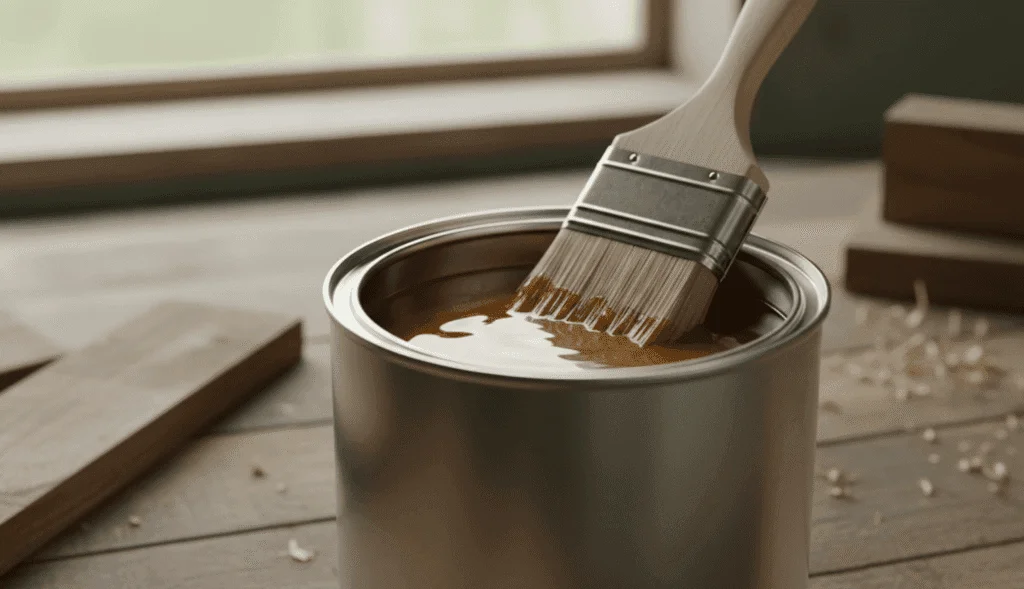
Wax (most often based on beeswax or carnauba wax) serves as a final surface finish or polish. Its function is to provide a water-repellent (hydrophobic) effect, a smooth feel to the touch and a satin sheen. Waxes are mainly used indoors on furniture and antiques, and are often combined with oil, which gives rise to so-called hard wax oils.
Comparison table – Overview and key differences
| Type of product | Main characteristics and function |
|---|---|
| Paint | Opaque coating, completely hides the wood grain, highest UV protection. |
| Varnish | Transparent, forms a hard surface film, high mechanical resistance, minimal UV protection. |
| Lazura | Semi-transparent/pigmented, enhances the grain, protects against UV and moisture. |
| Mořidlo | Colouring only with no protective function. Must be overcoated with varnish/oil. |
| Oil | Deep penetration, lets the wood breathe, natural look, easy maintenance. |
| Wax | Final finish, hydrophobic effect, silky feel to the touch, mainly for interiors. |
How wood finishes work: Protection principles
Understanding how these products work helps you predict how the finish will age over the years and what kind of renovation it will need. There are two basic mechanisms.
Film-forming coatings
This principle applies to paints, varnishes and thick-film lazury. The product creates a closed, impermeable layer on the surface of the wood – a film that acts as a shield. The film protects the wood from direct contact with water and dirt. The downside is that if the wood under the film expands and contracts (which it constantly does outdoors), the rigid film will eventually be damaged. Moisture then seeps under the coating and causes cracking, blistering and peeling.
Impregnation and penetration (non-film-forming)
This principle is typical for oils, mořidla and thin-film lazury. These products penetrate deep into the wood structure and do not seal the pores. The wood can still “breathe” – take in and release moisture. The advantage is that the surface does not peel over time but gradually wears away through erosion. Renovation is therefore much easier – usually you just clean the surface and apply a new coat.
UV protection
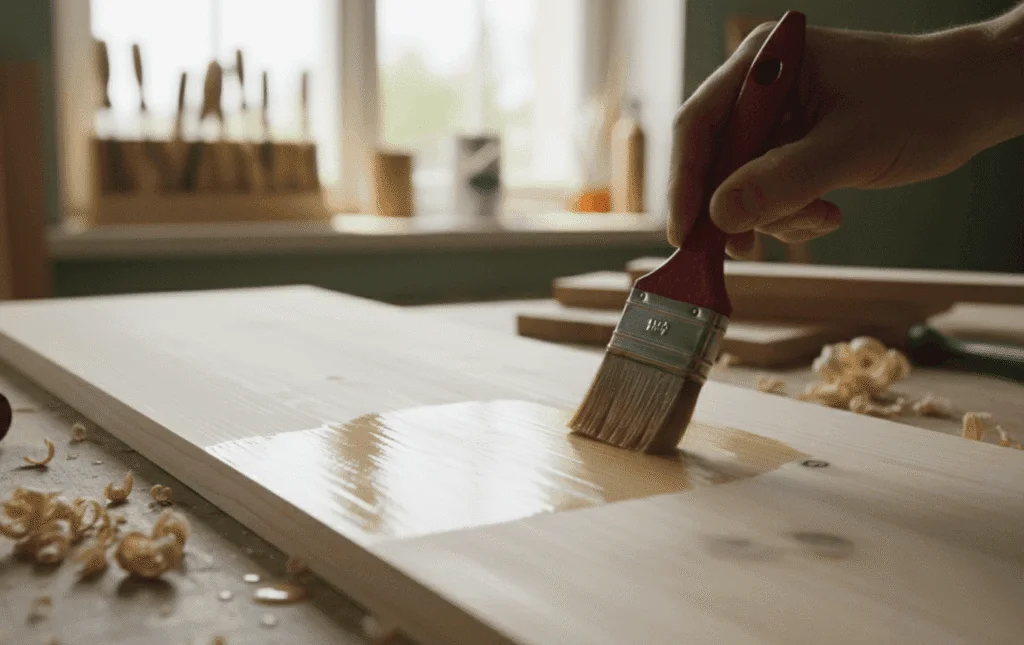
UV radiation is the silent killer of exterior wood. It breaks down the lignin in the cell walls, which leads to greying, brittleness and surface degradation. Effective protection is mainly provided by pigments and UV filters. The higher the opacity – in other words, the darker or more solid the colour – the better the protection. On the other hand, clear varnishes and clear oils with little or no pigment offer only minimal or no UV protection, so wood under a clear varnish outdoors will turn grey very quickly.
Key selection criteria: What to look out for
Choosing the right product comes down to several important factors that affect price, durability and how demanding the application will be.
Use (exterior vs interior)
Exterior and interior coatings differ significantly in composition. Exterior products must contain UV filters, components that increase resistance to weathering and often also fungicidal and algicidal additives to prevent mould and algae. Indoors, health safety and low VOC (volatile organic compounds) content are crucial, as these evaporate into the air. Water-based and natural products are the clear choice here.
Durability and maintenance interval
Long-life coatings such as opaque paints and thick-film varnishes can last 5 to 10 years. They need renovating less often, but that renovation is more demanding because you have to sand and remove the old film. Products with a shorter lifespan, such as oils and thin-film lazury, usually need refreshing every 1 to 3 years. However, their renovation is quick and simple – you typically just clean the surface and recoat it.
Degree of opacity
The level of opacity is both an aesthetic and protective decision. At one end you have opaque paints, which give you 100% protection but 0% visible grain. The best compromise is semi-transparent lazury, which tint the wood and protect it with pigments while keeping the grain visible. Finally, there are transparent varnishes and clear oils, which keep the grain fully visible but offer only minimal UV protection.
Type of binder and thinner (water-based vs solvent-based)
Water-based (acrylic) coatings have the advantages of fast drying, lower environmental impact, minimal odour and good flexibility. The downside is that they can sometimes form a softer film and may not be ideal for every type of wood. In contrast, solvent-based (alkyd, polyurethane) coatings create an extremely hard, durable film and have excellent adhesion. Their drawbacks are slow drying, strong odour (VOC) and a poorer environmental profile.
Environmental and health aspects
If the finish will come into contact with food, children or animals (kitchen worktops, children’s toys, bird feeders), always choose products with EN 71/3 certification (Safety for children’s toys) or food-safe approval. In this area, natural oils and waxes (for example linseed oil, hard wax oils) are the top choice.
Coverage (consumption)
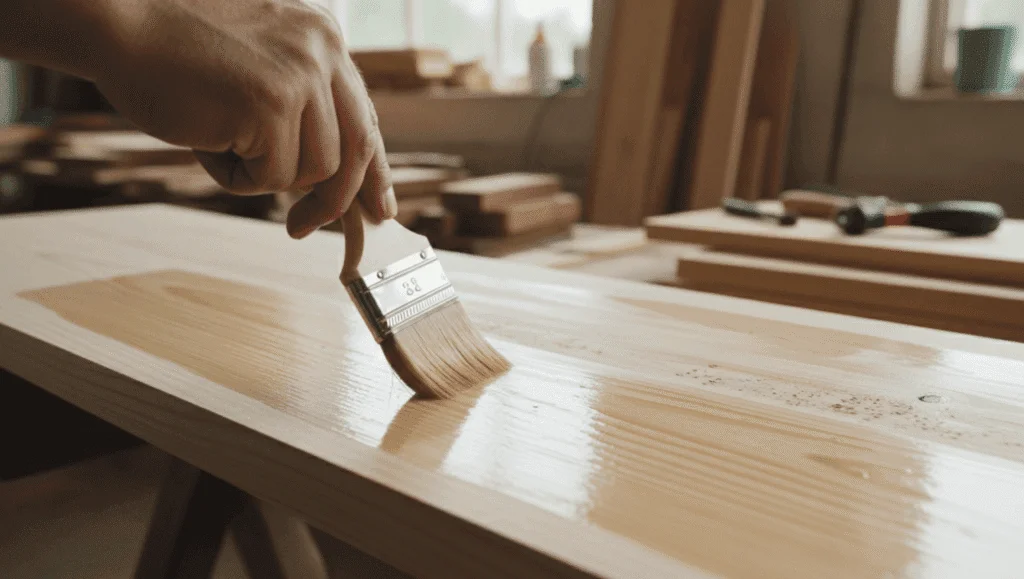
Ccoverage is given in m²/l. How to correctly calculate the amount you need depends mainly on the absorbency of the wood. Softwood (spruce, pine) soaks up much more product than hardwood (oak) or exotic wood. Tip: Always count on two coats and add a margin. Consumption is always higher for the first penetrating coat!
Choosing and recommendations: Making the right call
There is no single “best” product, only the one that is most suitable for your specific use.
Choosing by wood type
For softwood (spruce, pine), which is highly absorbent and prone to biological attack, deep impregnation and good fungicidal properties are crucial, so thin-film lazury or impregnation coatings are a good choice. For hardwood (oak, beech), which is less absorbent and more durable, oils and hard wax oils work best, as they highlight the grain and do not peel. Exotic wood (teak, ipe, bangkirai) contains natural oils, does not take opaque coatings and varnishes well, and therefore needs special exotic oils for maintenance.
Choosing by application
For decks and floors you need high mechanical resistance, so oils and hard wax oils are used. Facades and fences require strong UV and moisture protection, which lazury or paints provide best. Windows and doors need dimensional stability, so thick-film lazury or varnishes are ideal, as they hold the shape. And finally, for children’s toys and furniture you must use certified, non-toxic products.
Tips to avoid marketing traps
Be wary of the term “universal”. All-purpose products are usually compromises that don’t really excel at anything, so a specialised product will almost always perform better. Another tricky factor is price; price reflects the quality of the binder and pigments. Cheap lazury contain lower quality UV filters and pigments, which means shorter lifespan and faster greying of the wood. Always check the stated coverage and compare it with the price.
Correct application and maintenance: The foundation of long life
Even the most expensive finish will fail if you skimp on preparation.
Preparing the wood surface
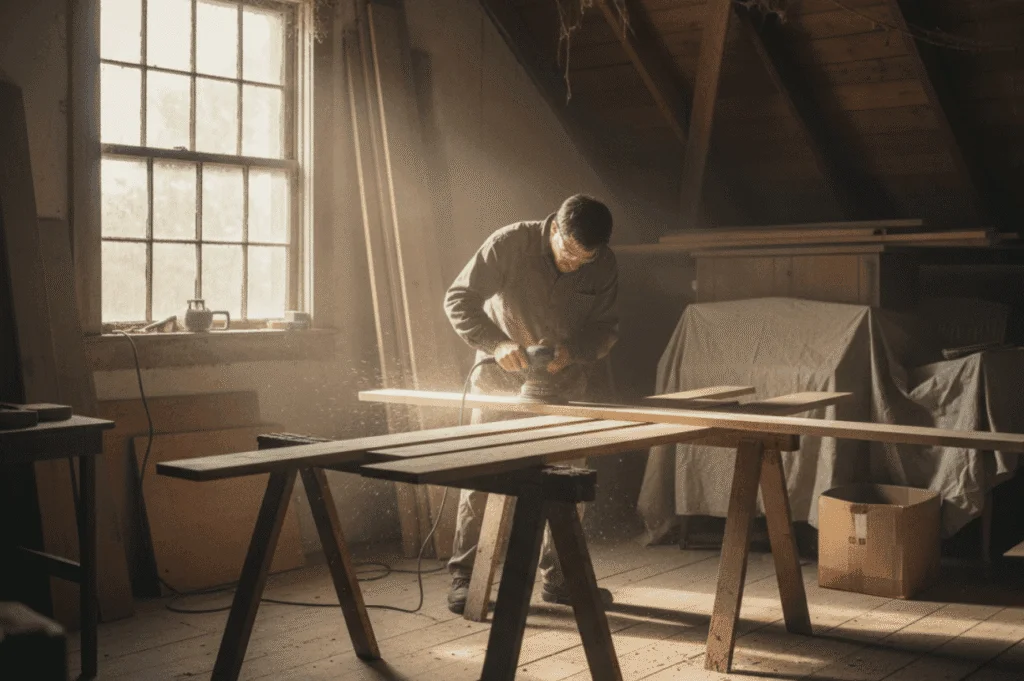
Preparation is absolutely crucial for durability and includes the following steps:
- Sanding: The surface must be clean, dry and free of grease. On old, weathered wood, start with a coarser grit (P60–P80); for the final finish P120–P180 is enough. Oil and wax need finer sanding (up to P180), varnishes work better with slightly coarser sanding (around P120).
- Removing old coatings: Varnishes and paints must be completely removed (sanding, heat gun, chemical strippers). For oiled surfaces, it’s usually enough to lightly sand to even out the surface.
- Degreasing: Exotic wood must be thoroughly degreased before application (for example with white spirit or a dedicated degreaser) because of its high resin and oil content.
Application process (number of coats and drying)
To achieve a good final result and long-lasting protection, it’s important to follow the right process. The first coat of lazury and oils is often applied thinned (according to the manufacturer’s instructions) to maximise deep penetration. This is critical for long-term protection. Always apply in the direction of the wood grain. In most cases, two coats are recommended for maximum protection. Between coats you must respect the drying time, and for varnishes and thick-film lazury it’s a good idea to lightly sand (P240 or finer) to remove raised fibres.
Maintenance and renovation
Regular maintenance is essential if you want to extend the life of the finish. For surfaces treated with oil or lazura, it’s time to renovate as soon as you notice that water no longer beads on the surface. Usually, you just clean the surface and apply one fresh coat without full sanding. For varnish or paint, renovation is needed as soon as you see the first signs of peeling. In that case, the damaged areas must be sanded back completely to sound wood, which is much more labour-intensive.
Most popular brands and manufacturers: Which are worth a look
There are several brands on the market that are worth considering. Osmo specialises in hard wax oils and natural finishes, known for high quality and certified safety. Remmers focuses on comprehensive wood protection systems, industrial coatings and highly durable lazury for windows, doors and facades. Balakryl concentrates on water-based paints and varnishes and is a leader in the DIY segment with products that dry quickly and are easy to use. For traditional lazury and exterior protection there is Xyladecor, offering products for fences and garden structures. And finally, Dřevodekor is a Czech manufacturer focusing on quality lazure varnishes and oils in the mid to higher price range.
Prices and budget ranges: When it pays to invest more
What you decide to spend is basically a decision about how long the coating will last and how much time you’ll spend on renovation. In the budget segment you’ll find basic varnishes and paints, mainly for interiors or less exposed areas, with a shorter lifespan. The mid-range offers the best price/performance ratio, with versatile use and good coverage. The premium segment includes specialist products such as marine varnishes or industrial coatings with excellent durability. When is it worth paying more? Always for exterior, heavily exposed surfaces that you don’t want to redo any time soon, such as facades, decks or windows. Investing in a higher-end product saves you time and money later on in renovation work.
Most common questions and answers (FAQ)
Can I apply varnish over oiled wood?
No, this is one of the most common and most serious mistakes. Varnish (film-forming) needs a clean, dry and above all grease-free surface for proper adhesion. Oil (penetrating) saturates the wood, which repels varnish, and the coating would start peeling off in a short time.
What is the difference between marine varnish and polyurethane varnish?
Marine varnish is designed to be extremely flexible and resistant to moisture and salt, so it can cope with constant movement of the wood. Polyurethane varnish (PUR) is designed to be extremely hard and abrasion-resistant. For floors and stable furniture, PUR varnish is usually the better choice.
Can I use the same lazura on softwood and hardwood?
Yes, but with care. On soft softwood (spruce), the lazura will have higher consumption because it penetrates deeper. On dense hardwood (oak), absorbency is lower, so it’s important to spread the coating carefully to avoid a shiny, over-applied layer on the surface. It’s usually better to choose a specialised oil/lazura for the specific wood type.
Summary and final tip
Protecting wood is always about balancing looks and performance. Keep these key points in mind: decide whether you want a hard shell (film such as varnish or paint) or a breathable, easy-to-renew surface (penetrating finish such as oil or lazura), and never forget that for exterior use you should always choose a pigmented coating. Pigment is protection. The darker and more opaque it is, the better your wood will be shielded.
Final recommendation: Always be clear about what you expect from the result (gloss, matt, visible grain, longevity) and how much wear the surface will see (foot traffic, rain, sun). Based on that, decide whether you need a film-forming or penetrating product.
Start your project knowing you have everything you need to choose the best “coat” for your wood. With the right care, your wood will reward you with long life and a beautiful appearance!