Perfume (EDP) vs. Eau de Toilette (EDT): What Are the Differences?
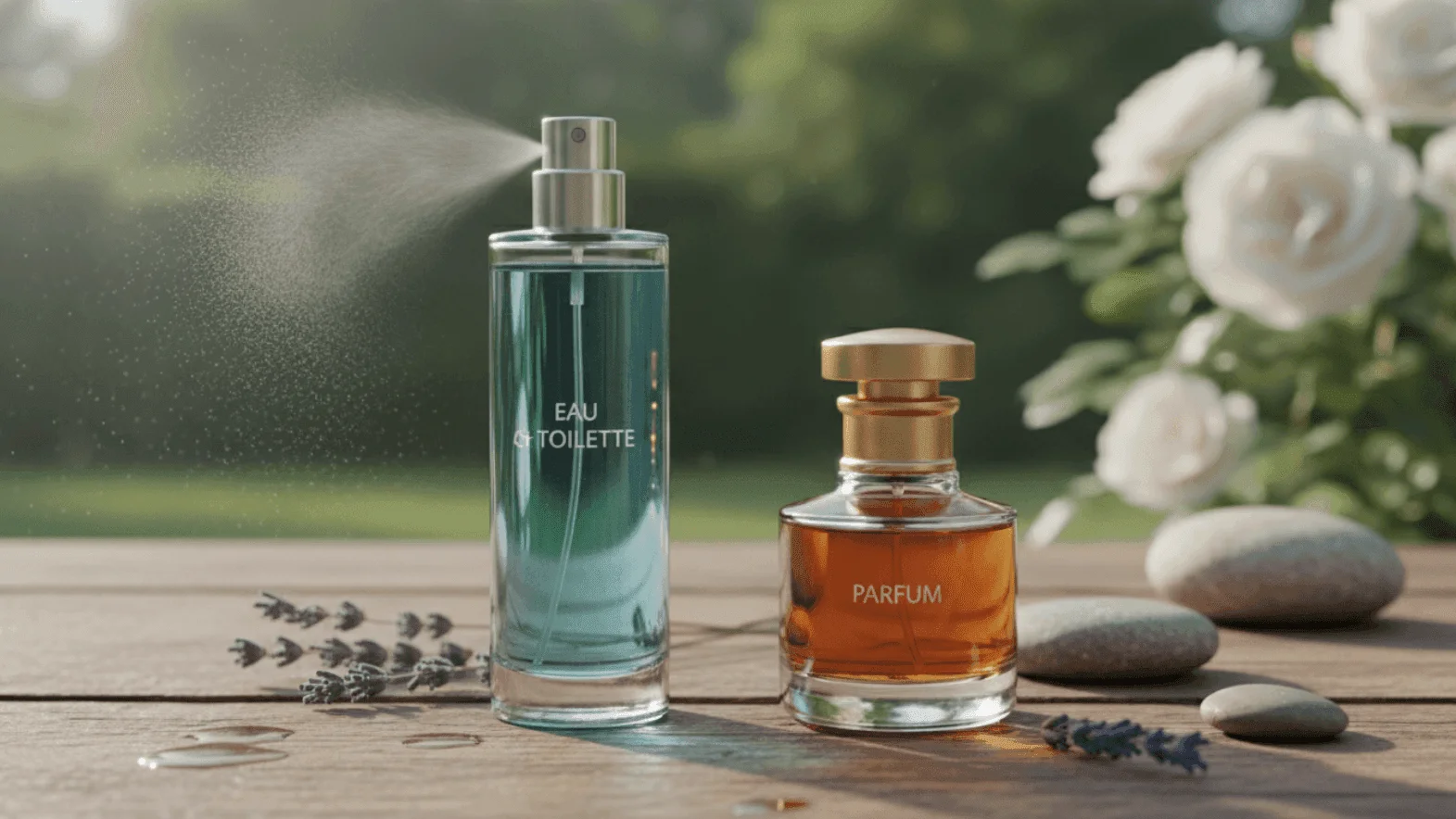
The world of fragrance is a complex and fascinating art, but for consumers it can be confusing. While a true perfume (Extrait de Parfum) is the most refined and concentrated form, the vast majority of scents on the market fall into the categories of Eau de Parfum (EDP) and Eau de Toilette (EDT). The main goal of this guide is to unpack the key difference between EDP and EDT, which is not just about price, but mainly about the wearing experience, longevity and intensity. We’ll help you understand how concentration affects the composition and projection of a fragrance, so you can always choose the right version for your needs.
Did you know: EDP has been growing in popularity in recent years and often dominates sales in the mid-range and premium price segments. The likely reason is the demand for better longevity and a stronger value-for-money ratio compared to Eau de Toilette, which usually needs to be reapplied more often.
The anatomy and chemistry of fragrance: How long it lasts and why
Every fragrance, whether it’s a light Eau de Cologne (EDC) or a powerful Perfume (Extrait), is built from three basic components: aromatic essences (natural or synthetic), alcohol and, to a lesser extent, water. Alcohol acts as a carrier that helps disperse the fragrance oils on the skin. The principle of longevity is simple: the less alcohol and the more fragrance oils, the longer the wear time and the stronger the projection (sillage). To understand how a fragrance develops over time, we need to look at its construction.
Fragrance construction (the so‑called fragrance pyramid)
A fragrance is made up of three stages, or “notes”:
The top notes create the first impression. These are light, volatile molecules that you notice immediately after application. However, they evaporate quickly, usually within 5 to 15 minutes. Typical examples are citrus fruits (bergamot, lemon), light herbs or some aldehydes. Their job is to grab your attention and lead you into the heart of the fragrance.
The heart is the core of the fragrance and defines its main character. These components appear once the top notes fade and keep the scent going for about 30 minutes to 3 hours. They bring the main theme and smooth the transition between the top and base. They are often floral or spicy notes.
The base notes are the anchor of the fragrance, made up of the heaviest molecules. They provide depth and hold the whole composition together. These are the longest-lasting notes, remaining on the skin for hours or even tens of hours. Base notes play a key role in fixation and in extending the life of the fragrance. They include rich, sensual ingredients such as sandalwood and cedarwood, resins, vanilla, amber or musk.
From ritual to daily hygiene: A brief history
The fragrance concentrations we know today are no accident; they reflect historical and social trends. For thousands of years, scents were used mainly for ritual purposes (burning resins). A major shift came in the late Middle Ages and early modern period. Because of poor hygiene, perfumes became an everyday necessity to mask unpleasant odours. In the 18th century, with the development of distillation and trade, perfumes became more widely available.
It was in this period that one of the first standards emerged – Eau de Cologne (EDC). Created in Cologne, this fragrance was originally sold as a medicinal elixir and quickly became a popular light and refreshing concentration, designed to be splashed generously all over the body. EDC laid the foundations for light, citrusy fragrances and showed that scent doesn’t have to be just a strong “perfume”, but can also serve as a gentle refreshment, which later led to the split into EDT and EDP.
The key difference: Concentration of fragrance oils and their types
The basic difference between all fragrance types lies in the ratio of aromatic essences to alcohol. This ratio directly affects intensity, sillage and price.
| Koncentrace (Originální název) | Český překlad | Procenta vonných složek |
|---|---|---|
| Parfém (Extrait de Parfum) | Parfém / Parfémový extrakt | 20 – 40 % |
| Eau de Parfum (EDP) | Parfémovaná voda | 15 – 20 % |
| Eau de Toilette (EDT) | Toaletní voda | 5 – 15 % |
| Eau de Cologne (EDC) | Kolínská voda | 2 – 4 % |
| Eau de Solide (EDS, Tuhý parfém) | Tuhý parfém | 1 – 3 % |
Eau de Parfum (EDP)
Eau de Parfum is the most popular concentration, offering a great balance between the intensity of true perfume and a more accessible price. The higher oil content means longer wear and more pronounced sillage. The scent feels fuller and richer, and the base notes are usually stronger and remain noticeable for longer. It’s ideal for evening wear, social events or for cooler climates, where you want your fragrance to stand out more. It’s a good choice if you prefer to apply your perfume just once a day. Its main advantage is the best price-to-longevity ratio and strong sillage (the scent trail). On the downside, it tends to be more expensive and can feel too intense for everyday wear or enclosed spaces such as offices.
Eau de Toilette (EDT)
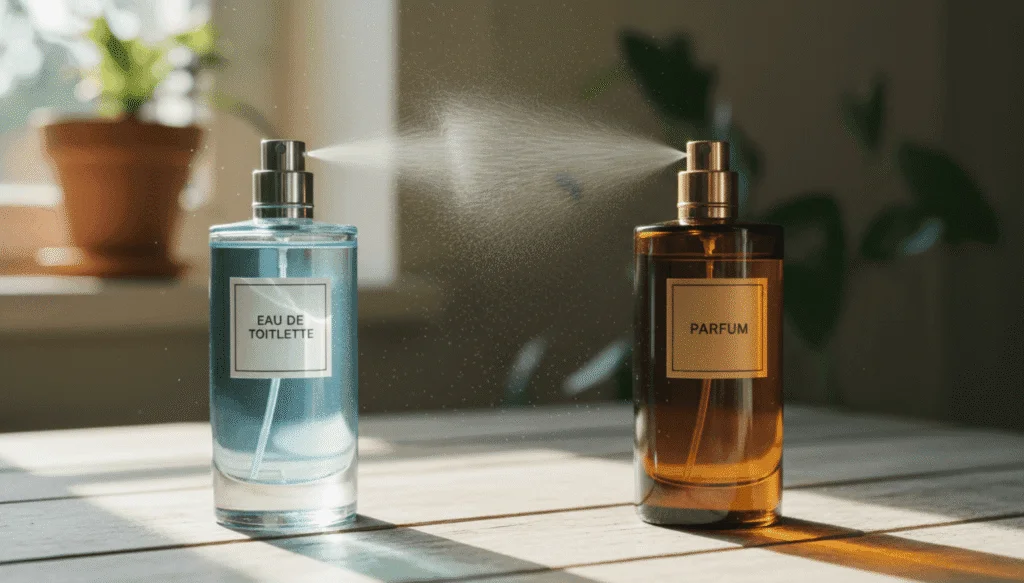
Eau de Toilette is a lighter, fresher option, historically intended for the “toilette” – your morning routine and refreshment. The lower oil concentration lets the light top and heart notes really shine. The scent is airier and softer, but it does not last as long. It’s a great choice for daytime wear, warm summer months or the office, where you don’t want to overwhelm people around you. Its main advantages are the lower price, a lighter, fresher character and the fact that it’s well suited to more frequent reapplication and layering. The downside is shorter longevity, so you’ll often need to top up during the day, and the sillage is usually more subtle.
More than just alcohol: The three pillars of a great fragrance
Concentration is crucial, but when choosing a fragrance you should also think about these three factors:
How composition affects longevity
The composition is critical. Even the strongest EDT made only of citrus and aquatic notes (light molecules) will have poorer longevity than an EDT with heavy woody and resinous notes in the base. That’s because heavy molecules (oud, patchouli, vanilla, amber, leather) in the base act as natural fixatives and extend longevity. If you want good staying power even from an EDT, focus on scents with a woody or oriental base.
Sillage: How far can people smell you?
Sillage is the French term for the “scent trail” or “projection” of a fragrance – how far from your body it can be smelled and how long that trail lingers. EDP typically has stronger sillage and can be detected from more than an arm’s length away, while EDT usually has softer sillage and sits closer to the skin. You’ll reach for high sillage (EDP) for parties, dates or outdoor events. Lower sillage (EDT) is better for the office, lunch meetings or public transport, where you want to be more discreet.
Longevity: How many hours will it stay with you?
Longevity is the total time the fragrance remains noticeable on your skin. For EDP, average longevity is around 6–8+ hours, often with the base notes detectable all day. EDT usually lasts 3–6 hours, and after about three hours it’s often just a very soft base close to the skin.
How to choose: EDP vs. EDT by situation and user
By season and climate
Heat speeds up evaporation and therefore boosts projection. For summer and hot weather, choose EDT. A light Eau de Toilette won’t turn into a heavy cloud in the heat, but will instead feel refreshing. For winter and cold weather, go for EDP. Cold air mutes fragrances, so you need a higher concentration to get enough presence.
By occasion: Day, night and the office
For daytime wear and office environments, EDT is ideal. It’s soft, discreet and won’t bother your colleagues. Look for light, fresh or “clean” compositions. For evening wear or special occasions, EDP is the clear choice. The higher concentration and stronger sillage work perfectly for events and add a touch of luxury to your outfit.
By skin type: The key to optimal longevity
Your skin chemistry is one of the most important factors that affect how long a fragrance lasts. On dry skin, scents fade faster because dry skin “drinks up” the alcohol, which speeds up the evaporation of the essences. In that case, it’s better to choose a higher concentration (EDP) or moisturise your skin before application. Oily skin, on the other hand, naturally holds on to fragrance oils. Scents last longer on it and often project better, so you can easily go for an EDT and still get decent longevity.
Getting the most out of your scent: Application and bottle care
If you want your fragrance, whether EDP or EDT, to last as long as possible, you need to follow a few simple rules.
Best places to apply
Apply your fragrance to pulse points, where blood flow is closer to the surface and body temperature is slightly higher, which helps the scent develop and project better. These include the wrists (don’t rub them together!), neck (behind the ears, on the carotid area) and the inner elbows. You can also, more occasionally, spray onto hair or clothing, but be careful about possible staining. Expert tip: Always apply perfume on moisturised skin. Before spraying, use a moisturiser (ideally fragrance-free or from the same line). The oils in the cream create a barrier that slows down evaporation and noticeably extends longevity.
Common application mistakes
One of the most common mistakes is rubbing your wrists together. The friction “breaks up” the fragrance molecules and makes the top notes disappear faster, which disrupts the natural development of the fragrance pyramid. With strong EDPs, less is more, so apply with a light hand.
Storing your bottles
Perfume is a delicate chemical solution. Poor storage is the fastest way to make it degrade. Protect it from heat and light. Never leave bottles in the bathroom (because of humidity and temperature swings) or in direct sunlight (for example on a vanity table by the window). The ideal place is a cool, dark cupboard or drawer. Light and heat speed up oxidation and change the chemical structure of the fragrance, which can result in a spoiled or unexpectedly weak scent.
Which brands are worth a look: An overview of the perfume world
The fragrance world is divided into several categories, each offering something different. Designer brands (e.g. Chanel, Dior, Guerlain, YSL) are the backbone of modern perfumery. They offer a broad portfolio of scents (EDP and EDT), often with a long history and premium quality. Guerlain, for example, is behind many iconic, complex compositions. Alongside them are niche brands (e.g. Byredo, Le Labo, Creed), which focus on an artistic, uncompromising approach to perfume. These brands usually offer higher concentrations (EDP or Extrait) and original, distinctive fragrance families. They target customers who want to smell unique rather than blend into the crowd. A third category is indie / artisanal brands, smaller independent creators who often experiment with unusual extracts and are popular with true connoisseurs.
Summary and final tip
The choice between EDP and EDT is always personal and should reflect your lifestyle, skin type and typical occasions. Keep in mind that EDP means more power and longer wear, making it ideal for evenings or colder weather. EDT means more freshness and softer sillage, so it’s perfect for daytime or warm conditions. The golden rule when deciding: Always test the same fragrance in both EDP and EDT directly on your skin (ideally one on each wrist). Wait at least 30 minutes for the top notes to fade so the heart and base can come through. Only then will you see how the fragrance truly develops on your skin.
Frequently asked questions
Does an EDT have the same composition of fragrance essences as the EDP from the same line?
A: Very often it does not. Brands may use the same fragrance family and the same key notes, but the composition is adjusted. The EDP version is usually reformulated to be richer, deeper and to have stronger base notes (for example more vanilla, woods or amber) to improve longevity. The EDT version, on the other hand, tends to highlight the fresh top notes for an immediate impact.
What does “flanker” mean in the perfume world?
A flanker is a new version or variation of an existing, popular fragrance (for example Dior Sauvage Parfum is a flanker of the original EDT version). It usually differs in concentration (such as a new EDP or Extrait) or has a tweaked composition for a different season (for example a Summer Edition or Intense version). It’s a way to keep the original line popular without having to build a completely new marketing campaign from scratch.
What is the difference between synthetic and natural fragrance ingredients?
Natural ingredients (essential oils, extracts) are complex but variable – their quality can change from one harvest to another. They are expensive, can trigger allergies and their use is often limited by ethical and environmental regulations. Synthetic ingredients (molecules) are consistent, stable, cheaper and allow perfumers to create new and unusual scent effects (such as the smell of the sea or freshly cut grass) that don’t exist in nature in an extractable form. A quality perfume uses a sophisticated mix of both for the best possible result.