What is an ETF and how do you invest in it?

Welcome to a guide that opens the door to the world of modern investing. Exchange-Traded Funds (ETFs) are no longer a tool reserved for finance professionals – they’ve become a core building block for growing wealth for millions of everyday investors. The goal of this in‑depth article is to demystify ETFs and give you all the knowledge and practical steps you need to choose and buy them.
Why should you care about ETFs?
Imagine that instead of buying a single stock (for example Apple or ČEZ), you buy a ready‑made “shopping basket” full of different assets – stocks, bonds, or even commodities. That’s essentially what an ETF (Exchange-Traded Fund) is. It’s an investment fund that holds a portfolio of assets and whose shares trade on the stock exchange just like regular stocks.
Why have ETFs become so popular in recent years? The answer lies in three key advantages. The first is instant diversification: by buying a single ETF you become a partial owner of dozens, hundreds, sometimes even thousands of companies around the world, which sharply reduces your risk. The second advantage is low costs. Because most ETFs are passive and simply track a given market index, they don’t need expensive analysts, which translates into significantly lower fees compared to traditional actively managed funds. And finally, ETFs offer simplicity and flexibility, because you can buy and sell them at any time during the trading day.
The aim of an ETF is to offer everyday investors a simple, low‑cost and transparent way to grow their money by harnessing the power of global markets.
How does an ETF work? The key to understanding passive investing
The way an ETF works is elegantly simple and at the same time brilliant. Most ETFs are designed to mirror the performance of a specific market index as closely as possible, for example the US S&P 500 (the 500 largest US companies) or MSCI World (thousands of companies from developed markets).
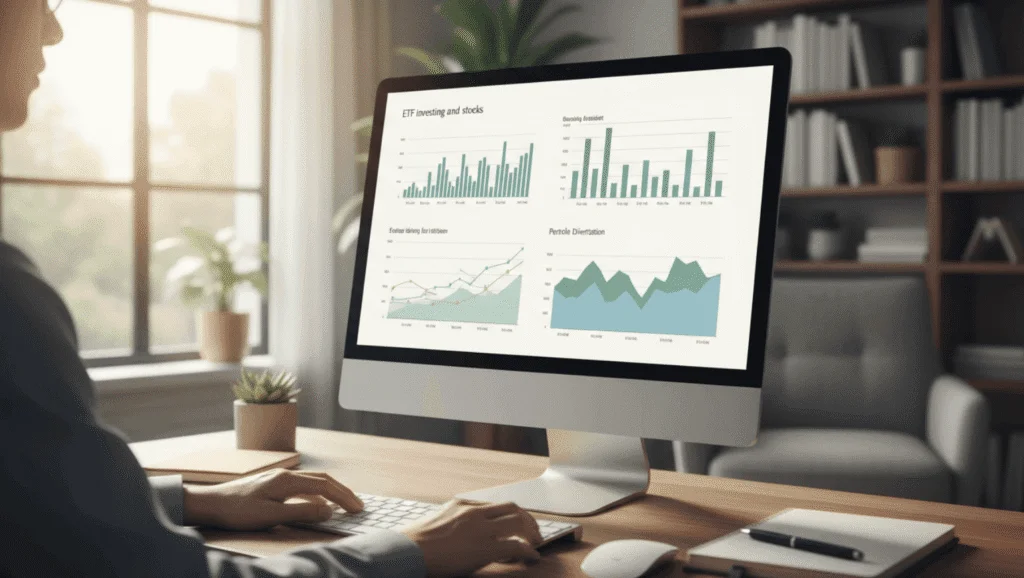
Index replication in practice
When a new ETF is launched, it issues shares and uses the money raised to buy securities in proportions that closely match the composition and weights of the target index. If the S&P 500 index goes up by 1%, the ETF’s goal is to deliver a 1% return as well (minus a small management fee).
Market price vs. Net Asset Value (NAV)
This is where ETFs differ from classic mutual funds. Every ETF has its own NAV (Net Asset Value), or net asset value. This is the theoretical value of all the securities the fund holds, calculated per share. But because an ETF trades on an exchange, its market price is set by current supply and demand. The market price can therefore differ slightly from the NAV. In practice, however, market makers (authorised participants) are constantly trading to keep this gap minimal, so the ETF price tracks the value of the underlying assets very closely.
Buying and selling
Buying an ETF is just as easy as buying shares of a well‑known company. ETFs trade on the exchange in real time. That means you can buy at 10:00 and sell at 14:00 at the prevailing market price. Unlike traditional funds, where you only know the price at the end of the day, ETF trading is highly transparent and flexible.
Did you know that the first ETF was launched only in 1993, and today this type of fund manages assets worth trillions of dollars worldwide?
Core ETF types: Find a fund for every investment goal
Not all ETFs are the same. You can choose from a wide range of funds, usually grouped by the type of underlying asset.

Equity ETFs
These funds track stock indices. They can be global (MSCI World), regional (S&P 500, STOXX Europe 600) or sector‑specific. Equity ETFs are suitable for almost every investor with a long investment horizon (5+ years) who aims for long‑term capital growth and can tolerate larger swings in value. They offer the highest growth potential, but also higher risk and volatility, which is their main downside.
Bond ETFs
These invest in government, corporate or municipal bonds. They help stabilise a portfolio and generate regular income. They are suitable for more conservative investors looking for stability, capital preservation and a steady stream of interest income (coupons), and they work well as the stabilising part of a balanced portfolio. They come with lower price volatility than equities, but at the cost of lower expected returns.
Commodity ETFs
These track the prices of specific commodities such as gold, silver, oil, gas or agricultural products. They are often used as a hedge against inflation or as a tool for diversifying risk. They tend to be used by more experienced investors for targeted diversification or as protection against systemic risks (for example through gold). They can deliver high gains when commodity prices rise, but they also come with very high volatility and risk. It’s important to know that some ETFs hold commodities physically, while others use derivatives.
Sector and thematic ETFs
These focus on specific industries (technology, healthcare, financials) or on major themes and megatrends (artificial intelligence, robotics, clean energy). They are suited to investors who have strong convictions about the future of a particular sector or theme. They can deliver above‑average returns if the chosen sector outperforms the market, but at the cost of lower diversification and higher concentration risk.
Key parameters for choosing an ETF
When you compare two ETFs that track the same index (for example MSCI World), the differences usually come down to these key parameters.
Total cost (TER – Total Expense Ratio)
TER is the annual fee the fund manager charges for running the portfolio. It includes all ongoing operating costs of the fund and is expressed as a percentage of your invested assets. It’s one of the most important metrics. A low TER (often below 0.25% per year) is a hallmark of a good passive fund and over the long term (10+ years), even a 0.5% annual difference in TER can add up to a huge gap in your final return.
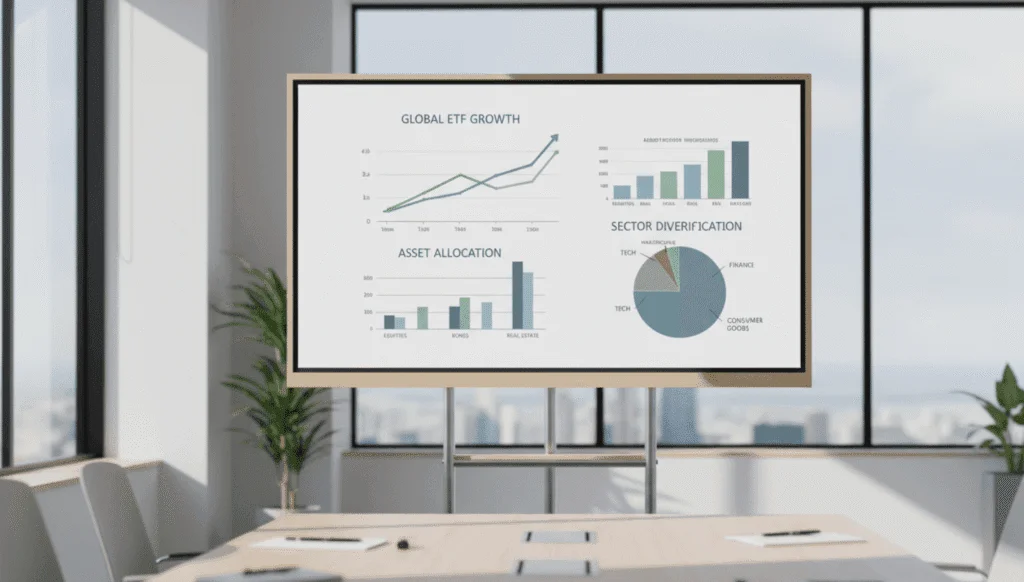
Tracked index
This is the benchmark the fund follows. Before you invest, always check which regions, sectors and companies the index covers. If you want global diversification, you might choose MSCI World. If you want only the largest US companies, you might pick the S&P 500. The index has to match your investment strategy.
Here is a table with an even more concise explanation of the key indices.
| Název indexu | Stručné vysvětlení |
|---|---|
| S&P 500 | Index 500 největších amerických společností. Měřítko pro výkonnost amerického trhu. |
| STOXX Europe 600 | Index 600 největších společností z evropských zemí. Hlavní měřítko pro výkonnost evropských akcií. |
| MSCI World | Široký globální index akcií z 23 vyspělých zemí. Základ pro globální diverzifikaci. |
Replication method (Physical vs Synthetic)
This tells you how the fund replicates the index. Physical replication means the fund actually buys the underlying assets (stocks or bonds) in the same proportions as the index. It is considered more transparent and less risky in terms of counterparty risk. Most large ETFs use physical replication, either full replication or so‑called sampling, where they hold only the most important securities.
Synthetic replication means the fund does not directly hold the underlying assets, but instead enters into swap contracts with an investment bank that commits to delivering the index’s return to the fund. This approach can be cheaper and more accurate, but it introduces counterparty risk (the risk that the bank fails), which is, however, strictly limited by UCITS regulation.
UCITS is a European standard for investment funds that ensures strong investor protection, investment in safe and liquid assets, and the ability to market the fund across the EU once it has been approved in one member state.
Dividend policy (Accumulating vs Distributing)
This is a crucial choice for long‑term growth. Accumulating ETFs automatically reinvest dividends back into the fund. You don’t have to worry about reinvesting yourself and, from a Czech tax perspective, this is often more advantageous for long‑term growth, because your money benefits from automatic compounding.
Distributing ETFs, on the other hand, pay out dividends regularly to the investor (often quarterly or semi‑annually) into their brokerage account and are suitable for people living off their investments who need regular income.
Liquidity and Assets Under Management (AUM)
AUM (Assets Under Management) tells you how much money the fund manages. Higher AUM (in the billions of dollars) signals investor confidence and financial stability. Liquidity refers to trading volume. The more liquid an ETF is, the lower the spread (the difference between the bid and ask price), which means you buy and sell at better prices. Always choose funds with sufficient size and high liquidity.
Fund currency and currency risk
Every ETF is denominated in a specific currency (EUR, USD, GBP), but the fund currency itself does not determine the currency risk of the underlying assets. If the fund holds US stocks (USD) and you buy it in EUR, you are still exposed to USD/EUR currency risk. There are special ETF share classes with currency hedging (Hedged) that use derivatives to eliminate currency risk (for example CZK‑hedged share classes for Czech investors). These ETFs tend to have lower volatility but higher TER, and for long‑term investing, hedging is usually not recommended because of the higher costs.
How to choose the right ETF: A practical step‑by‑step guide
Choosing the right fund is easier than you might think. Follow these steps.
Define your investment goal and time horizon
Be clear about why you are investing (retirement, housing, passive income) and for how long. If you are investing for 15+ years (for retirement), you can afford to choose higher‑risk equity ETFs with greater growth potential. If you are investing for 3 years, opt for more conservative bond or cash‑like ETFs with lower volatility.
Decide on your level of diversification
Do you want maximum simplicity? Choose a single global equity ETF (for example tracking MSCI World or FTSE All‑World) and you’ll cover the whole world. Want to be more hands‑on? You can build your own mix, for example 70% US (S&P 500), 20% Europe and 10% emerging markets.
Compare specific ETFs by their parameters
Once you know which index you want to track (for example S&P 500), go to specialised online tools (such as JustETF, TradingView). Compare all available funds that track the S&P 500 and filter them by low TER, high AUM and your preferred dividend policy (accumulating). Then pick the best option from the shortlist.
What to watch out for when buying
Be aware of several common pitfalls. First, avoid very narrowly focused ETFs. Newly launched funds tracking extremely narrow segments (for example “cloud services in Africa”) tend to carry high risk and low liquidity, so it’s better to stick to broad, global indices. Second, don’t ignore your broker’s fees. Even the best ETF becomes expensive with the wrong broker (high trading fees), so always compare broker transaction fees and check whether they offer commission‑free purchases for selected ETFs. And finally, don’t try to time the market. Don’t wait for the “perfect” moment to buy – in the long run, regular investing (so‑called Dollar‑Cost Averaging) tends to be the most successful strategy.
Fees and taxes associated with ETFs
Investment fees add up over time, so it’s important to understand every cost item.
| Typ poplatku | Co znamená a komu jde | Jak je vysoký |
|---|---|---|
| TER (Total Expense Ratio) | Roční poplatek správci fondu za správu. Strhává se automaticky z majetku fondu. | Typicky 0,07 % – 0,50 % ročně. |
| Poplatek za nákup/prodej (Transakční) | Poplatek, který si účtuje broker za provedení obchodu na burze. | Dnes často nulový (u velkých brokerů pro oblíbené ETF) nebo fixní částka. |
| Spread | Malý rozdíl mezi nákupní a prodejní cenou v daný okamžik. | U likvidních ETF téměř nulový. |
| Poplatek za vedení účtu | Roční poplatek účtovaný brokerem za správu vašeho investičního účtu. | U většiny moderních brokerů nulový. |
Taxation of ETFs in the Czech Republic
Taxation follows Czech law and depends on two factors. Taxation of capital gains means that profits from selling ETFs are exempt from income tax in two situations.
The first is when you hold the ETF for more than 3 years (the holding period test).
The second is when your total proceeds (profit) from selling securities in a given year do not exceed 100,000 CZK. If neither condition is met, the profit is taxed at the standard income tax rate.
The next point is taxation of dividends (for distributing ETFs). Paid‑out dividends are subject to tax, and you need to distinguish whether the dividend comes from a Czech or foreign source and apply the rules for withholding tax and double taxation treaties (it is more complex in the case of US stocks).
Important notice: This information is general in nature. Given the complexity of international taxation and double taxation treaties, you should always consult a tax advisor for your specific situation.
The most well‑known and largest ETF providers
There are hundreds of ETF issuers on the market, but a few of them dominate thanks to the volume of assets they manage and their low fees.
iShares (by BlackRock)
This is the world’s largest ETF provider, managing trillions of dollars. It offers an extensive and highly diversified product range covering almost any index and sector you can think of. Despite its size, it remains very competitive on price.
Vanguard
Vanguard is one of the pioneers of passive investing, best known for its extremely low costs (TER). Its funds are often synonymous with low‑cost, efficient wealth building, and Vanguard is a popular choice for long‑term, low‑fee portfolios.
Xtrackers (by DWS)
This is a major European ETF provider with a broad product line, including many funds using physical replication. They are a strong player especially on European markets and often offer attractive alternatives to the very largest funds.
Amundi
Amundi is the largest European asset manager and offers a wide range of ETFs focused on European markets as well as on ESG strategies (sustainable investing). They place strong emphasis on funds that comply with European UCITS regulation.
History and evolution of ETFs: From a radical idea to trillions in assets
The idea of an exchange‑traded fund emerged as a cheaper, more transparent and more flexible alternative to traditional mutual funds, which were burdened by high fees and opaque trading.
The revolution began in 1993, when the first successful ETF was launched in the US – SPDR S&P 500 ETF (ticker: SPY). This fund, which tracks the S&P 500 index, became one of the most traded instruments in the world and kicked off the boom in passive investing.
As the ETF market developed, it brought continuous innovation. Competition has driven TER down to just fractions of a percent per year. At the same time, UCITS regulation expanded significantly, setting strict rules for investor protection and diversification in Europe. The latest wave of innovation focuses on actively managed ETFs and funds built around ESG (Environmental, Social, Governance) principles, which allow investors to consciously support sustainability.
In conclusion: How to start building wealth
ETFs are a powerful, transparent and low‑cost tool that has truly democratised access to long‑term wealth building. They are ideal for anyone who wants to invest simply and efficiently and let the market do the heavy lifting.
With ETFs, you don’t have to become a stock‑picking expert or search for the next big winner – you just decide whether you want to invest in global equities, bonds or other assets. The key to success is choosing the right ETF based on your goals and risk profile, keeping a close eye on low fees (TER), and sticking to your strategy despite short‑term trends and market swings.
The most important step is to get started. Even a small but regular investment can grow into a substantial amount over time thanks to the power of compounding.
Frequently asked questions (FAQ)
Is investing in ETFs safe?
Yes, ETFs are considered a safe investment vehicle in terms of the risk of the manager defaulting. It’s important to distinguish between two types of risk here. The first is market risk, which you always bear. If the value of the stocks in the fund falls (for example the S&P 500), the value of your ETF will fall as well. The second is provider default risk. If the asset manager (for example BlackRock) were to go bankrupt, the fund’s assets are kept separate from the manager’s own assets and held with a custodian, which means they are your property and will be returned to you. On top of that, European funds are subject to strict UCITS regulation, which sets high standards for investor protection and diversification.
What is the main difference between an ETF and a classic mutual fund?
The main difference lies in trading and costs. An ETF trades on the stock exchange in real time and its price moves every second (just like a stock). A classic mutual fund trades off‑exchange and its price (NAV) is calculated only once a day. In addition, passive ETFs (which simply track an index) typically have significantly lower annual fees (TER) than actively managed mutual funds.
How much money do I need to start investing in ETFs?
Thanks to modern online brokers and the option to buy fractional shares/ETFs, investing is now accessible to virtually everyone. Many brokers let you start with very small amounts, for example from 500 CZK, and some even offer free regular investing into selected ETFs. What really matters is consistency, not a large initial lump sum.