Cape Verde: Islands of Sun, Sand and Wind
Cape Verde is a hidden gem among travel destinations that many people overlook, even though it offers everything a traveler could want. If you’re looking for a place where European sophistication meets African soul, where endless summer is tempered by a pleasant breeze, and where the local culture bursts to life through music and traditions, Cape Verde is the place for you.
These islands are not just about beaches and sunshine – they are places with a fascinating history, rich culture, and striking natural beauty that deserve the attention of every traveler.
Why choose Cape Verde?
Did you know that over the last half-century, Cape Verde has produced more acclaimed artists than many much larger countries? This small archipelago in the Atlantic Ocean, roughly 570 to 680 kilometers off the west coast of Africa, is the birthplace of world‑famous musicians, home to endless white‑sand beaches and dramatic active volcanoes that seem to touch the sky. Cape Verde is not your typical African destination – these are islands where African traditions blend with European heritage, where people are incredibly welcoming and where time seems to slow down.
Cape Verde is an ideal choice for travelers looking for a varied mix of relaxation and adventure. Whether you want to unwind on picture‑perfect beaches, get your adrenaline pumping with kitesurfing, explore historic sites, or dive into authentic local culture, you’ll find plenty to love here. The archipelago is made up of ten larger volcanic islands and five smaller islets, each with its own personality and a unique experience to offer.
History: From discovery to independence
Words that created a country
The story of Cape Verde began to unfold only in the mid‑15th century, which makes these islands one of the youngest inhabited regions in the world. In 1462, the Italian nobleman in Portuguese service Antoni de Noli founded the first settlement, called Ribeira Grande, on the island of Santiago. This spot became a key strategic hub for Portuguese sailors heading further south to Africa or on to India.
Cape Verde was originally intended mainly as a supply station for ocean voyages, but over time it gained far greater importance. The local climate and location were ideal for growing sugarcane, which relied on slave labor. Within 150 years, the islands had become a major center of the slave trade, with enslaved people shipped from West Africa to Brazil, the Caribbean, and later North America.
Revolution and the road to independence
Although Cape Verde was under Portuguese rule for several centuries, the wave of nationalism grew stronger in the 20th century. The independence movement was founded by Amílcar Cabral, who in 1956 established the African Party for the Independence of Guinea and Cape Verde (PAIGC). A turning point came with the Carnation Revolution in Portugal in 1974, which overthrew the autocratic regime and led to major changes in Lisbon’s colonial policy.
On 5 July 1975, Cape Verde became an independent republic. The first president was Aristides Pereira, and although the country followed a socialist ideology and a one-party system for the next 15 years, over time the islands transformed into one of the most stable and democratic countries in Africa. This so‑called “African democratic miracle” is now seen as a benchmark of political stability on the continent.
Location, geography and climate
Where Cape Verde is located
Cape Verde lies in the Atlantic Ocean between 17°13' and 14°48' north latitude and 22°22' and 25°22' west longitude. More precisely, it is located about 680 kilometers northwest of Senegal and Mauritania and roughly 1,400 kilometers south of the Canary Islands. This strategic position at the crossroads of sea routes between Europe, Brazil and Africa has had a major impact on its history and culture.
The archipelago consists of around 25 islands and islets with a total area of 4,033 square kilometers. Only 10 are considered main islands, while the remaining 15 are smaller islets. Geographically, the islands are divided into two groups based on the prevailing winds:
- Windward Islands (Barlavento) in the north: Santo Antão, São Vicente, Santa Luzia (uninhabited), São Nicolau, Sal and Boa Vista. These islands tend to be windier and more low‑lying.
- Leeward Islands (Sotavento) in the south: Fogo, Santiago, Maio and Brava. These islands are generally more mountainous with more varied vegetation.
Geography and landscape
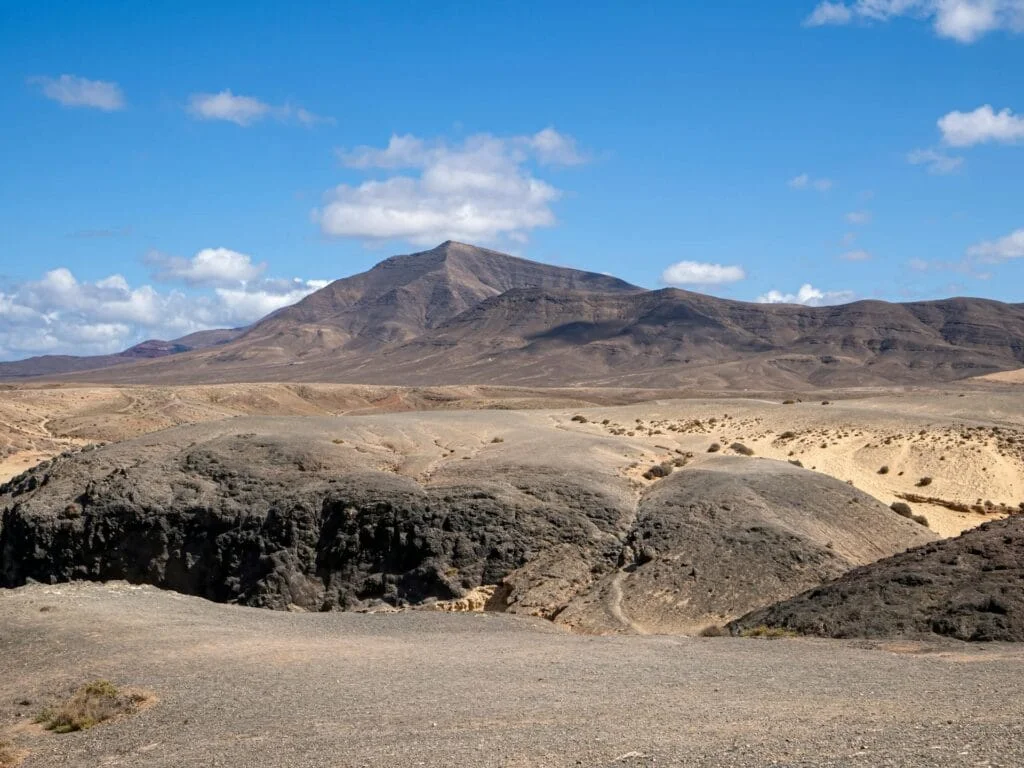
Cape Verde owes its varied geology to its volcanic origin – the islands formed as Africa and South America drifted apart some 180 million years ago. This volcanic past is reflected in today’s landscape, shaped by heavily eroded lava fields, rocky deserts and dramatic mountain ranges.
The landscape varies across the different island groups. The eastern islands (Boa Vista, Maio and Sal) are mostly flat, with sand dunes, low hills and salt lagoons. In contrast, the western islands (Brava, Fogo, Santiago, Santo Antão, São Nicolau) are mountainous, with deep valleys and dramatic slopes. These differences in terrain have a direct impact on the climate, vegetation and overall feel of your stay.
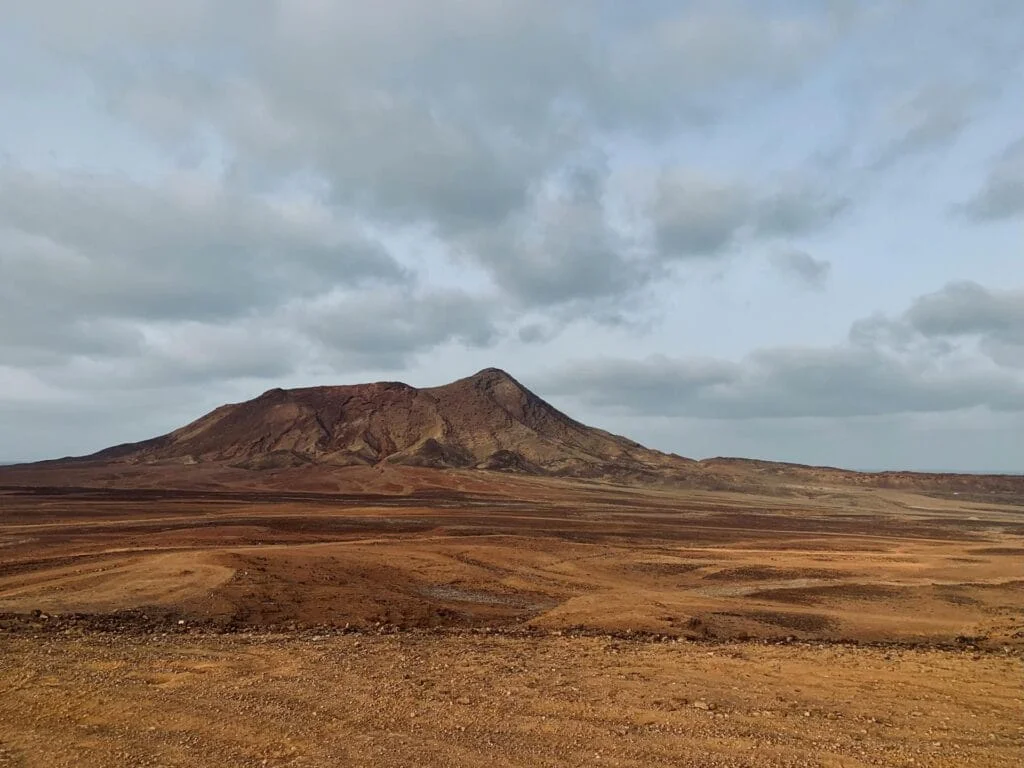
Although Cape Verde lies close to Africa, its landscape is surprisingly dry. Farmland makes up only 11 percent of the total area; the rest is made up of rocky deserts and volcanic formations.
Weather and when to go: Your guide to the seasons
Cape Verde is a destination where rain is very rare and the sun shines almost all year round. When planning your trip, the key factors are air temperature, ocean temperature and the strength of the local wind. The islands have two main climate seasons:
- Dry season – from November to June
- Rainy season – from July to October (even then, rainfall is minimal)
There is also a distinct windy season, which runs roughly from October to mid-July and is ideal for water sports enthusiasts.
| Month | Average daytime temperature (°C) | Average night-time temperature (°C) | Sea temperature (°C) |
|---|---|---|---|
| January | 25 | 20 | 23 |
| February | 25 | 20 | 23 |
| March | 26 | 21 | 24 |
| April | 26 | 21 | 24 |
| May | 27 | 22 | 24 |
| June | 27 | 23 | 25 |
| July | 28 | 24 | 26 |
| August | 30 | 25 | 27 |
| September | 30 | 25 | 28 |
| October | 29 | 24 | 27 |
| November | 28 | 23 | 26 |
| December | 26 | 22 | 25 |
During the winter months (December to March), the wind is at its strongest, making this period perfect for kitesurfing and windsurfing. Summer months, on the other hand, bring the least rainfall, the best swimming conditions and the liveliest atmosphere.
- For relaxing on the beach and swimming: June to September
- For kitesurfing and windsurfing: December to March
- For trekking and hiking: November to April
- For the best mix of everything: October and November
Regions and types of destinations: Where to stay and what to do
Sal: The tourist heart of Cape Verde
Sal is the most touristy island and offers the best infrastructure of all the Cape Verde islands. It mainly attracts fans of beaches, relaxation, and water sports. Its development took off around 2005, driven by solid infrastructure and great conditions.
The island is almost completely flat, dominated by sand dunes, low hills, and blazing sun. The main hub is the town of Santa Maria, which boasts 17 kilometers of white-sand beaches and all the facilities a traveler could want. From hotels, restaurants, and bars to souvenir shops – everything is in one place.
Thanks to steady winds, Sal is also a world-class kitesurfing hotspot, home to the legendary Ponta Preta beach, a cult spot for surfers from all over the world.
Boa Vista: Island of sand dunes and unspoiled beauty
Boa Vista was discovered by travelers over the last decade and is now rapidly growing as a tourist destination. Although its infrastructure is similar to Sal, it is a bit less commercial and keeps more of its original character.
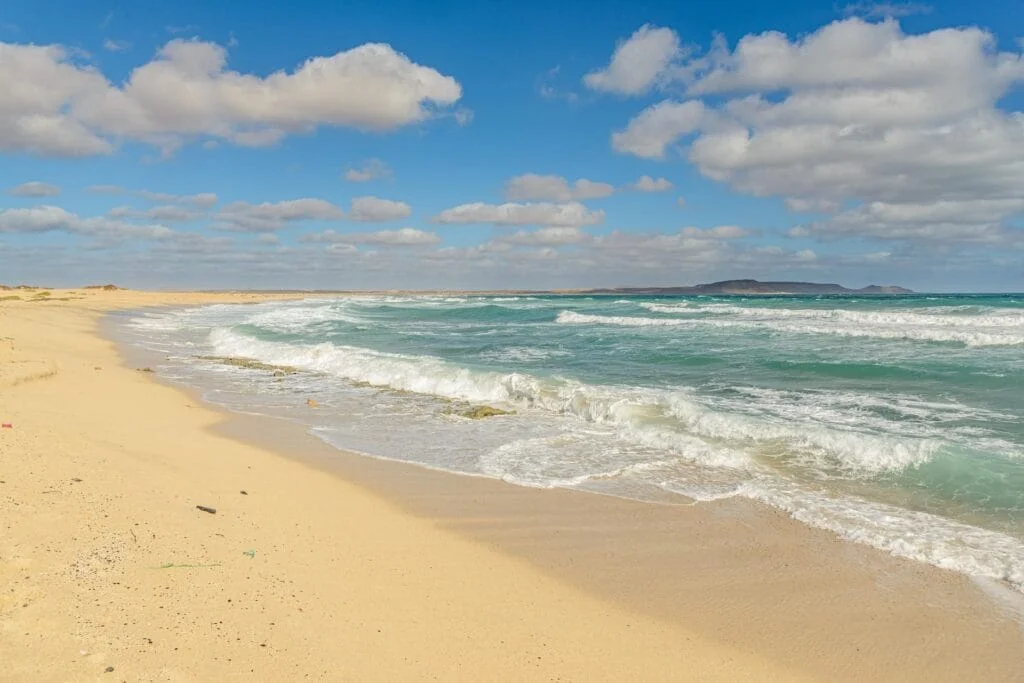
The island is best known for its stunning long white-sand beaches, especially Praia de Santa Mónica (18 km of golden sand) and Praia de Chaves (a 5 km beach lined with sand dunes). On the northern coast, you’ll find the iconic Praia de Atalanta with the wreck of the Spanish cargo ship Cabo Santa Maria, which ran aground here in 1968 and today makes for a unique photo spot.
Boa Vista is the right choice for travelers looking for a quieter alternative to Sal with breathtaking beaches and wild nature.
Santiago: The heart of culture and history
Santiago is the largest island in Cape Verde and its cultural and historical heart. This is where you’ll find the capital city Praia, home to more than half of the country’s population and buzzing with a vibrant African vibe, especially in the evening when live music spills out into the streets from every direction.
The most important place on Santiago, however, is Cidade Velha – the old town, which is the first European city in the tropics and a UNESCO World Heritage Site. A walk through its narrow streets feels like stepping back several centuries. Here you’ll find the impressive Real de São Filipe fortress, built as protection against pirates, the old pillory Pelourinho (where enslaved people were punished), and the church of Nossa Senhora do Rosário from 1495, said to be the oldest colonial church in the world.
Santiago is perfect for travelers who want to combine relaxing on the beach with exploring history and local culture.
Fogo: Active volcano and adventure
Fogo is an island dominated by the only active volcano in the archipelago – Pico do Fogo (2,829 meters). The ascent to the summit ranks among the most accessible volcano hikes in the world and is a once-in-a-lifetime experience.
The island is also known for its excellent wines. Local wineries produce varieties such as Cabernet Sauvignon and Tempranillo, which is quite surprising given the volcanic landscape. The villages in the caldera (Chã das Caldeiras) are home to a traditional way of life and authentic crafts.
Santo Antão: The greenest island and a hiker’s paradise
Santo Antão is often called the “greenest island in Cape Verde” and for many travelers it’s the most beautiful island in the entire archipelago. Its rugged mountains, deep valleys and terraced fields make it ideal for hiking and trekking.
Places like the Paúl valley or the Cova crater offer dramatic scenery that’s hard to picture until you see it with your own eyes. Hiking routes range from a few hours to several days, and basic trekking skills are more than enough.
São Vicente and Mindelo: The cultural capital
São Vicente is home to the city of Mindelo, widely considered the “cultural capital” of Cape Verde. The city is full of small squares, colorful historic houses and a genuinely local atmosphere. This is where the famous carnival parade takes place every year, often compared to the one in Rio de Janeiro.
Mindelo is also the ideal place to dive into live music, traditional dances and local cuisine.
Brava and Maio: Lesser-known islands
Brava – nicknamed the “island of flowers” – is one of the least visited islands, but it offers stunning scenery with high biodiversity and an authentic atmosphere far away from tourist crowds.
Maio, on the other hand, is a flat island with long sandy beaches and is ideal for travelers looking for complete peace and seclusion.
Most famous landmarks and towns
Cidade Velha: UNESCO World Heritage Site
Cidade Velha, or “Old Town”, became a UNESCO World Heritage Site in 2009 and is the only landmark in Cape Verde with this status. This historic town is located on the island of Santiago, about 10 kilometers from the modern capital Praia.
The town was founded in 1462 and over the centuries became one of the most important centers of the transatlantic slave trade. You can feel its history in the remains of old buildings. The Real de São Filipe Fortress, built at the end of the 16th century, dominates the cliff above the town and was constructed to protect it from pirates. The town was in fact attacked several times, including by Francis Drake in 1586 and by French pirates in 1712.
In the town center you will find Praça Pelourinho – a square with a pillory where enslaved people were publicly punished, a dark but important reminder of this chapter in history. Nearby stands the church of Nossa Senhora do Rosário from 1495, the oldest colonial church in the world, which is still in use and decorated with a Manueline portal and Gothic vaults.
A walk along Rua Banana – the first colonial-style street built in Africa – feels like stepping back in time.
Praia: The capital with an African soul
Praia is the capital and largest city of Cape Verde. It is located on the island of Santiago and is home to a surprisingly modern lifestyle blended with a traditional African vibe.
The center is built around Praça Alexandre Albuquerque, a square surrounded by colonial buildings, including the presidential palace and the neo-Gothic cathedral Nossa Senhora da Graça. The streets of Praia are full of color, vibrant houses, and live music, especially in the evening. The city is a great starting point for visiting Cidade Velha, which is only 15 kilometers away.
Close to the city you will also find the beautiful Farol de Dona Maria Pia lighthouse, built in 1881, which offers wonderful views of the ocean and the surrounding area.
Santa Maria: Tourist hub on Sal
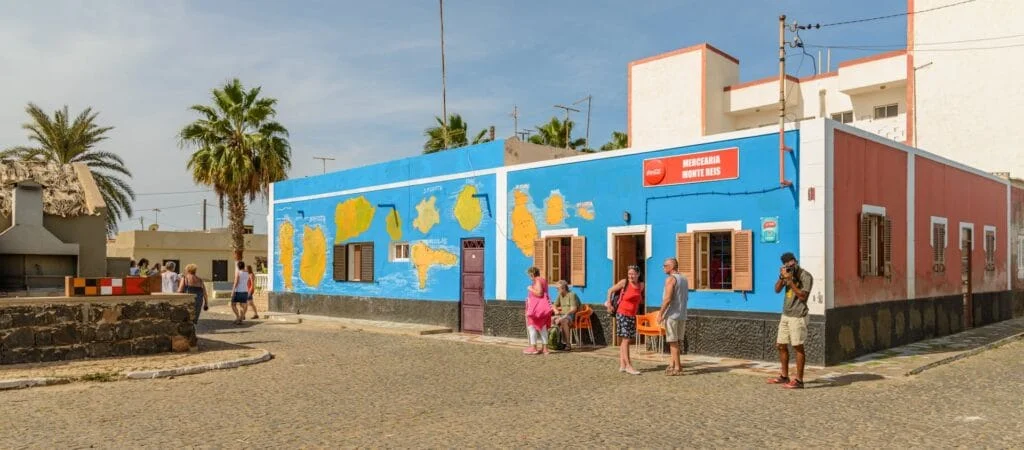
Santa Maria on the island of Sal is the most important tourist hub in Cape Verde. This once sleepy fishing village has grown into a lively resort with modern infrastructure. The streets Amílcar Cabral and 1 de Junho are lined with shops, restaurants, and bars. The town is the beating heart of the island and a perfect place for souvenir shopping, tasting local dishes, and enjoying the nightlife.
Sal Rei and Mindelo: Original island atmosphere
Sal Rei on the island of Boa Vista is a smaller town with colonial architecture and the lively Praça de Santa Isabel square. Here you can visit the 19th-century church Igreja de Santa Isabel and stroll along the waterfront lined with colorful fishing boats.
Mindelo on São Vicente is a cultural center with a truly authentic vibe. The town is the home of traditional music and festivals, including the famous Cape Verde Carnival, which takes place here every year.
Natural beauty and national parks
Beaches: Sand and sunshine at every turn
Cape Verde is a paradise for beach lovers. The islands boast kilometres of white-sand beaches that rank among the most beautiful in the world.
- Praia de Santa Mónica on the island of Boa Vista is an iconic 18-kilometre-long beach with fine golden sand and crystal-clear blue water. While the northern part of the beach is home to tourist resorts, the southern end belongs to the Morro de Areia nature reserve, which protects local birdlife and sea turtles.
- Praia de Santa Maria in the south of Sal, with its white sand and stunning blue water, is on par with the finest beaches in the Caribbean.
- Praia de Chaves on the west coast of Boa Vista stretches for about 5 km and is famous for its sand dunes.
- Praia de Atalanta on the northern coast of Boa Vista is known for its soft sand, crystal-clear sea, and the iconic Cabo Santa Maria shipwreck, which ran aground here in 1968 and is now a popular photo spot.
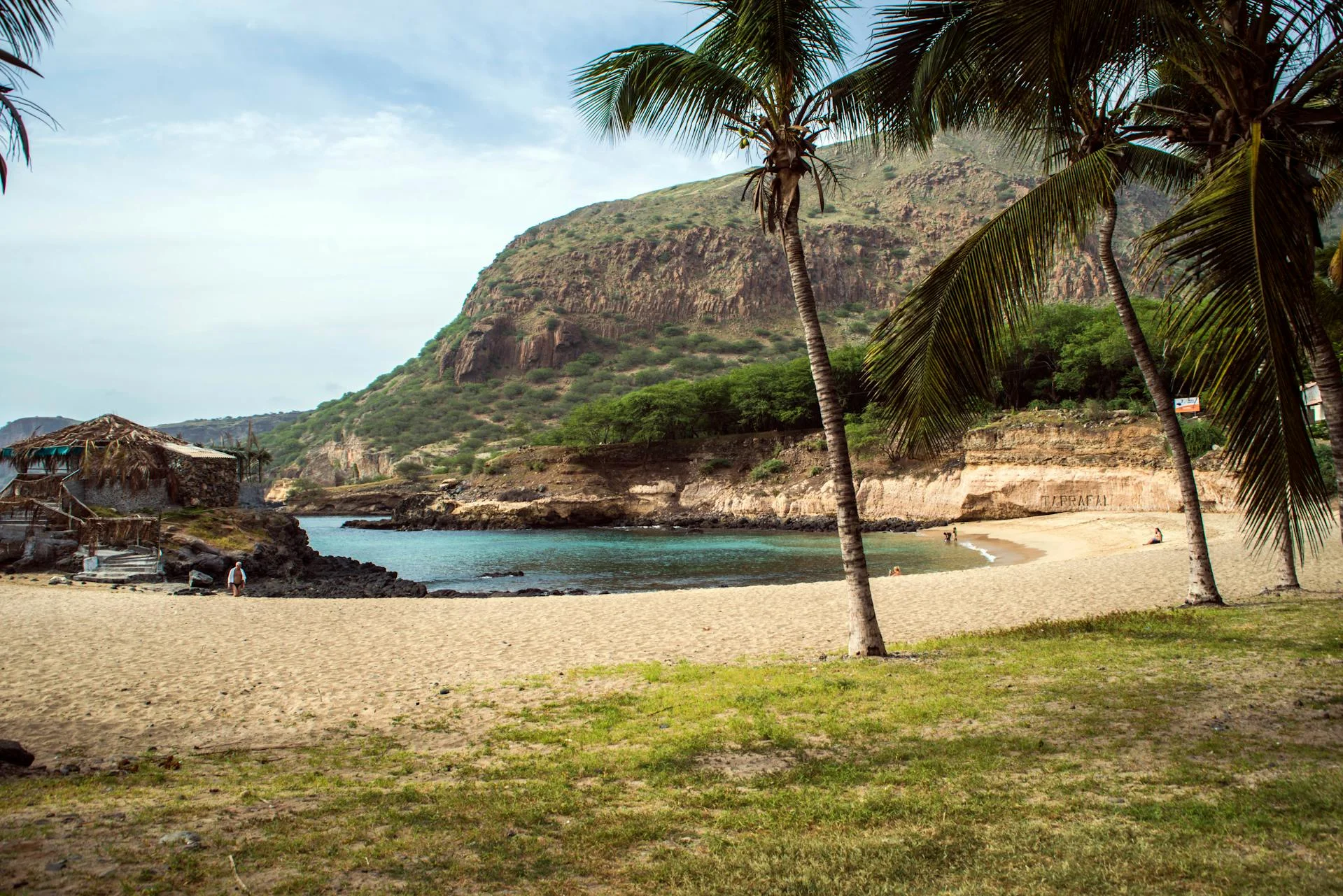
- Praia do Tarrafal on the island of Santiago is considered the most beautiful beach on the island, with golden sand, coconut palms, and green volcanic hills in the background.
The archipelago also offers some unusual beaches. On the island of Sal you will find the “Shell Cemetery” beach (Cemetery Beach), covered in a thick layer of shells, as well as a black volcanic sand beach.
Natural highlights: Lagoons and caves
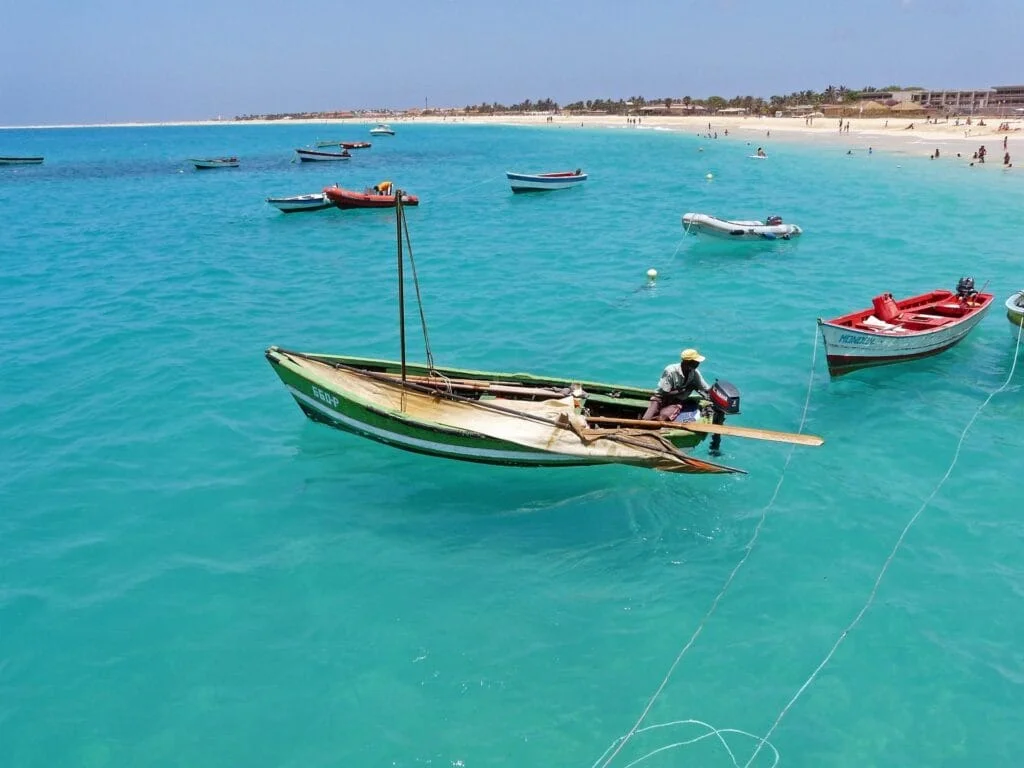
Buracona Lagoon in the northwest of Sal Island is a natural lava pool with a clever internal structure. At noon you can see the “Magic Eye” phenomenon here – sun rays reflect off the water and create the illusion of a blue eye.
The Salinas salt lake in the crater of the Pedra de Lume volcano on Sal Island is several times saltier than the Dead Sea. Here you can try floating in water so dense that you can hardly sink.
Fauna and flora: A unique ecosystem
The natural wealth of Cape Verde is surprising given its location in a desert zone. The flora itself is very poor though – originally only about 250 plant species grew here because of the lack of water and volcanic bedrock. Over the centuries people planted exotic non-native species and caused erosion that has almost completely wiped out the original vegetation.
Vegetation on the islands includes tropical fruit trees, tea and coffee plantations, sugar cane fields, and typical savanna grasses and shrubs. A characteristic species is the “dragon tree” (Dracaena draco) with its wide-spreading crown. On the mountainous islands you can admire mangroves and forested ridges.
There are around 80 endemic species in the wild – plants that do not grow anywhere else in the world. These include, for example, the Tornabenea umbellifer and several species of acacia.
In terms of fauna, birdlife is the real highlight – mammals and snakes are almost absent here. On the islands of Fogo, Santa Luzia and others, rare bird species nest, some of which survive in only a few dozen individuals worldwide. Among them are the Cape Verde gull and Cape Verde shearwater.
The interior is home to drought-tolerant reptiles, especially lizards – giant species up to 50 centimeters long died out roughly 50 years ago.
The sea around Cape Verde is a true paradise – you can find huge sea turtles, dolphins, smaller shark species and humpback whales here. There are also large fish populations, including tuna and groupers, as well as lobsters and crabs, which makes these waters a real magnet for anglers and divers.
Gastronomy and culture
Typical food and drinks
Cape Verdean cuisine is a unique blend of African tradition, Portuguese influence, and Creole creativity. The key ingredients are seafood, pork, sweet potatoes, rice, and corn.
- Cachupa is the national dish of Cape Verde and something you really should try. It’s a hearty, stew-like meal made from meat or fish served with a side of corn and beans, often thickened with pumpkin and potatoes.
- Feijoada – a dish of braised meat and beans with plenty of spices.
- Canja – a tasty soup made from chicken and rice.
- Bafa – stewed seafood prepared in a traditional way.
- Grogue – a local spirit made from sugar cane, very high in alcohol.
- Xerém – a dish made from corn flour mixed with water, butter, and salt.
- Queijo de cabra com doce de papaia – goat cheese topped with papaya jam, served as a dessert.
- Pastel – fried stuffed pastries.
- Beer – the local brand is called Strela and it’s a popular drink.
On the island of Fogo you’ll also find a small winery growing varieties such as Cabernet Sauvignon and Tempranillo, which is quite an unexpected surprise.
Meal times and restaurant etiquette
People in Cape Verde tend to eat fairly late. Breakfast is usually served between 7 and 9 a.m. Lunch, which is the main meal of the day, is served between noon and 2 p.m., while dinner is traditionally eaten after 8 p.m.
In restaurants, guests are expected to behave respectfully. Tips are usually around 5–10% of the total bill and are a welcome gesture.
Cultural customs and festivals
Cape Verdeans are extremely proud of their culture, which comes to life especially through music, dance, and traditional food. Music is not just entertainment – it’s part of their identity and everyday life.
- Morna is a distinctive music style with a melancholic to deeply tragic feel, made famous by the world‑renowned Cape Verdean singer Cesária Évora. In 2019, morna was recognized by UNESCO as Intangible Cultural Heritage.
- Funaná is an energetic dance style with a distinctive accordion sound and rhythmic moves, popular at celebrations and in local bars and clubs.
- Batucada is a form of traditional group drumming that you’ll hear everywhere, especially after New Year during the run‑up to carnival.
- The Cape Verdean carnival is one of the biggest festivals of the year. It’s celebrated every year with huge energy and vibrant costumes, and the carnival on São Vicente is often compared to the one in Rio de Janeiro.
Cape Verdeans really know how to have fun and enjoy life – hardly a week goes by without some kind of concert, dance show, or festival, especially in the summer and around Christmas and New Year.
Key practical information
Currency and payments
The official currency of Cape Verde is the Cape Verdean escudo (CVE). The escudo has a fixed exchange rate to the euro: 1 EUR = 110 CVE. You cannot exchange this currency in the Czech Republic, and Czech crowns are not accepted here.
The best currency to bring is the euro, which you can use directly in many hotels and restaurants. In larger towns and tourist areas you can also pay by international payment card (VISA, MasterCard).
You can get cash in escudos at hotel receptions, exchange offices, banks, or by withdrawing from ATMs. Be prepared for relatively high fees, so it’s better to exchange the amount you expect to need in one go.
Entry requirements and visas
To enter Cape Verde you need:
- A valid passport – it’s recommended that it be valid for at least 6 months after your planned departure date.
- Airport security tax – 3,400 CVE (approx. $34), which can be paid online by registering no later than 5 days before departure, through your travel agency, or on arrival at the airport.
Good news for Czech travellers: Since 1 January 2019, Cape Verde has lifted the visa requirement for EU citizens for stays of up to 30 days. For a longer stay, you need to apply for a visa.
Safety and local customs
The security situation in Cape Verde is very good and the country is politically stable. The rate of violent crime is low, but there is some petty crime, especially pickpocketing in larger towns and crowded places.
Safety tips:
- Keep your valuables in hotel safes and avoid carrying large amounts of cash.
- Be cautious in crowded areas and avoid wearing flashy jewellery.
- Do not walk alone in remote neighbourhoods of big cities.
- When swimming in the sea, pay attention to the often strong currents.
Cape Verdeans are generally very friendly and welcoming. Local culture blends African and European influences, creating a unique and tolerant atmosphere.
Healthcare and insurance
In Cape Verde, you have to pay for all medical services in cash. Cape Verde has no agreement with the Czech Republic or the European Union on free healthcare.
The quality of healthcare varies:
- The main islands (Sal, Boa Vista, Santiago) have public hospitals and private clinics providing basic care.
- The level of equipment does not always match European standards.
- In less populated areas, healthcare is limited.
It is absolutely essential to take out travel insurance with high coverage limits that also includes possible evacuation and repatriation.
For common issues (sunburn, stomach problems, minor injuries), care is easy to access. Most larger hotels have their own private doctor or have an agreement that a doctor visits several hotels and is available at set times. Pharmacies are well stocked.
Basic phrasebook
| Czech phrase | Cape Verdean Creole |
|---|---|
| Hello / Good day | Oi / Olá |
| Good night | Boa noite |
| Thank you | Obrigado (male) / Obrigada (female) |
| Please | Por favor |
| How much does it cost? | Kantu kusta? |
| How are you? | Kumo bu sta? |
| Very good | Mutu bon |
| I don’t speak Creole | N ka ta papia kriolu |
| Do you speak English? | Bu ta papia inglés? |
| Where is the toilet? | Undi e kaza di banhu? |
| Water | Água |
| Food | Kumida |
| Beer | Cerveja |
| Beach | Praia |
Transport and logistics
How to get to Cape Verde
Cape Verde is not served by regular passenger ferries – the only realistic option is to fly. From the Czech Republic, you usually fly with a layover, for example in Lisbon.
The flight time from Prague to Cape Verde is roughly 6–7 hours of actual flying. You will land at one of the four international airports:
- Aeroporto Internacional Amílcar Cabral (SID) – Sal Island (the busiest one)
- Aeroporto Internacional Aristides Pereira (BVC) – Boa Vista Island
- Aeroporto Internacional Nelson Mandela (RAI) – Santiago Island
- Aeroporto Internacional Cesária Évora (VXE) – São Vicente Island
Getting around the islands
In Cape Verde, there is no central public transport system linking airports with tourist resorts. You can get around in several ways:
- Taxi – the most common option. Prices are fixed (for example, from Sal Airport to Santa Maria around 15 EUR).
- Aluguer (shared taxi) – shared minibuses running on fixed routes, cheaper but less comfortable.
- Rental car – prices start at about 45 EUR per day.
Between the individual islands, you can travel by plane or ferry. The main airline for domestic flights is Bestfly Cabo Verde. Ticket prices range from $110 to $280.
Prices and travel budget
Compared to the Czech Republic, Cape Verde is similarly priced or slightly more expensive, especially in tourist hotspots. Outside these areas, prices for things like food can be lower.
Approximate daily budget per person
- Budget travel: 4 000–5 000 CVE (about $40–$50)
- Guesthouse accommodation, eating in local eateries.
- Guesthouse accommodation, eating in local eateries.
- Mid-range travel: 7 000–9 000 CVE (about $70–$90)
- Mid-range hotel, meals in standard restaurants.
- Mid-range hotel, meals in standard restaurants.
- Luxury travel: 15 000+ CVE (about $150+)
- High-end resorts, fine dining, private transfers.
- High-end resorts, fine dining, private transfers.
Example prices
- Lunch in a standard restaurant: 500–800 CVE (about $5–$8)
- Dinner in a mid-range restaurant: 1 000–1 500 CVE (about $10–$15)
- Local beer: 150–200 CVE (about $1.50–$2)
- Taxi ride within the city: 300–500 CVE (about $3–$5)
How to plan the perfect trip
Choosing the right region for your travel style
- For beginners and families: The islands of Sal and Boa Vista offer the best infrastructure and a very safe environment. Perfect for carefree days relaxing on the beach.
- For history and culture lovers: Santiago with Cidade Velha and Praia gives you fascinating history and an authentic African vibe.
- For adventure seekers and hikers: Santo Antão is the trekking king, with dramatic mountains and deep valleys.
- For water sports enthusiasts: Sal and Boa Vista in winter (December–March) are ideal for kitesurfing and windsurfing.
- For travellers looking for peace and quiet: Maio and Brava are less visited and offer complete calm and isolation.
- For volcano and geology fans: Fogo is unique, with an active volcano and outstanding natural scenery.
Common mistakes and tips
- Don’t book every night in advance – Cape Verde really rewards flexibility, so you can adapt to the weather and your mood.
- Watch out for strong sea currents – not every beach is safe for swimming.
- Allow plenty of time for travelling between islands.
- Try local food in small restaurants, not only in tourist resorts.
- Learn a few words of Creole – locals really appreciate it.
- Be realistic with your plans – things move a bit slower here than in Europe (Cape Verde’s motto is “No Stress”).
Sample itineraries
- 7 days – Ideal first visit:
- Days 1–4: Sal (beach relaxation, water sports, Salinas salt lake)
- Days 5–7: Santiago (flight to Santiago, visit to Cidade Velha and Praia)
- Days 1–4: Sal (beach relaxation, water sports, Salinas salt lake)
- Days 5–7: Santiago (flight to Santiago, visit to Cidade Velha and Praia)
- 10 days – Nature lovers:
- Days 1–2: Sal (arrival, getting used to the climate)
- Days 3–7: Santo Antão (flight to São Vicente and ferry to Santo Antão, trekking in the Paúl and Ribeira Grande valleys)
- Days 8–10: São Vicente (visit Mindelo, departure)
- Days 1–2: Sal (arrival, getting used to the climate)
- Days 3–7: Santo Antão (flight to São Vicente and ferry to Santo Antão, trekking in the Paúl and Ribeira Grande valleys)
- Days 8–10: São Vicente (visit Mindelo, departure)
- 14 days – Complete experience:
- Days 1–3: Sal (beaches, water sports)
- Days 4–6: Boa Vista (Santa Mónica and Chaves beaches, shipwreck)
- Days 7–9: Santiago (Cidade Velha, Praia, culture)
- Days 10–12: Fogo (hike up the volcano)
- Days 13–14: Return to Sal and departure
- Days 1–3: Sal (beaches, water sports)
- Days 4–6: Boa Vista (Santa Mónica and Chaves beaches, shipwreck)
- Days 7–9: Santiago (Cidade Velha, Praia, culture)
- Days 10–12: Fogo (hike up the volcano)
- Days 13–14: Return to Sal and departure
Summary and final tip
Cape Verde is not a one‑time destination – it’s a place that wins you over with its authenticity, the warmth of its people, and its stunning landscapes. Whether you go for a laid‑back beach break on Sal, an adventure on the Fogo volcano, a history‑packed trip to Cidade Velha, or trekking through the valleys of Santo Antão, one thing is certain – Cape Verde will stay with you. This small African archipelago carries centuries of both painful and joyful history, reflected in every local face and in every note of its traditional music.
Cape Verde will not let you down – trust those who have been there and can’t wait to go back.
Kategorie:
Články (Nejnovější / Podobné)
Mauritius: A Guide to Paradise with White Beaches and Turquoise Water
12/20/2025
Seychelles: An Island Paradise in One Guide
12/16/2025
Thailand: A Complete Guide to the Land of Smiles
12/14/2025
Japan: A Guide Between Geisha and Robots
12/13/2025
Vietnam: The Secrets of Phở, Strong Coffee, and Chaotic Streets
12/11/2025