Seychelles: An Island Paradise in One Guide
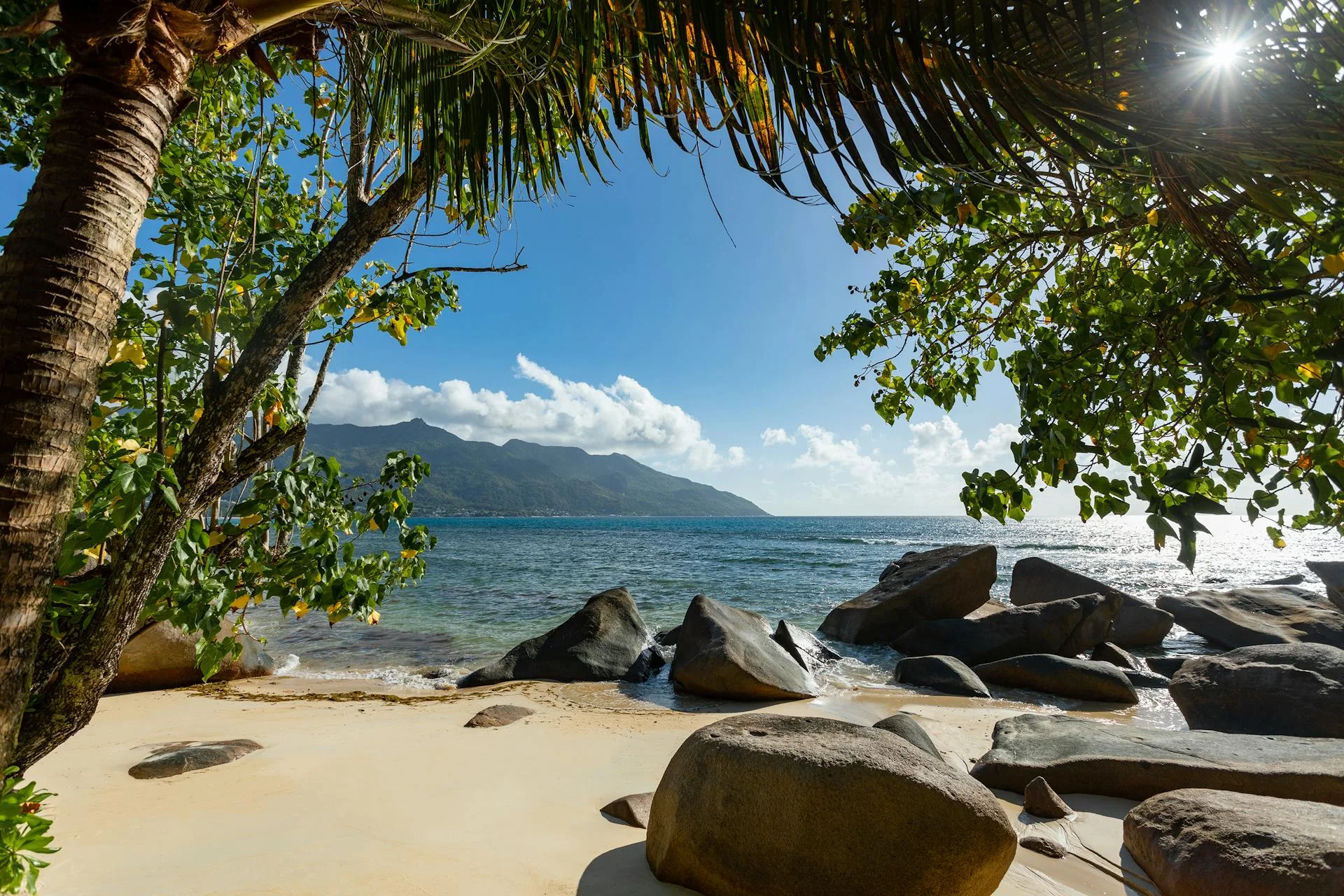
The Seychelles are one of the most mysterious and beautiful destinations in the world, spread across 115 islands in the middle of the Indian Ocean. This picturesque archipelago lies northeast of Madagascar and east of the African mainland, creating a truly unique and secluded getaway for travelers.
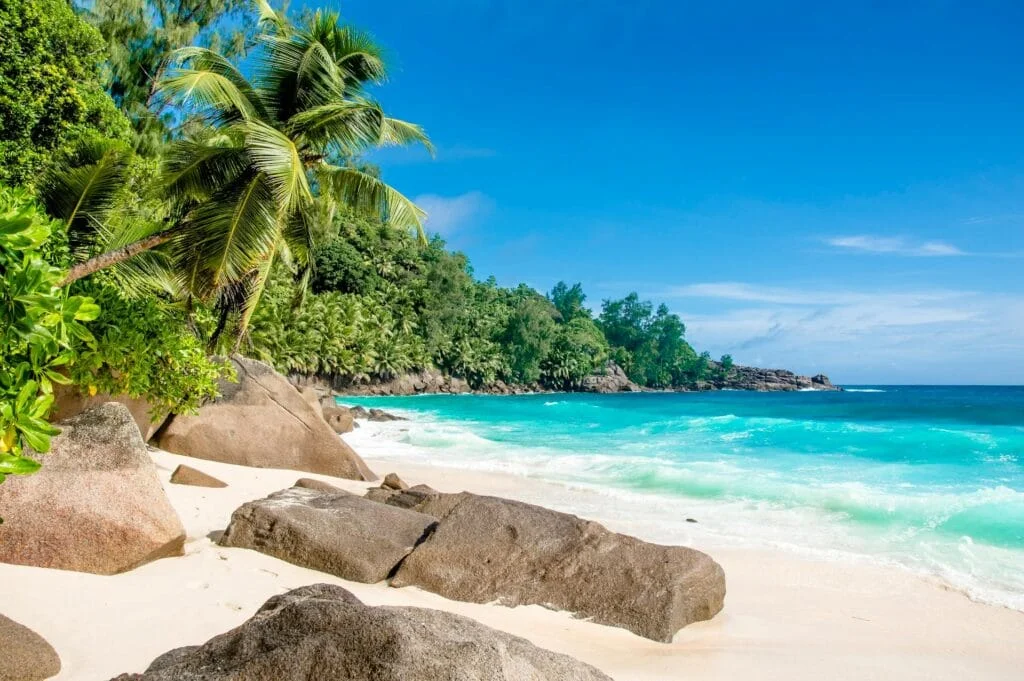
These are not islands built for mass tourism – they are for travelers who want real peace and quiet, unspoiled nature, and a refined kind of variety without the crowds. The mix of pristine coral reefs, dramatic granite boulders, white sand, turquoise water, and lush tropical greenery quickly shows you why this destination is so sought-after.
Did you know that the Seychelles are home to one of the smallest UNESCO World Heritage Sites? Vallée de Mai National Park on Praslin Island covers just 20 hectares and is home to the famous Coco de Mer palm, which has the largest seed in the plant kingdom.
History of the Seychelles archipelago
The Seychelles have a fascinating history that stretches from the Middle Ages to the present day. Although the archipelago was known to Arab seafarers as early as around the year 800, the first documented European discovery was recorded in 1502, when the famous Portuguese navigator Vasco da Gama sailed past the islands on his way to India. For a long time, the Portuguese simply passed by and paid little attention to them. Things changed in the 18th century, when the French recognized their strategic position.
In 1756, France sent an expedition to the islands led by Captain Cornelius Nicolas Morphey, who claimed Mahé and seven other islands as French territory. Interestingly, the archipelago was named after Jean Moreau de Séchelles, the finance minister of King Louis XV of France. From that moment on, the islands have been known as the Seychelles. French settlers, together with enslaved people brought from Africa and Madagascar, began to establish plantations and botanical gardens, especially on Sainte Anne Island around 1770.
This French influence did not last long. The British, unhappy with the French presence in the Indian Ocean and driven by their own trade interests, seized the islands in 1794. This sparked years of conflict between the British and the French, during which the French commander Quéau de Quinssy tried eight times to restore the French flag over the islands. In 1811, the Seychelles finally came under permanent British rule, and in 1840 the capital was named after Queen Victoria. After slavery was abolished in 1833, new settlers arrived from India and China, which greatly enriched the local culture. The Seychelles did not gain independence until 1976, and since then they have become one of the most desirable and luxurious destinations in the world.
Location, geography and climate
Location and geography
The Republic of Seychelles is a unique geographical formation stretching over more than 1,100 kilometers east to west and 800 kilometers north to south. All 115 islands cover roughly 455 square kilometers of land, while their territorial waters span about 1.3 million square kilometers of ocean. Geographically, Seychelles is divided into two main groups. The Inner Islands, 42 in total, are made up of massive granite outcrops and form the northeastern part of the archipelago. These islands are the oldest and most densely populated. Fifty percent of the population lives on the largest island, Mahé, and another twenty percent is spread across Praslin and La Digue. The Outer Islands, 73 in total, are flat coral atolls with no natural freshwater sources and are almost uninhabited. They include, for example, the famous Bird Island and the well-known Alphonse Atoll.
The largest island, Mahé, reaches 905 meters at the peak of the Morne Seychellois range, which is also the highest point of the entire archipelago. The other islands are much lower and flatter. From a geological point of view, Seychelles is very old – the core of the Inner Islands is formed by granite that is more than 650 million years old. The coastline is dramatic, with sandy beaches alternating with high granite cliffs and secluded coves.
Climate and weather for travelers
Seychelles enjoys a tropical climate that stays mild and pleasant all year round thanks to the Indian Ocean. Average temperatures are around 25–30 °C throughout the year, so it never gets really cold on the islands. This tropical climate is strongly influenced by the monsoons, which divide the year into four distinct periods. From May to September, the southeast trade winds blow, bringing the driest and most comfortable time to visit. During this period, temperatures are a pleasant 24–28 °C and the sky is usually clear with very little rain. In contrast, from December to March, calm spells alternate with stronger northwesterly winds, which bring higher humidity and showers that usually do not last long.
In general, the best time to visit is between seasons – in April and May, when sea temperatures are around 29–31 °C, prices are lower than in peak season and there are fewer tourists. November and mid-January are also very favorable months. Average annual rainfall is around 3,000 millimeters, which is quite a lot, but most of the rain falls in the winter months and usually comes in short tropical downpours.
| Month | Average daytime temperature | Average night-time temperature | Sea temperature | Weather and season |
|---|---|---|---|---|
| January | 30 °C | 24 °C | 29 °C | Humid, rainy, northwesterly wind |
| February | 30 °C | 24 °C | 30 °C | Hottest month, very high humidity |
| March | 30 °C | 24 °C | 30 °C | Less rainfall, more stable weather |
| April | 32 °C | 24 °C | 31 °C | Peak heat, calm conditions, excellent for diving |
| May | 29 °C | 23 °C | 31 °C | Transition period, water still warm, lower humidity |
| June | 28 °C | 22 °C | 28 °C | Dry season, light breeze, ideal weather |
| July | 27 °C | 21 °C | 27 °C | Dry, pleasantly warm, great for the beach |
| August | 25 °C | 20 °C | 26 °C | Coolest temperatures, consistently dry and stable |
| September | 26 °C | 21 °C | 26 °C | Dry weather continues, slight warming |
| October | 27 °C | 22 °C | 27 °C | More frequent showers, temperatures rising |
| November | 28 °C | 23 °C | 28 °C | Onset of the rainy season, tropical conditions |
| December | 28 °C | 24 °C | 29 °C | Rainy period, Christmas-time weather |
Regions and types of destinations – island guide
Mahé Island – the heart of the Seychelles
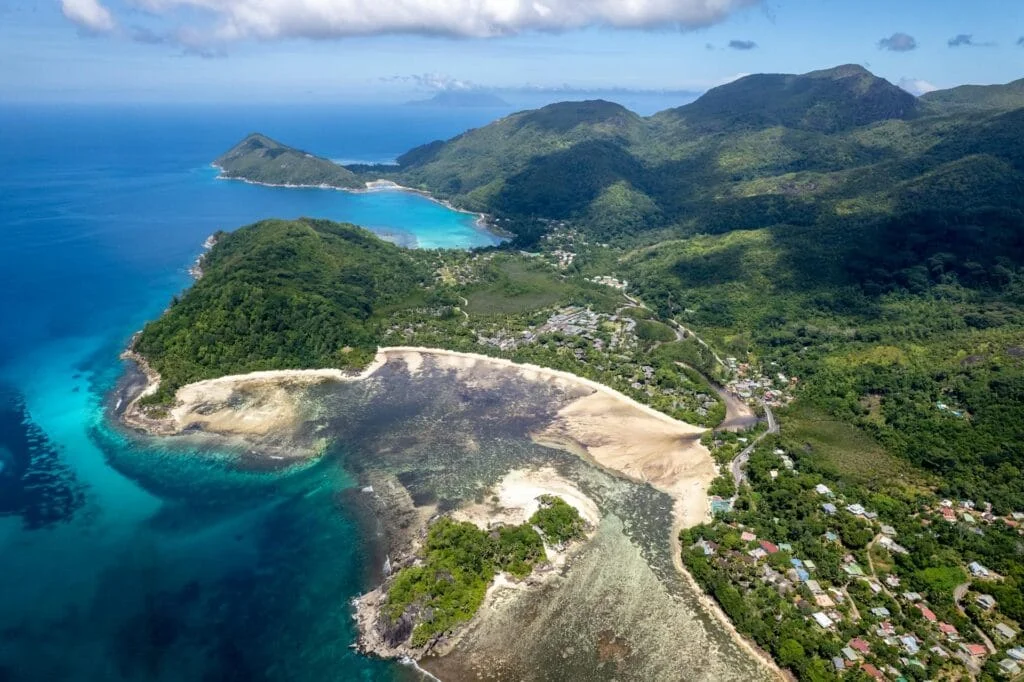
Mahé is the largest island in the archipelago and home to roughly 80 percent of the population. The island is the center of everyday life, culture, and tourism. The capital city Victoria is one of the smallest capitals in the world – only about 26,000 people live here. Even so, it is a lively city with colorful houses, a spacious market, museums, and the country’s administrative hub. The historic part of town offers an authentic feel of local life without hectic mass tourism. Mahé is also home to the main airport and port, so it’s the first place you’ll get to know when you arrive.
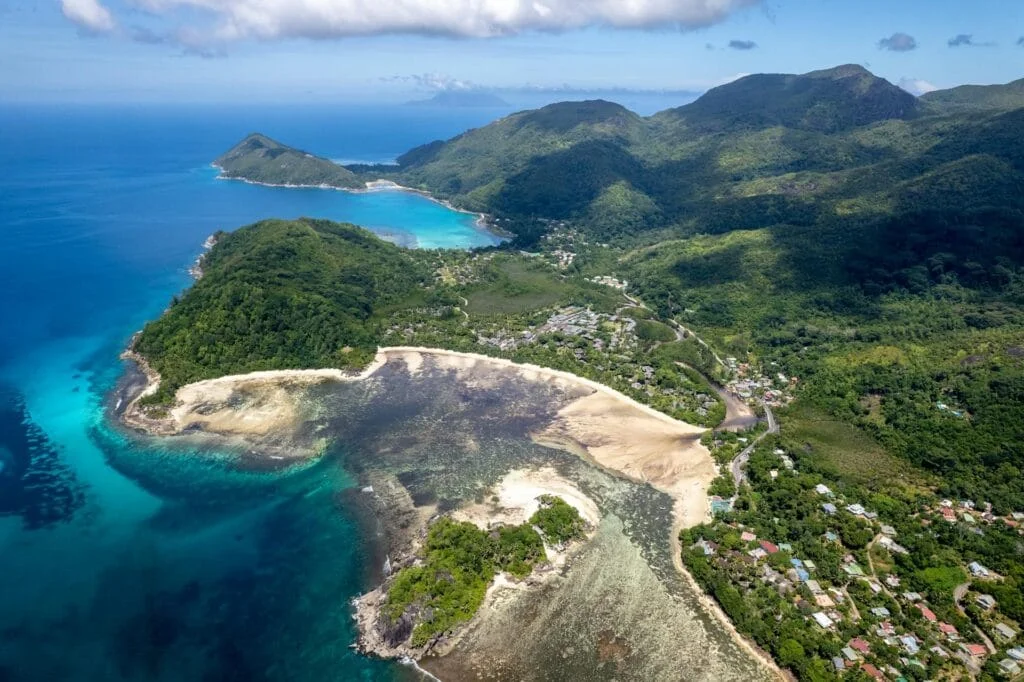
Mahé is a mountainous island with dense vegetation and a dramatic coastline. This is where you’ll find the Morne Seychellois National Park, which covers around 20% of the island and offers beautiful hiking trails and views over the whole island and surrounding lagoons from its 905-meter peak. The hike to the top of Morne Seychellois takes about 3–4 hours and is not technically difficult, although it is physically demanding. The trail leads through tropical forest with stunning ocean views and, if you’re lucky, you may spot rare endemic birds. Mahé is also a beach hub, although it’s better suited for city visits, shopping, dining, and shorter stays.
Praslin Island – a natural treasure chest
Praslin is the second-largest island with just under 8,000 inhabitants and offers an ideal mix of nature and comfort. This is where you’ll find the UNESCO World Heritage Site Vallée de Mai, the smallest World Heritage location on the planet, covering only 20 hectares. This primeval forest is home to the famous Coco de Mer palm, which holds at least three world records. It has the largest seed in the plant kingdom – individual seeds can reach up to 50 centimeters in size and weigh up to 25 kilograms. The seeds resemble a woman’s buttocks, which is why this palm is often linked to erotic symbolism. The islands of Praslin and Curieuse are among the few places in the world where Coco de Mer grows naturally.
The walk through Vallée de Mai is easy and takes 1.5–3 hours, depending on the route and your pace. The terrain is forested and humid, and along the way you’ll come across small streams and fallen branches, so proper footwear is important. The entrance fee is 410 Seychellois rupees (SCR), which is roughly $30. The reserve is open daily from 9 a.m. to 4 p.m. Praslin also boasts beautiful beaches, especially in the north of the island, where you’ll find one of the most stunning beaches in the Seychelles – Anse Lazio.
La Digue Island – the car-free island
La Digue is the third most visited island, yet in many ways the most charming. The island is known for its almost non-existent car traffic – people get around mainly by bicycle, with only a handful of vehicles, most of them electric. The most common way to reach La Digue is by ferry from Praslin, which takes about 45 minutes. La Digue is a small island with only around 3,000 residents and is home to one of the most photographed beaches in the world: Anse Source d'Argent. This beach is famous for its monumental granite boulders that create dramatic scenery, pink sand, and crystal-clear water. There are endless photo opportunities here, so it tends to be crowded, especially between 10:00 a.m. and 4:00 p.m.
La Digue is also home to the L'Union Estate park, where you can see historic vanilla and coconut plantations. The entrance fee to the park is 115 SCR. The island is perfect for a day trip from Praslin or for a longer stay if you’re looking for peace and an authentic island vibe.
Most famous landmarks and towns
The city of Victoria
Victoria is one of the smallest capital cities in the world, with a population of around 26,000. Despite its size, it’s a lively and colorful place with historic buildings, restaurants, shops, and a local market. The main attraction is the Victoria Market (Sir Selwyn Selwyn-Clarke Market), the heart of the city since the 19th century, offering local fish, fruit, vegetables, and traditional Creole food. The market is where you’ll experience real local culture and get a taste of authentic everyday life. The city also has several museums, such as the Seychelles National Museum, where you can learn about the history of the islands, and the National Archives, which preserve important documents.
Victoria also has a beautiful harbor where you can watch fishing boats and cargo ships. A walk through the historic city center takes about 2–3 hours, and it’s worth setting aside at least one full day of your stay to visit.
Morne Seychellois National Park
Morne Seychellois National Park is located mainly on Mahé and includes one of the best-known trekking routes in the Seychelles – the trail to the summit of Morne Seychellois. The main route starts in the Mission Lodge area and leads through forest with stunning viewpoints along the way. The trek takes 3–4 hours there and back and it’s not an easy stroll – some sections are quite steep and you’ll need a reasonable level of fitness. The reward is absolutely worth it. From the top you can see most of the Inner Islands, the surrounding lagoons and, on a clear day, even more distant islands.
Botanical Garden on Mahé
The Botanical Garden in the Mont Fleuri area on Mahé is the perfect place to discover the endemic flora of the Seychelles. The garden is home to more than a hundred plant species, including the iconic Coco de Mer palm, various palm species and exotic trees. A walk through the garden takes 1–2 hours and the setting is very pleasant, with plenty of shade and spots to sit and relax. It’s best to visit in the morning, when the garden is quieter and the temperature more comfortable.
Vallée de Mai National Park
This already mentioned national park on Praslin is without a doubt the most important UNESCO natural site in the Seychelles. The rainforest with its endemic plant and animal species offers an unforgettable experience for nature lovers. Besides the Coco de Mer palm, the rare Seychelles black parrot (Coracopsis nigra barklyi) lives here, along with other endemic species. You can explore the trails on your own or join a guided tour, where a guide will explain the key ecological features of the reserve.
Natural wonders and national parks
Saint-Anne Marine National Park
Saint-Anne Marine National Park near Mahé is the first national park in the Seychelles and one of the best spots for snorkeling and diving. The park stretches around six small islands and is home to more than 150 species of fish, turtles, rays and beautiful coral reefs. The best way to visit is on a glass-bottom boat trip, which lets you watch the underwater world without having to dive. Alternatively, you can snorkel straight from the beach. Ste. Anne Island, part of the park, also has a historical highlight – the first French settlement was founded here in the 18th century.
Mangrove forests
The mangrove forests on Curieuse Island form a unique ecosystem and provide a habitat for various bird and fish species. Walking through the mangroves is an unusual and fascinating experience – you’ll see how the trees adapt to salt water and you can spot crabs and other wildlife. Curieuse is a small island that you can easily visit on a day trip from Praslin.
Curieuse Island and its history
Curieuse has an unusual past – in the 19th century, a leprosarium was built here, and later it served as a correctional facility for young offenders. Today the island is a nature reserve with historic ruins that remind visitors of its history. You will also find giant tortoises living here in a semi-wild state.
The most beautiful beaches in the Seychelles
Anse Source d'Argent – the most photographed beach in the world
Anse Source d'Argent on La Digue is the most famous and most photographed beach in the entire archipelago. It is known for its monumental granite boulders that create dramatic scenery, pink sand and crystal-clear water. Entry to the L'Union Estate park, through which you access the beach, costs 115 SCR. The best time to visit is early in the morning, when the beach is still quiet and free of crowds of photo-hungry visitors. At high tide the water is shallow and perfect for swimming; at low tide you can walk around the dramatic rock formations.
Anse Lazio – the most beautiful beach on Praslin
Anse Lazio lies on the northern coast of Praslin and many travellers consider it the most beautiful beach in the Seychelles. It stretches along a stunning bay with white sand, turquoise water and majestic coconut palms. Snorkelling here is excellent, especially on the left side of the beach where you’ll find coral reefs. The beach is fairly spacious and offers several restaurants and bars where you can enjoy lunch and a drink.
Beau Vallon – the best-known beach on Mahé
Beau Vallon is the largest and most famous beach on Mahé. It curves in a long crescent of fine white sand and calm water. The beach is ideal for families and beginner swimmers – the water is shallow and slopes gently into the sea. Beau Vallon offers plenty of facilities – water-skiing, parasailing, restaurants and bars. Local food and craft markets are also held here, especially on Saturdays and Sundays.
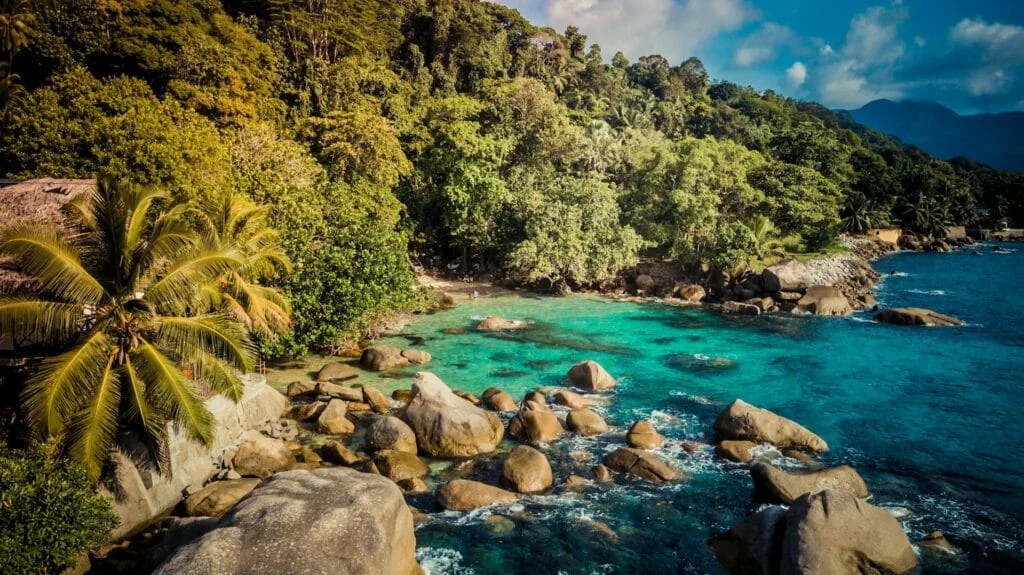
Anse Intendance
Anse Intendance in the south of Mahé is one of the island’s most beautiful and wild beaches. There are stronger currents and bigger waves, so it’s not ideal for swimming, but it’s an unspoilt and stunning spot. The beach is also known as a place where sea turtles come to lay their eggs, which is a fascinating natural spectacle.
Port Launay – a quiet beach for snorkelling
Port Launay is located on the northwestern coast of Mahé and is a peaceful bay with shallow water. It’s ideal for families with children and for beginner snorkelers. The beach is never crowded and offers unspoiled nature without hectic tourism.
Anse Soleil – a small romantic bay
Anse Soleil is a small romantic bay on Mahé with soft sand and clear water. The beach is perfect for quiet moments and photos, especially at sunset. Parking is free along the road, but it’s better to use the designated parking area.
Activities and entertainment
Diving and snorkeling
The Seychelles rank among the world’s top destinations for diving and snorkeling. Conditions are almost perfect here – warm water, excellent visibility and rich marine life. The variety of fish and corals is stunning, and if you’re lucky, you may spot turtles, rays and also colorful corals. The best months for diving are April, May, October and November, when underwater visibility is at its best and the sea is calmest. Many resorts in the Seychelles have their own PADI dive centers, where you can take courses for both beginners and advanced divers. You can snorkel from almost any beach.
Water sports
Many beaches offer a wide range of water sports. Water skiing, parasailing, jet skis, banana boat rides and sailing are all popular. The Beau Vallon bay is one of the top spots for these activities. You can also enjoy non-motorized sports such as kayaks, canoes and pedal boats, which are available at most resorts.
Deep-sea fishing
For fishing enthusiasts, the Seychelles offer excellent deep-sea fishing. Out in the ocean you can encounter tuna, marlin and other big game fish. Trips are organized by specialized agencies based in the ports.
Trekking and hiking
The Seychelles are not just a beach paradise – they also offer great trekking trails. The best-known hike is to the summit of Morne Seychellois, which takes 3–4 hours and rewards you with stunning views. We’ve already mentioned a walk through Vallée de Mai park. There are also shorter hikes on various islands, where you can get to know the local flora and fauna.
Rock climbing
The Seychelles also offer rock climbing in several locations, especially on Mahé with its dramatic granite cliffs. If you have climbing experience, you can try different routes here.
For nature and bird lovers
The Seychelles are home to many endemic bird species. Bird Island is home to large bird populations and the largest living tortoise – a male Aldabra giant tortoise named Esmeralda. You can visit the island on a one-day boat trip.
Nightlife and entertainment
The Seychelles do not have as much buzzing nightlife as some other destinations, but you can still enjoy pleasant evenings in bars and restaurants. The capital Victoria has several bars and a nightclub where you can have fun. Many resorts offer evening programs with live music and dancing.
Gastronomy and culture
Typical food and drinks
Seychellois cuisine is a fascinating blend of African, Asian and European influences. The foundation is Creole cuisine, mixed with elements of French, Chinese, Indian and African cooking. Fish and seafood dominate every menu – they are fresh and prepared in many different ways. The most popular national dish is fish curry (Cari Poisson) – a Creole fish curry made from fresh fish, most often grouper or tuna, cooked in a coconut milk sauce with local spices and served with white rice and papaya chutney.
Other popular dishes include octopus curry (Octopus Curry), Ladob – a sweet dish made from bananas or sweet potatoes cooked in coconut milk with sugar and vanilla, and grilled fish (Grilled Fish). Coconut milk is used in almost every dish, giving it a distinctive flavor.
Eating out in restaurants in the Seychelles is quite expensive – lunch in a better restaurant will cost you at least $35 per person. Cheaper options include local pizzerias and street food stalls, where you can eat for 60–200 SCR. The most budget-friendly option is staying in an apartment with a kitchenette and cooking your own meals. Popular drinks include local rum, beer (about $4.50) and fresh coconut water.
Dining tips
Breakfast is usually served between 7 and 10 a.m., lunch between 12 and 2 p.m., and dinner between 7 and 9 p.m. A tip of 5–10% is often already included in the bill, but if you are happy with the service, you can add more. Nudism and topless sunbathing are not accepted on public beaches.
Cultural customs and festivals
The Seychelles are not a country of big festivals like some other destinations. Local customs are mainly rooted in Creole traditions and the historical influence of French, African and Indian culture. Interestingly, homosexuality was a criminal offence until 2016; today it is legal and attitudes are more tolerant. The main national holidays are similar to those in Europe – Christmas, Easter, New Year. Local markets are the place to experience the real culture.
Key practical information
Currency and payments
The local currency is the Seychellois rupee (SCR), divided into 100 cents. The exchange rate is roughly 0.04–0.08 $ per rupee. Only exchange money at official exchange offices or banks. The most convenient option is to withdraw cash from your home account at an ATM, which you will find in all major resorts and towns. Many places accept card payments, especially resorts and tourist-oriented restaurants. You usually cannot pay by card at markets and in small shops. Euros and dollars are also widely accepted in Seychelles.
Entry requirements and visas
Czech citizens can stay in Seychelles without a visa for up to three months within a six‑month period from the first entry. You therefore do not need to arrange a visa in advance. However, an online Travel Authorisation is mandatory and must be arranged before arrival. You fill it in at seychelles.govtas.com and you can obtain it within 24 hours for a fee of 10 EUR, payable by credit card.
On arrival you must present:
- A copy of your passport and a photograph
- Proof of accommodation for the entire stay
- A reservation for domestic transport
- Proof of a return flight ticket
- Travel insurance that covers the costs of any illness
Safety and local customs
From a political and security point of view, Seychelles has been stable for a long time. However, petty street crime has been on the rise in recent years. It is advisable to follow basic safety rules – leave valuables and documents in the hotel safe and be careful when walking outside, especially after dark. When swimming and diving, you must watch out for strong underwater currents and reefs. There have also been shark attacks in the past, so it is recommended to avoid swimming in deep water at sunrise and sunset.
Healthcare and vaccinations
Seychelles has decent medical facilities on Mahé, but options are limited in more serious cases. Taking out comprehensive travel insurance is strongly recommended. No vaccinations are mandatory, but vaccines against typhoid fever and hepatitis are recommended. Your routine vaccinations (tetanus, etc.) should also be up to date. Tap water should be boiled before drinking or replaced with bottled water.
Fauna and flora
The Seychelles are home to many endemic species you won’t find anywhere else in the world. Among plants, the most famous is the Coco de Mer palm, which has the largest seed in the plant kingdom. Other typical plants include various palm species, the traveller’s palm and vanilla. The local fauna features Seychelles endemics such as the Seychelles parrot, Seychelles blue pigeon, Seychelles fruit bat and several other bird species. In the sea you can encounter turtles, rays and a huge variety of colourful fish.
Basic phrasebook
| Czech phrase | Translation into Creole/French |
|---|---|
| Hello / Good day | Bonjour / Bonzour (kreolsky) |
| Good evening | Bonsoir / Bonswar (kreolsky) |
| Thank you | Merci / Mersi (kreolsky) |
| Thank you very much | Merci beaucoup / Mersi bokou |
| Please | S'il vous plaît / Si ou ple |
| Excuse me / Sorry | Excusez-moi / Ekskiz mwan |
| How much does it cost? | Combien ça coûte? / Kombyen i koute? |
| I don't understand | Je ne comprends pas / Mon pa konpran |
| Do you speak English? | Parlez-vous anglais? / Ou koz angle? |
| Where is ...? | Où est ...? / Kote ...? |
| Water | Eau / Dilo (kreolsky) |
| Beer | Bière / Labyer |
| Food | Nourriture / Manze |
| Doctor | Médecin / Dokter |
| Help | Au secours / Ed |
| Beach | Plage / Plaz |
| Sea | Mer / Lanmer |
Transport and logistics
How to get there
The main entry point is Seychelles International Airport (SEZ) on Mahé Island. There are no direct flights from the Czech Republic, so you will fly with at least one stopover, most often via Dubai (Emirates), Doha (Qatar Airways) or other major international hubs. The average travel time from Prague is 12–13 hours with one or two layovers. Return tickets usually cost around $650–$1,100 depending on the season and how far in advance you book. You’ll often get the best deals when you book roughly 7 weeks ahead.
Getting around
On Mahé you can get around by rental car, taxi or bus. Public transport is very cheap – buses run frequently until the evening. A single ride costs about 7 SCR. Taxis are a more expensive option, so always agree on the fare in advance.
Car rental on Mahé costs about $65–$130 per day. It’s best to book your car online in advance. Remember that driving in the Seychelles is on the left-hand side of the road! Mountain roads are often narrow and lack guardrails, so driving requires extra care. On Praslin you can also rent a car. On La Digue there are hardly any cars – people get around mainly by bike.
You’ll be getting between the islands by ferry. The ferry from Mahé to Praslin takes about 1 hour, and the ferry from Praslin to La Digue around 45 minutes. Tickets cost roughly $22–$31 per journey. It’s a good idea to book your ferries in advance, especially in peak season.
Prices and trip budget
The Seychelles rank among the more expensive destinations, especially for travelers from Europe. Prices are roughly double the average prices in the Czech Republic. Below is an overview of the main price ranges:
- Budget accommodation: The cheapest apartments and guesthouses start at around $90 per night. They offer basic comfort, but they’re practical and clean. Lunch in small local restaurants or at street food stalls costs about $4–$9.
- Mid-range: A double room in a beach hotel starts at roughly $180. A meal for two in standard restaurants will come to about $67. Entrance fees to parks and activities are usually around $22–$45.
- Luxury accommodation: High-end beach resorts start at about $900 per night and can go much higher. Dining in five-star hotel restaurants will cost you around $135–$225 per person.
As a rule of thumb, plan for about $110 per person per day, which covers a hotel with breakfast, food, entrance fees, and simple activities. For a more luxurious trip, count on $225–$360 per person per day. You can save money by choosing slower ferries if you’re not in a rush. On the other hand, it’s worth investing in a hotel room with an ocean view or direct beach access – experiences like that are part of what makes the Seychelles special.
How to plan the perfect trip
Choosing the right area for your travel style
- For beginners: We recommend starting on the island of Mahé, where you’ll find the widest range of services, information, and options. Mahé is ideal for getting to know the Seychelles, including their history and culture.
- For families with children: Families should choose beaches with shallow water, such as Beau Vallon, Port Launay or Anse Royale. These beaches are safe for small children and offer all the essential facilities.
- For solo travellers and couples: You can afford to explore more. We recommend visiting all three main islands – Mahé, Praslin and La Digue. You can go diving, snorkelling and enjoy more active trekking.
- For nature lovers: Focus on Vallée de Mai, Morne Seychellois National Park, the mangrove forests and Bird Island. Diving and snorkelling also offer stunning nature experiences.
- For seniors: The Seychelles can be a good choice for seniors if they stick to gentler activities. The botanical garden, calm-water beaches and short walks are ideal.
Typical planning mistakes
- Don’t underestimate how much time you need: The Seychelles are small, but exploring them properly takes time. Don’t try to see everything in just a few days.
- Book your transport in advance: Ferries can sell out in high season. Booking a few days ahead is sensible.
- Be careful with food: Seychellois cuisine is varied and sometimes quite spicy. If you have a sensitive stomach, stick to simpler dishes.
- Don’t forget travel insurance: Healthcare services are expensive for foreigners.
- Stay safe after dark: Although the islands are relatively safe, there’s no need to take unnecessary risks.
Sample itineraries
A week in the Seychelles – relaxation and nature
- Day 1: Arrival on Mahé, check-in, walk around Victoria.
- Day 2: Morne Seychellois National Park, botanical garden.
- Day 3: Ferry to Praslin, visit to Vallée de Mai.
- Day 4: Praslin, Anse Lazio beach, relaxation.
- Day 5: Trip to La Digue, Anse Source d'Argent beach.
- Day 6: La Digue, cycling around and exploring the island.
- Day 7: Return to Mahé, shopping and departure.
10 days – a complete experience
- Day 1–2: Mahé – Victoria, Beau Vallon Beach, botanical garden.
- Day 3–4: Praslin – Vallée de Mai, Anse Lazio Beach.
- Day 5–6: La Digue – Anse Source d'Argent, cycling around the island.
- Day 7–8: Return to Mahé, hike in Morne Seychellois National Park, snorkeling.
- Day 9–10: Beach relaxation, last-minute shopping and departure.
14 days – a diver’s paradise
- Day 1–3: Mahé – getting settled in, basic activities, diving in Saint-Anne Marine Park.
- Day 4–5: Praslin – Vallée de Mai, coastal diving.
- Day 6–7: La Digue – relaxation and snorkeling.
- Day 8–9: Mahé – more advanced dive sites.
- Day 10–12: Trips to more remote islands, deep diving.
- Day 13–14: Relaxation and departure.
Summary and final tips
The Seychelles are a dream destination for every traveler – whether you’re after pure beach downtime, exploring natural treasures, or an adrenaline rush from water sports. The mix of fascinating history, rare flora and fauna, stunning beaches, and welcoming locals makes the Seychelles one of the most sought-after places in the world. This archipelago isn’t for travelers who want to tick everything off in a single week – it’s a place where it really pays to stay longer and soak up the local atmosphere.
The best time to visit is outside the main season – April, May, October, and November usually offer the best balance of weather, prices, and fewer tourists. The Seychelles are not a budget destination, but every dollar you spend comes back to you in the form of unforgettable experiences. Whether you choose a week of laid-back beach time, island-hopping by bike, or diving into the underwater world of the ocean, the Seychelles bring it all together in one place. The main thing is to enjoy their magic for both relaxation and discovery. Chances are that once you return, you’ll be planning how to get back there as soon as possible.
Kategorie:
Články (Nejnovější / Podobné)
Mauritius: A Guide to Paradise with White Beaches and Turquoise Water
9/28/2026
Cape Verde: Islands of Sun, Sand and Wind
9/23/2026
Thailand: A Complete Guide to the Land of Smiles
9/16/2026
Japan: A Guide Between Geisha and Robots
9/14/2026
Vietnam: The Secrets of Phở, Strong Coffee, and Chaotic Streets
9/11/2026