Cooking in the great outdoors? With the right stove, it’s a breeze
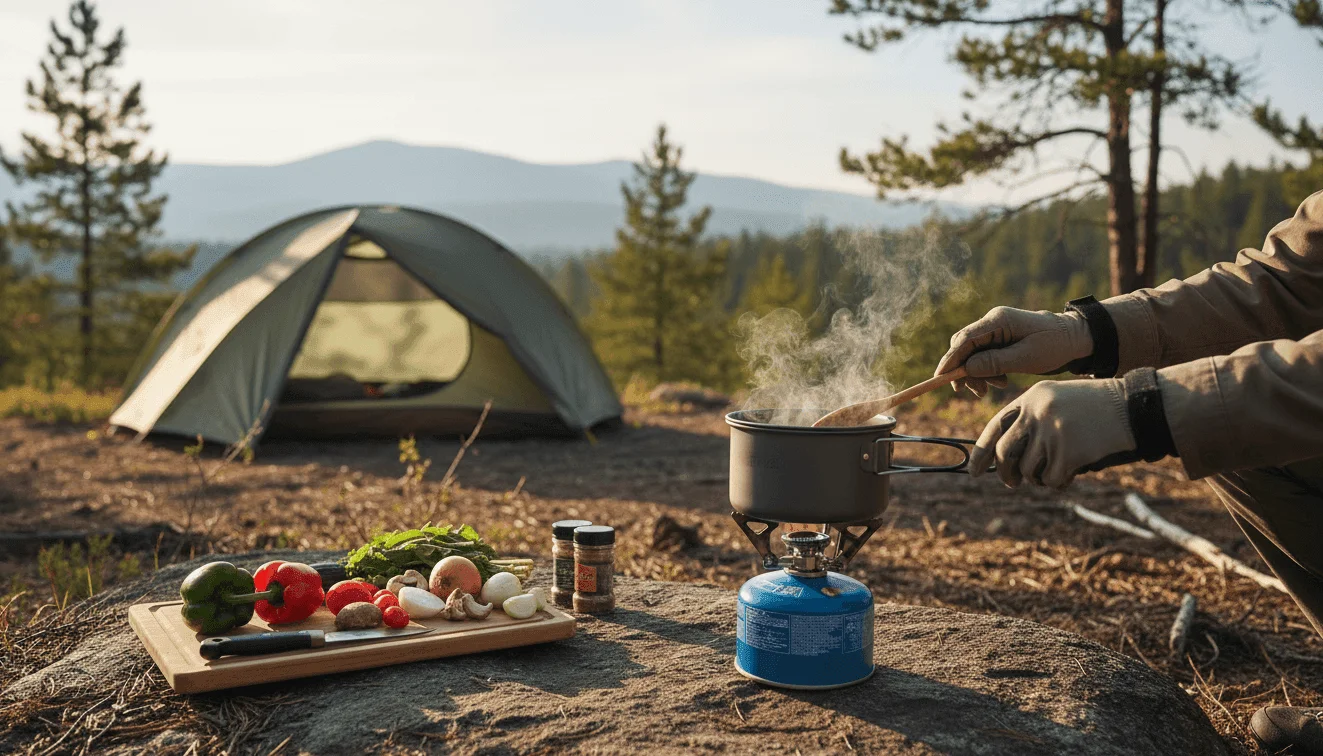
Whether you’re planning a weekend trip into forests, a demanding mountain traverse, or just a relaxing day by the water, a reliable stove is the cornerstone of your camp kitchen. A hot meal and a warm drink can work wonders after a long day – they boost your energy, warm you up, and lift your spirits. In this complete guide, we’ll dive into the world of outdoor stoves to help you choose the best one for your needs.
Why is a stove better and safer than an open fire?
The romance of a crackling campfire is undeniable, but in practice a dedicated stove is often the smarter choice. It’s faster, more compact, and you can control the flame easily and safely. It’s also more nature-friendly, doesn’t leave behind a fire scar, and its use usually isn’t restricted by fire bans that apply in most protected areas.
Did you know a modern gas stove can boil a liter of water in under 3 minutes, while on an open fire it can take several times longer and you’ll burn through much more fuel?
Types of outdoor stoves by fuel
Fuel is the heart of every stove and its type determines key features – from output and ease of use to reliability in harsh conditions. Let’s take a closer look at each category.
Gas stoves
Gas stoves are by far the most popular and widespread option. Their appeal lies in maximum simplicity and clean operation. Just screw the burner onto the gas canister, turn the valve, spark it, and within seconds you have a powerful, easily adjustable flame. The fuel is a propane–butane mix (sometimes with isobutane added for better cold-weather performance), which burns cleanly and without odor.
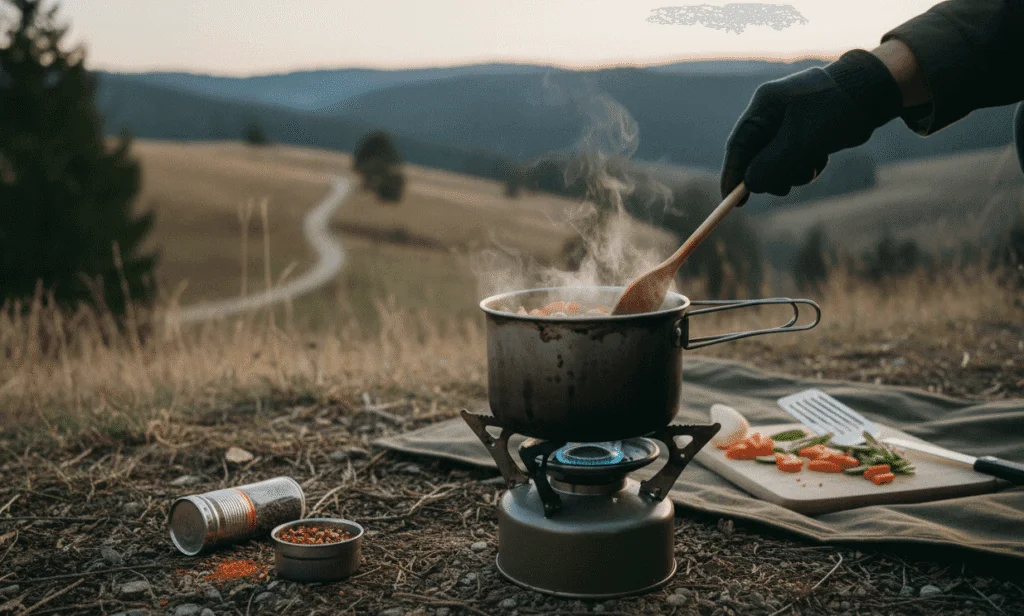
There are two main canister types. Screw-on (threaded) canisters are the standard for most backpacking stoves and you can disconnect and reconnect them at any time, which makes packing easier. They’re widely available from many mutually compatible brands. In contrast, pierceable canisters are a cheaper option that you cannot remove from the stove once attached until they’re completely empty. They’re better suited to car camping, where you don’t need to pack the stove away often.
Gas stoves are an ideal choice for beginners, weekend hikers, and anyone who wants maximum comfort, speed, and zero maintenance.
| Advantages | Disadvantages |
|---|---|
| Very easy and fast to use | Lower performance in freezing temperatures and at high altitude |
| Excellent, smooth flame control | Hard to tell how much fuel is left |
| Clean burning with no soot or smell | Empty canisters are a burden on the environment |
| High safety and reliability | Canisters may be hard to find in remote parts of the world |
Liquid-fuel (white gas) stoves
Liquid-fuel stoves are the workhorses for the toughest conditions. They’re the go-to choice for mountaineers, winter campers, and travelers heading into remote areas. The system is more complex: you first pressurize the fuel bottle with a pump. The pressure pushes liquid fuel (white gas, kerosene, or even diesel) into the generator tube, where the heat of the flame vaporizes it. Only this fuel vapor then burns. The process requires a short preheat, but in return you get outstanding power that doesn’t drop off even in severe cold or thin high-altitude air.
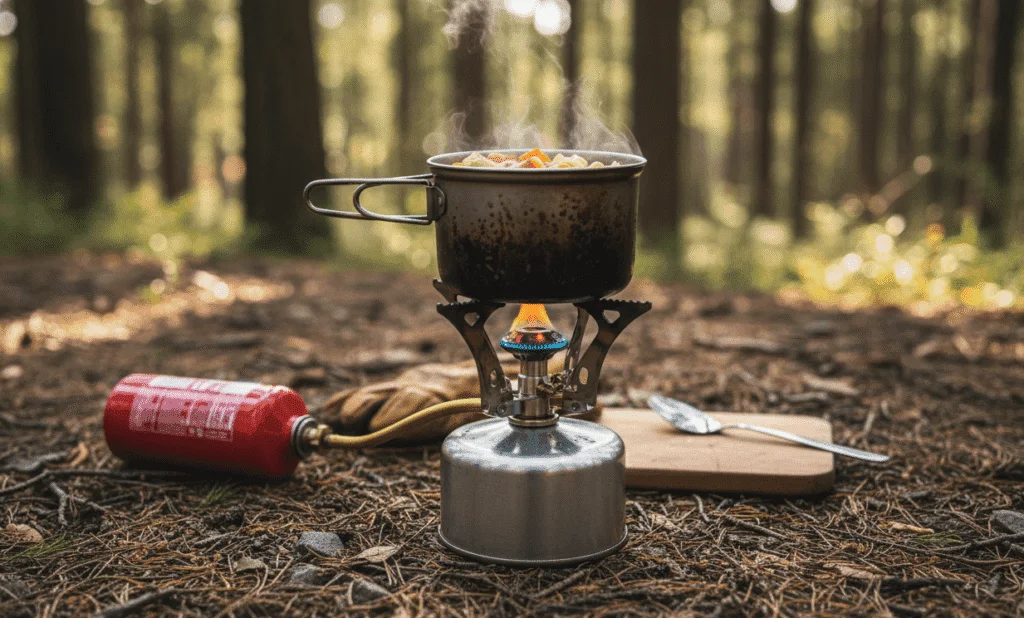
They’re ideal for demanding users who need absolute reliability in extreme conditions and value low running costs and globally available fuel.
| Advantages | Disadvantages |
|---|---|
| Excellent, stable performance in freezing temperatures and at high altitude | Requires regular maintenance and jet cleaning |
| Very low running costs (liquid fuel is cheaper than gas) | Noisier and more complex to use (pumping, preheating) |
| Fuel (white gas) is available almost worldwide | Higher purchase price of the stove |
| Can burn different types of liquid fuel | Potential for sooty pots and risk of fuel spills |
Solid-fuel stoves (wood-burning “twig” stoves)
Wood-burning twig stoves are a return to basics and embody independence and self-sufficiency. Their design cleverly uses the chimney effect – air is drawn in through lower vents, which boosts combustion and reduces smoke. More advanced models work on a gasifying principle: they have double walls, and preheated air between them mixes with smoke (wood gas) and burns it off in a secondary combustion, creating a very efficient, relatively clean flame.
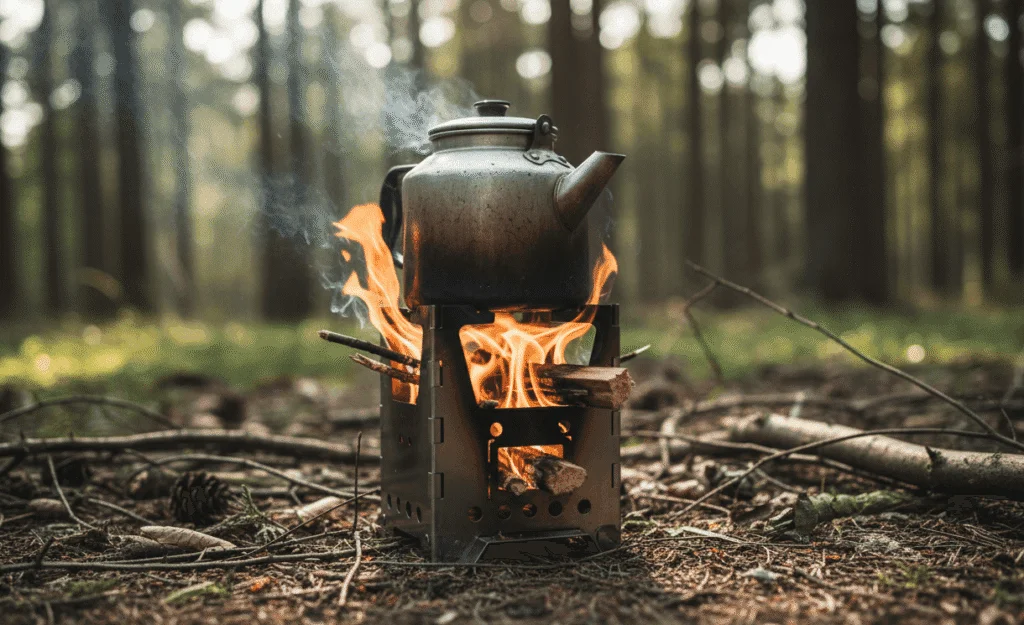
The fuel is anything you can gather in the forest – dry twigs, small branches, cones, or bark. They’re a good fit for bushcraft fans, eco-conscious hikers, and long-distance trekkers who need to be independent of carried fuel.
| Advantages | Disadvantages |
|---|---|
| Fuel is free and available almost everywhere in nature | Dependent on weather (dry wood is hard to find in the rain) |
| Eco-friendly (burning a renewable resource) | Sooty cookware |
| Low weight and excellent packability (some models) | Often banned in periods of drought and in strict protection zones |
| Very reliable (nothing much can break) | Longer cooking times and poor flame control |
Alcohol stoves
Alcohol stoves are synonymous with minimalism and absolute simplicity. They’re basically a small cup (often brass or titanium) that you fill with liquid alcohol (ideally denatured alcohol or bioethanol) and light. The flame is completely silent and dependable, because the stove has no moving parts that could fail. Some models even offer basic flame control with a sliding lid.
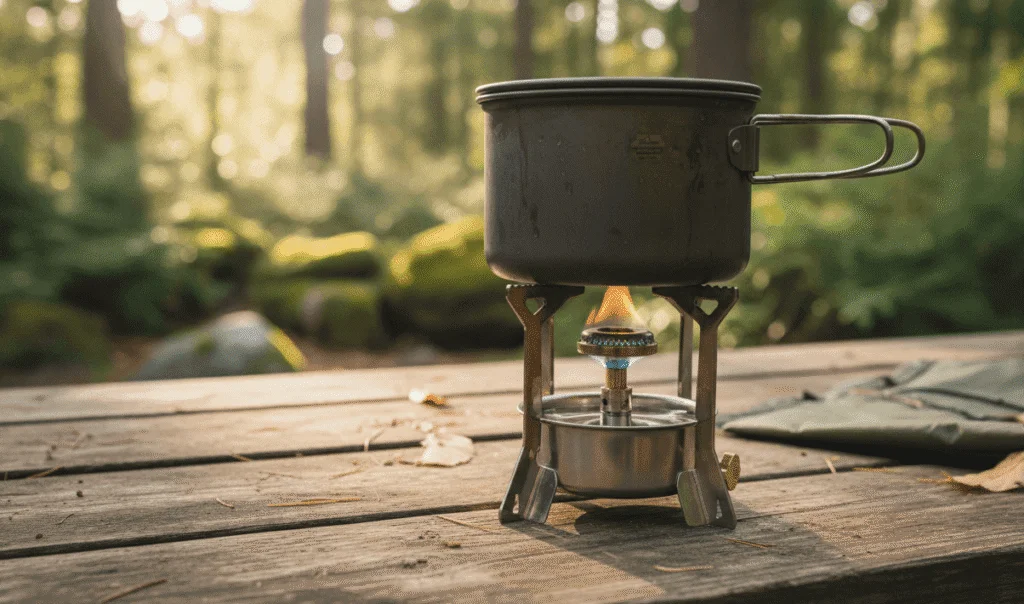
They’re the go-to option for ultralight hikers, minimalists, and stealth campers who care more about low weight (the lightest models weigh just a few grams) and total silence than about boil times.
| Advantages | Disadvantages |
|---|---|
| Extremely low weight and excellent packability | Low output and longer boil times |
| Absolutely silent, reliable operation (no mechanical parts) | Highly sensitive to wind (you need a good windscreen) |
| Very simple design and easy to use | Nearly invisible flame in direct sunlight (burn risk) |
| Fuel is relatively cheap and easy to find | Lower energy density and higher fuel consumption |
Integrated cooking systems
Integrated systems, pioneered by Jetboil, are a small revolution in boiling-water efficiency. Their key is the fixed connection between burner and pot, with a built-in heat exchanger (fins) on the bottom. This exchanger dramatically increases the surface area exposed to the flame and prevents heat from escaping around the sides. The result is extremely fast boil times and very low fuel consumption.
These systems are perfect for climbers, solo hikers, and anyone who mainly rehydrates freeze-dried meals and needs to boil water as quickly and efficiently as possible.
| Advantages | Disadvantages |
|---|---|
| Extremely fast boil times (0.5 l of water in about 100 seconds) | Higher purchase price |
| Very efficient and fuel-saving | Less suitable for regular cooking (e.g. frying), tends to burn food |
| Great wind resistance and stable performance | Bulkier and heavier than minimalist stoves |
| All components pack inside the cooking pot | Limited compatibility with other cookware |
Key parameters when choosing
Once you know the main fuel types, it’s time to focus on the technical details that will determine how happy you’ll be with your stove.
Output and boil time are given in watts (W) and in general, the higher the number, the faster the stove will boil water. Top gas and liquid-fuel stoves reach outputs above 3000 W, which lets you boil a liter of water in 3–4 minutes.
Weight and pack size are crucial for backpacking and ultralight trips, where every gram counts. The lightest alcohol stoves weigh under 20 g, titanium gas burners around 50 g. For car camping, weight is basically irrelevant.
Stability and construction are key for safety. Stoves that screw directly onto the canister are taller and less stable. Remote canister models with a hose and their own legs sit lower and offer much better stability for larger pots.
Flame control matters if you want to do more than just boil water – for example, simmer rice or fry food. Smooth, precise flame adjustment is where gas stoves shine. Liquid-fuel and alcohol stoves usually offer much rougher control.
Windscreen is absolutely essential. Wind is the biggest enemy of efficient cooking – it can increase boil times by tens of percent and dramatically raise fuel use. An integrated windscreen or a separate aluminum shield is therefore a must-have.
Ignition method affects comfort. A piezo igniter (a button that creates a spark) is very convenient, but can be unreliable in damp or freezing conditions. Experienced travelers always carry a backup lighter or fire steel, because manual ignition is 100% dependable.
Performance in winter and at altitude is critical for extreme use. As temperature and air pressure drop, gas stoves lose power. For winter conditions and high mountains, liquid-fuel stoves are by far the most reliable option.
How to choose the right stove for you
There’s no single “best” stove for everyone. It always depends on your specific plans.
For a weekend hiker, the ideal choice is a classic screw-on gas stove. You want simplicity, reliability, and good value for money. It’s light, compact, and completely hassle-free to use.
For a minimalist or ultralight backpacker, every gram matters. This is where a titanium alcohol stove shines, ideally paired with an ultralight titanium mug and a windscreen. A tiny gas burner is a solid alternative.
For family car camping, weight and size are not a priority. You need stability for large pots, plenty of power, and safety. A two-burner camping stove on a large propane–butane cylinder or a stable hose-fed gas stove will serve you very well.
For climbers and winter expeditions, reliability in extreme cold and at high altitude is absolutely crucial. The only real choice is a liquid-fuel (multi-fuel) stove that won’t let you down. As a fast water boiler, an integrated system like the MSR Reactor is a good backup.
Practical tips: use and maintenance
Safety first is non-negotiable. Always handle fuel well away from open flames. Never leave fuel bottles or canisters in direct sunlight. Cook on a flat, stable surface and never leave a lit stove unattended.
Proper cleaning and maintenance will extend your stove’s lifespan. Gas and alcohol stoves are almost maintenance-free. Liquid-fuel stoves need regular jet and fuel-line cleaning according to the manufacturer’s instructions to prevent clogging.
Tips for efficient cooking will save you both fuel and time. Always use a lid – you can save up to 30% fuel. Cook in a sheltered spot. Use pots with as wide a base as possible. For pasta, you only need to bring the water to a boil, then take the pot off the stove and let the pasta finish under the lid.
When to repair a stove and when to buy a new one? With branded stoves (MSR, Primus), a wide range of spare parts is usually available, so repair is often worth it. With cheap no-name stoves, it may be simpler and safer to replace them.
Most popular brands and manufacturers
MSR (Mountain Safety Research) is a legendary American brand known for innovation and extremely reliable liquid-fuel stoves (WhisperLite, XGK) and top integrated systems (Reactor).
Jetboil specializes in integrated cooking systems and is practically synonymous with them. Their stoves are built for maximum speed and fuel efficiency when boiling water.
Primus is a Swedish brand with roots going back to 1892. It offers a wide range of high-quality, dependable stoves for all types of users, from gas to multi-fuel models.
Pinguin is a Czech brand focused on excellent value for money. Their gas stoves are a popular choice among everyday hikers.
Coleman is a traditional American manufacturer focused mainly on camping and family outdoor gear. Their stoves are robust and powerful.
Price: how much should you spend on a stove?
Entry-level stoves (up to $40) include simple screw-on gas burners, alcohol stoves, and basic twig stoves. They’re perfectly adequate for occasional weekend use.
Mid-range stoves ($40 – $100) are the sweet spot for most users. In this bracket you’ll find quality, reliable gas stoves from established brands, often with piezo ignition, plus basic integrated systems.
Premium and expedition stoves (over $100) are aimed at people who take their adventures seriously or are heading into demanding conditions. Here you’ll find top-tier liquid-fuel stoves, ultralight titanium models, and the most powerful integrated systems.
Summary and final tip
Choosing the right stove isn’t rocket science, but it does take some thought. The most important step is to be clear about where, when, and how often you’ll use it. For most hikers, a quality gas stove will be the best choice, offering the ideal balance of comfort, performance, and price. Remember, the most expensive stove isn’t always the best one for you. A reliable stove is an investment in comfort and great experiences on your trips.
Whichever stove you choose, we wish you plenty of great meals and memorable moments outdoors.
Frequently asked questions (FAQ)
Can I take a gas canister on a plane?
No, absolutely not. Gas canisters, like other liquid and gaseous fuels, are considered dangerous goods and are strictly banned in both carry-on and checked baggage. A stove (burner) without fuel usually passes security, but it’s always best to check the specific airline’s rules. You’ll need to buy the canister at your destination.
What’s better: an integrated system or a separate stove and mess kit?
It depends on what you want to do. If your priority is to boil water for dehydrated meals as quickly and efficiently as possible, an integrated system (e.g. Jetboil) is the clear winner. But if you plan more “creative” cooking – frying, simmering, or cooking for several people – a separate stove and classic mess kit will give you more flexibility, stability, and better flame control.
How do I know how much fuel to take on a multi-day trek?
It’s hard to estimate precisely, because consumption depends on temperature, wind, altitude, and what you’re cooking. A good starting point is a rule of thumb based on real use: for one person on a weekend trip (2 days), count on roughly 20–30 grams of gas per day (for heating water for breakfast and dinner). For two people, it’s usually around 40–50 grams per day. The best approach is to test it at home: weigh a full canister, boil a liter of water, then weigh the canister again. That way you’ll get a realistic idea of how much fuel your specific stove uses.
Kategorie: