French Polynesia: A Complete Guide to the Timeless Paradise of the Pacific Ocean
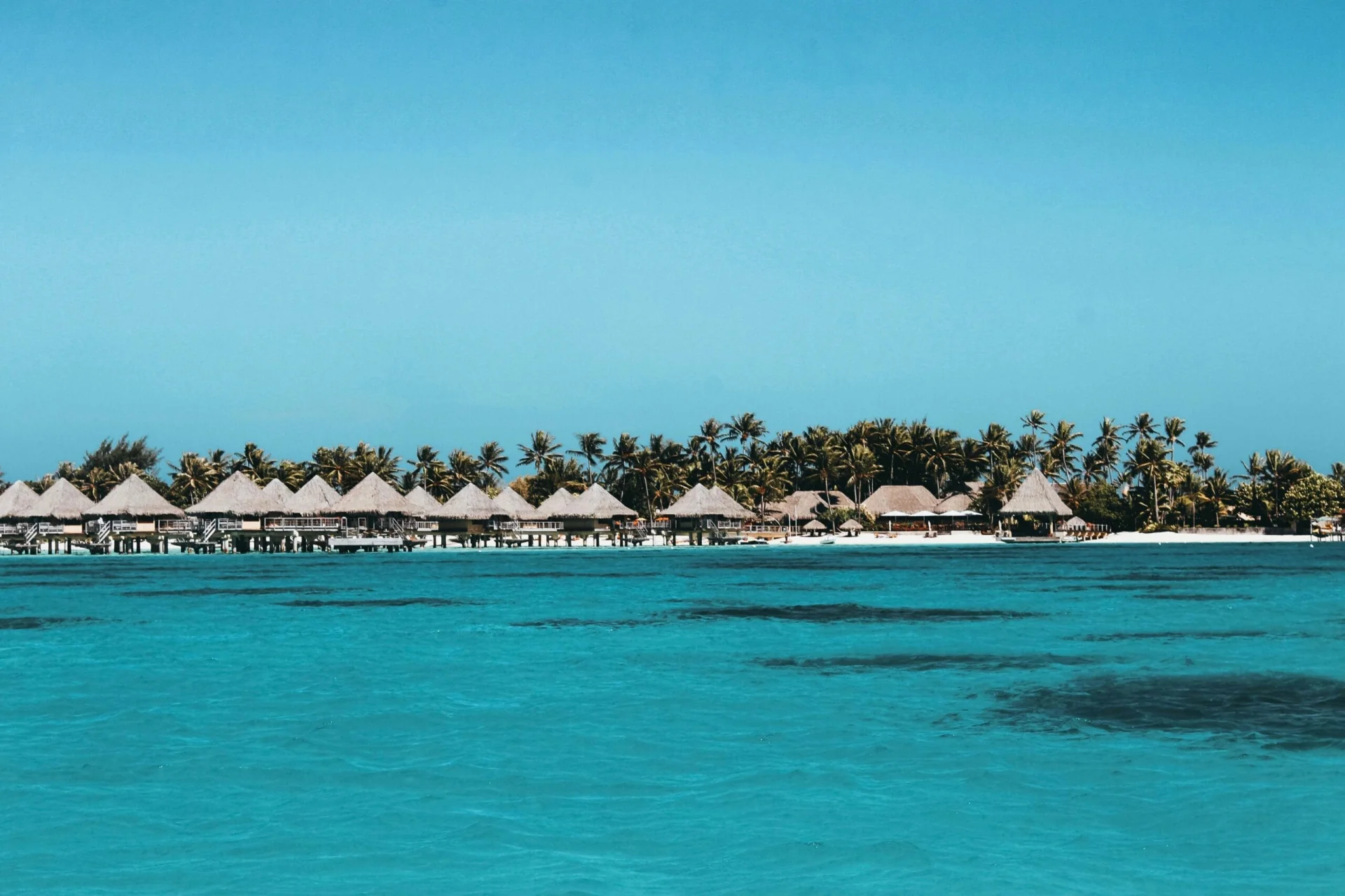
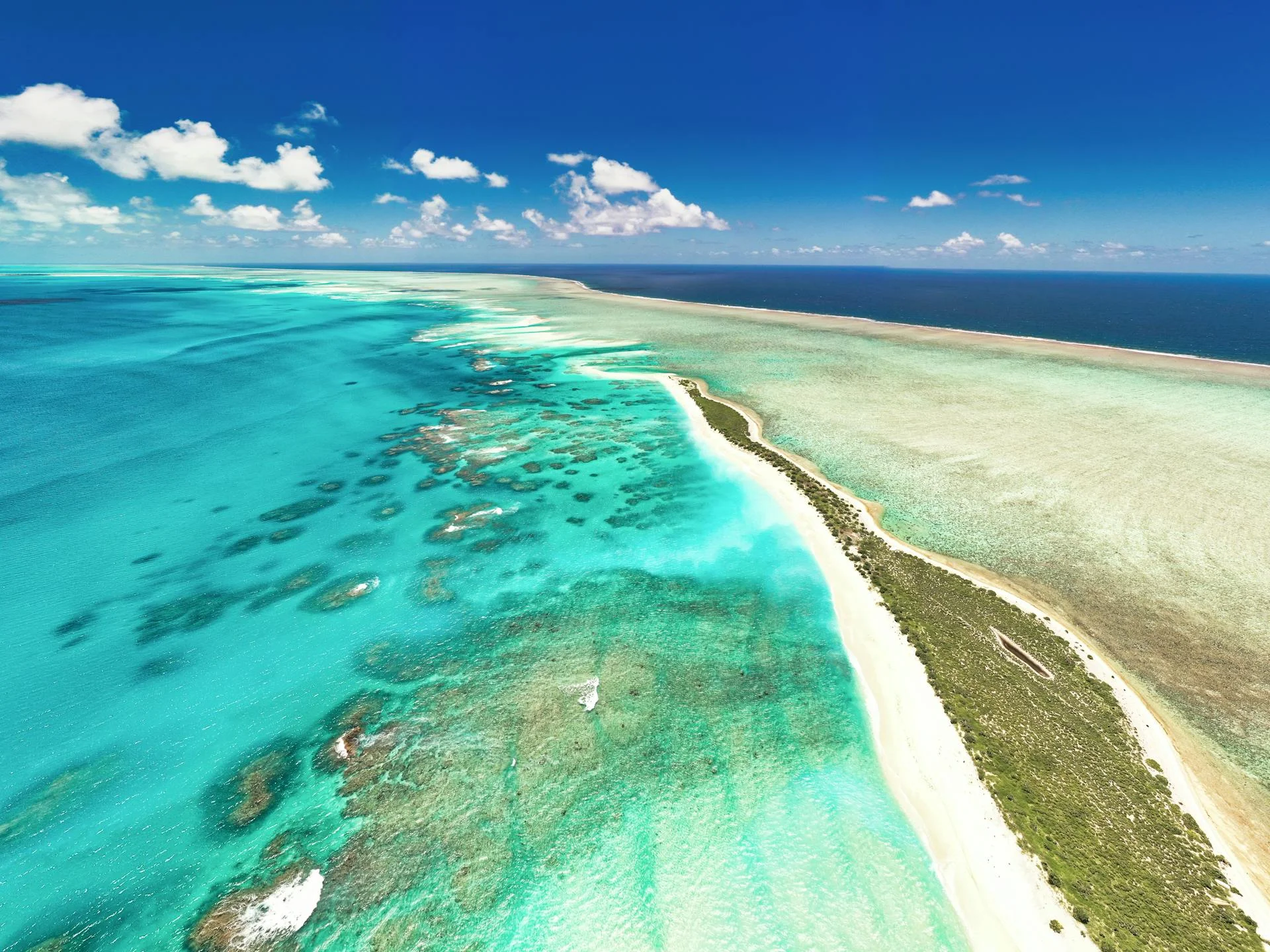
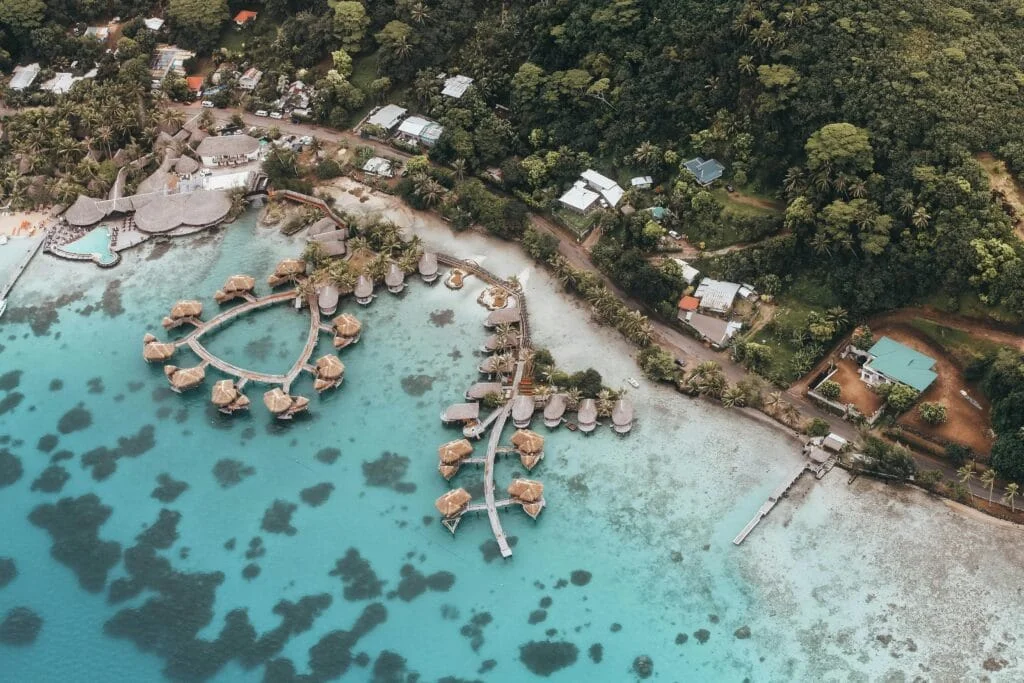
French Polynesia, a land of 118 islands scattered across an area as large as Europe, is one of the most remote and magical places on Earth. This “last inhabited part of the planet” stretches across the Southern Hemisphere in the Pacific Ocean and is the very definition of a tropical paradise – a place where turquoise lagoons meet white-sand beaches, lush greenery surrounds ancient Polynesian temples, and luxury overwater resorts on stilts welcome travelers from all over the world.
The fascinating history of French Polynesia
French Polynesia has one of the most captivating histories in the entire Pacific. It is home to some of the last discovered islands on the planet, which makes its past a story of extraordinary human resilience and navigation skills. The first settlers arrived around 200 BC, when Austronesians – exceptional seafarers from Southeast Asia and Oceania – set out on an unprecedented journey across the Pacific in search of new homelands. Equipped with only basic tools but driven by unwavering determination, they discovered the Marquesas Islands, which became the first inhabited area and later a starting point from which Polynesian civilization spread to every corner of the South Pacific. These ancient people built one of the most remarkable maritime cultures in the world.
A turning point in the islands’ history came when Fernão de Magalhães appeared in 1521, becoming the first European to sight Polynesian shores. Although he did not stop, he opened the door to gradual European colonization. Other explorers followed in his wake – in 1767 the British sailor Samuel Wallis, followed by Louis-Antoine de Bougainville in 1768, who named the islands “New Cythera” because of their beauty and the local women. The islands slowly drew more European attention, but the real transformation began with the arrival of French Catholic missionaries. In 1834 the first French Catholic missions reached Polynesia, and although they were expelled after two years, France sent a warship and in 1842 declared a French protectorate over Tahiti and the island of Tahuata.
The colonial era lasted a long time and left a deep mark on local culture and society. In 1880 French Polynesia officially became a French colony, and in 1888 France claimed the entire archipelago, which sparked a series of uprisings by the indigenous population against colonial rule. World War II brought a new chapter – the islands became part of Free France and many local men were called up to fight. After the war, the archipelago was transformed into a French overseas collectivity, a status it still holds today, with French Polynesia remaining part of the European Union. This historical background is essential for understanding modern Polynesia – it is a legacy of colonization reshaped into a unique blend of Western and Polynesian culture.
Location, geography and climate
Location and geographical facts
French Polynesia lies in the Southern Hemisphere within the tropical zone and stretches across an incredible distance of roughly 2,000 kilometers from west to east and 2,400 kilometers from north to south. The total land area of the archipelago is about 4,198 square kilometers, but the islands are scattered across an ocean area larger than the whole of Europe – over 4 million square kilometers. This huge spread between the islands is one of the reasons why the local culture is so diverse and why island-hopping here calls for careful planning. The closest neighbors of French Polynesia are the Cook Islands about 350 kilometers to the west, Kiribati roughly 430 kilometers to the northeast, and the Pitcairn Islands around 370 kilometers to the east.
The geography of French Polynesia is highly varied and fascinating – you’ll find two completely different types of islands. Most of the archipelago is made up of coral atolls – flat, low-lying islands that sit just above sea level, with central lagoons surrounded by coral reefs. These atolls are unique in that when you walk inland from the beach, you often reach water again after just a few hundred meters. At the other end of the spectrum are the volcanic islands with dramatic mountain scenery – peaks rising more than a thousand meters above the sea. The highest mountain in all of Polynesia is Mount Orohena on the island of Tahiti, reaching 2,241 meters.
French Polynesia is divided into five main island groups. First are the Society Islands (Îles de la Société), the best-known and most visited – they include mountainous volcanic islands such as Tahiti, Moorea, Bora Bora, Huahine, Raiatea and Tahaa. Second are the Tuamotu Islands, the largest Polynesian archipelago made up of hundreds of small atolls spread across a vast area of the ocean. The third group is the Marquesas Islands (Îles Marquises), located close to the equator and known for their steep, towering mountains and deep valleys. The fourth group is the Gambier Islands, formed by fourteen small volcanic islets lying far to the south. The fifth and final group is the Austral Islands (Îles Australes), consisting of five rugged volcanic islands such as Rurutu, Tubuai and Raivavae.
Climate and weather for travelers
French Polynesia has a tropical climate all year round with average temperatures of around 25–31 °C. The water surrounding the islands is consistently warm – on average 26–28 °C, which makes it perfect for swimming and water sports in any season. One of the key features of the Polynesian climate are the trade winds – strong winds blowing from the northeast to the southeast, reaching speeds of 40–60 kilometers per hour, which significantly shape the weather throughout the year. These winds act like natural air conditioning and help take the edge off the tropical heat.
Polynesia is defined by two main seasons – dry and rainy. The dry season runs from May to October – this is winter in the Southern Hemisphere. During these months, average daytime temperatures sit at around 25 °C, night temperatures drop to about 20 °C, and rainfall is minimal, often not exceeding 70 millimeters per month. August is the driest month, with an average of just 48 millimeters of rain. In contrast, the rainy season lasts from November to April – summer in the Southern Hemisphere. During this period, temperatures are around 28 °C and the rain is much heavier. December and January are among the wettest months, with 250–300 millimeters of rainfall, while the capital Papeete on Tahiti records an average of 335 millimeters in January.
It is important to note that French Polynesia lies on the edge of the hurricane belt; storms can occur between November and March. However, hurricanes rarely hit Polynesia, and when they do, they are usually less intense. At the same time, all the islands enjoy more than 3,000 hours of sunshine per year, which is quite remarkable – there are more sunny days here than in many other tropical destinations.
| Month | Daytime temperature (°C) | Nighttime temperature (°C) | Sea temperature (°C) | Rainfall (mm) | Characteristics |
|---|---|---|---|---|---|
| January | 29 | 25 | 28 | 300 | Warm, very rainy |
| February | 29 | 25 | 28 | 280 | Warm, rainy |
| March | 29 | 24 | 28 | 250 | Warm, still rainy |
| April | 28 | 23 | 27 | 200 | Warm, less rain |
| May | 27 | 22 | 27 | 120 | Mild, start of the dry season |
| June | 26 | 21 | 26 | 100 | Cooler, dry |
| July | 26 | 20 | 26 | 80 | Most beautiful time of year |
| August | 26 | 20 | 26 | 48 | Driest month |
| September | 27 | 21 | 26 | 70 | Pleasant, dry |
| October | 28 | 22 | 27 | 120 | End of the dry season |
| November | 29 | 24 | 27 | 150 | Warm, start of the rainy season |
| December | 29 | 24 | 28 | 270 | Warm, start of the hot season |
Regions and types of destinations: Your travel map
Society Islands (Îles de la Société): The heart of Polynesia
The Society Islands are the best-known and most visited region of French Polynesia, and it’s no surprise – they include some of the most important and most beautiful places in the entire archipelago. This region is divided into two parts: the Windward Islands (Îles du Vent) and the Leeward Islands (Îles Sous-le-Vent).
Tahiti is the largest and most populated island in Polynesia, with an area of roughly 1,042 square kilometers and a population of about 180,000 people. The island has a distinctive figure-eight shape – two mountainous parts connected by a narrow isthmus. The highest peak, Mount Orohena, reaches almost 2,241 meters and beautiful Polynesian legends are tied to its summit. For most travelers, Tahiti is the main gateway to Polynesia, as it is home to Tahiti Faa'a International Airport – the only international airport in Polynesia.
Papeete, the capital of Polynesia, is located on Tahiti and is a lively urban hub with more than 30,000 residents. Although it’s not a classic beach resort – the beaches aren’t ideal and some have black sand due to their volcanic origin – the city has huge charm and rich culture. The famous Polynesian market Marché de Papeete is a colourful, fragrant place where you can buy everything from fresh daily catches and tropical fruit to handmade art. In the city centre you’ll find the Notre Dame Cathedral with its modest yet dignified architecture, and the beautiful Paofai Protestant Church, painted in an unusual pink-and-white colour scheme. The harbour in Papeete is one of the most luxurious in the Pacific, with some of the world’s most spectacular yachts and cruise ships moored here.
On Tahiti, it’s well worth visiting the Fautaua Valley, which leads through tropical jungle beneath 2,000-metre-high volcanoes to a dramatic waterfall, where you can swim in a cool natural pool. The village of Punaauia, not far from the capital, is home to the Museum of Tahiti and Its Islands, offering a fascinating insight into the history and culture of Polynesian peoples, as well as Lagunária, an aquarium showcasing local flora and fauna.
Moorea lies just 17 kilometres from Tahiti, and the flight between the two islands is one of the shortest in the world – it takes only five minutes. Even though Moorea is so close to Tahiti, the atmosphere is completely different – it’s calmer, greener, and easier on the wallet. The island has a distinctive heart shape, formed by its two volcanic peaks. Moorea is best known for its peaceful vibe, natural beauty, and excellent diving conditions.
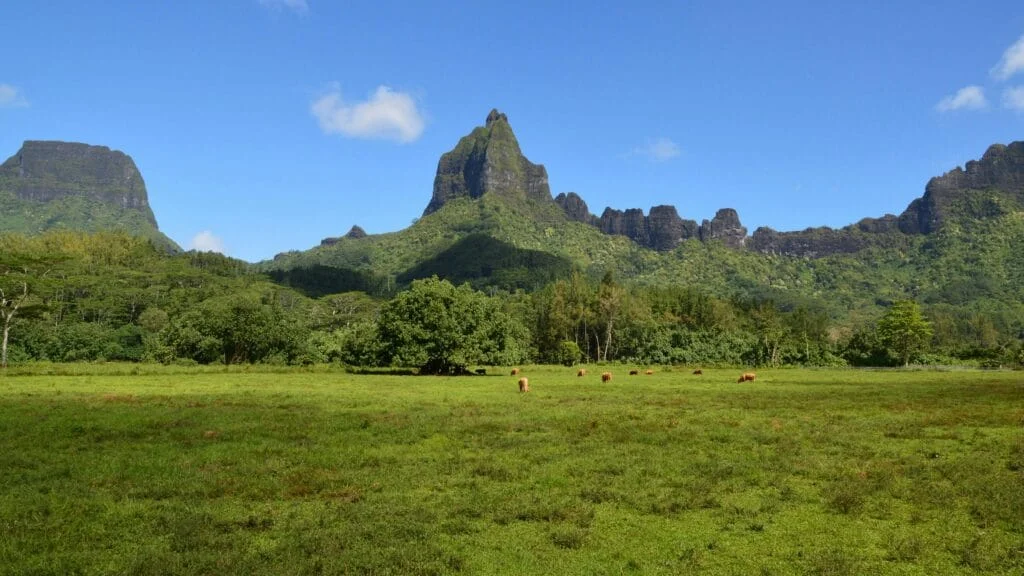
Temae Beach on the east coast is said to be the widest beach in all of Polynesia and is a popular spot for snorkelling. The Belvédère lookout sits in the heart of the island and offers breathtaking views of towering mountains, lush forests, and two stunning sea bays: Cook’s Bay and Opunohu Bay. Both bays are full of vibrant marine life and are favourites among divers. On Moorea, it’s worth tackling the trek to Mount Moua Puta. It calls for solid fitness, but you’ll be rewarded with a spectacular view and the chance to cool off in local waterfalls.
Bora Bora is arguably the most iconic island in Polynesia and regularly ranks at the top of lists of the most beautiful places in the world. In Tahitian, the name Bora Bora means “firstborn”, which likely refers to the island emerging above the ocean surface after a volcanic eruption five million years ago. Today, the island is slowly sinking back into the sea – from the original circular crater, only a half-moon and two dramatic peaks still rise above the water. The rest has been swallowed by the lagoon.
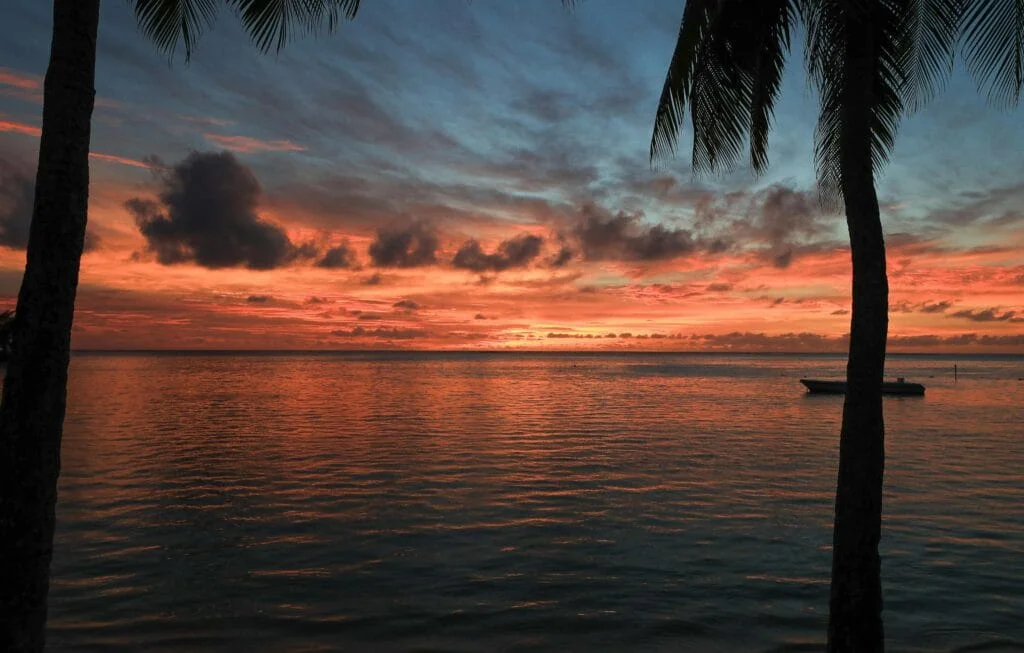
Bora Bora is surrounded by a coral reef that shields the island from the wild depths of the open ocean. The line between “hell” (the deep ocean with crashing waves) and “paradise” (the warm, shallow, blue lagoon) is surprisingly thin – just two to ten meters. Matira Beach on the southern side of the island is often called one of the most beautiful beaches in the world – CNN ranked it eighth in a global poll. The beach is about 1.5 kilometers long, covered in fine white sand and framed by turquoise water. It’s especially famous for its sunsets at Matira Beach, when the sky turns shades of orange, pink, and purple.
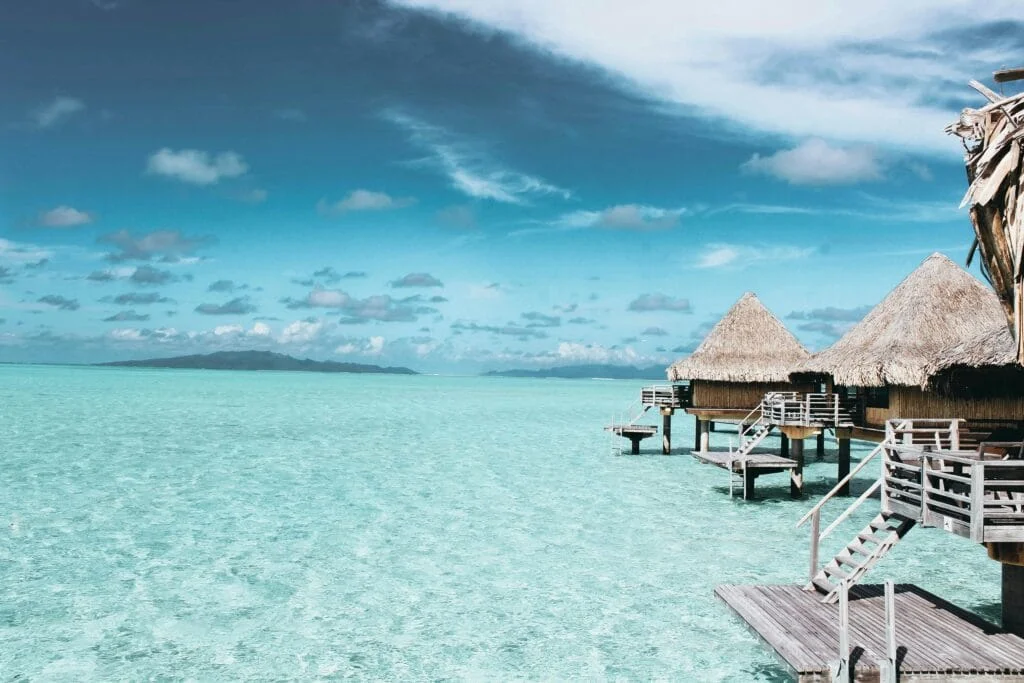
Bora Bora is also the most expensive destination in Polynesia – accommodation here can cost up to thousands of dollars per night in luxury overwater bungalows. There are, however, more affordable options too, from guesthouses to campsites. The island is ideal for travelers looking for the perfect mix of high-end comfort and raw natural beauty.
Huahine is made up of two distinct islets separated by a narrow channel. The larger Huahine Nui is more developed and lively, but also noisier. The smaller Huahine Iti, on the other hand, is almost uninhabited and showcases untouched Polynesian nature at its best. Huahine is home to Marae Maeva, the largest and best-preserved ceremonial site in Polynesia – ancient Polynesian temples with deep history and strong spiritual energy. The island is also known for its sacred blue-eyed eels, which locals have traditionally fed for generations.
Raiatea is one of the most sacred places in Polynesian culture. For thousands of years, it was the center of Polynesian spirituality and migration. From Raiatea, the great wave of Polynesian settlement spread across the South Pacific. The island is home to Marae Taputapuātea – the most important Polynesian ceremonial site in the entire archipelago – which has been recognized as a UNESCO World Heritage Site. Raiatea shares the same surrounding lagoon as its neighboring island.
Tahaa is a very sparsely populated island with fewer than 5,000 inhabitants, encircled by a stunning lagoon. The whole island is widely known as the vanilla-growing capital of Polynesia – if you want to see vanilla plants growing, breathe in their scent, and experience their rich aroma, Tahaa is where it all comes to life. The island is also a hub for cultivating black Tahitian pearls – the famous pearl farms are scattered throughout the lagoons around Tahaa.
Tuamotu Atolls: Wonders of Coral Reefs
The Tuamotu Islands (Îles Tuamotu) form the largest Polynesian archipelago, spread across a vast stretch of ocean covering more than 4 million square kilometers. Within this area lie hundreds of small coral atolls, grouped into several smaller clusters. The Tuamotu atolls are defined by their low-lying coral rings with central lagoons, offering some of the best diving conditions anywhere in the world.
Rangiroa is the second-largest atoll on the planet (after Aldabra Atoll in the Seychelles) and is home to some of the most famous dive sites. The coral reefs here rank among the clearest and best preserved in the world. The Tiputa Pass, which links the lagoon with the open ocean, is a legendary dive spot packed with fish and marine life.
Fakarava is one of the best-known diving destinations in Polynesia. The nature reserve in the Garuae Pass connects the lagoon with the ocean and is home to schools of fish, rays, sharks, and stunning coral formations. Underwater photographers enjoy incredible conditions for capturing marine life here.
Tikehau is famous for its pink beaches – white sand mixed with pink coral fragments creates a truly surreal effect. The Tikehau lagoon is also home to a huge variety of fish species and other marine life.
Manihi is a major center for Tahitian black pearl farming. You can also visit pearl farms here and learn about the pearl cultivation process. It starts by inserting a foreign object into an oyster, which naturally coats it with layers of nacre, gradually forming a beautiful pearl. The process takes up to 18 months.
The Marquesas Islands: The wild heart of Polynesia
The Marquesas Islands (Îles Marquises) are the wildest and least developed part of Polynesia in terms of tourism. Located close to the equator, they are defined by steep, towering mountains and deep ravines that create a dramatic and often inaccessible landscape. The Marquesas also captivated the famous painter Paul Gauguin, who spent his final years here and created some of his most iconic works.
Nuku Hiva is the largest island in the archipelago and is home to Hatiheu Bay, one of the deepest natural bays in the world. You will also find the Vaipo Waterfall here, a dramatic 350-meter cascade plunging into a lush green valley.
Hiva Oa is famous as the island where Paul Gauguin lived and died. It is home to his Maison du Jouir (House of Pleasure), now a restored museum, as well as his grave in the local cemetery. The island offers beautiful waterfalls and traditional Polynesian culture.
Ua Pou is known for its five volcanic spires rising from the sea like monuments. Ua Huka and Fatu Hiva offer a less developed, more authentic Polynesian way of life.
Gambier Islands: The least-known gem
The Gambier Islands are made up of fourteen small volcanic islands located 1,700 kilometers southeast of Papeete. Their landscape is defined by mountain slopes washed by the sea and wide, curving bays. Their more southerly position brings a cooler climate than on Tahiti.
Mangareva is the largest island in the group and the site of the main village, Rikitea. Here you’ll find the Saint-Michel de Rikitea Cathedral, the oldest Christian cathedral in Polynesia (built in 1848) and at the same time the largest church in Polynesia. The waters around the Gambier Islands are renowned for the exceptional quality of their black Tahitian pearls.
Austral Islands: Quiet beauty on the edge
The Austral Islands (Îles Australes) consist of five rugged volcanic islands: Rurutu, Tubuai, Rimatara, Raivavae, and Rapa. Their landscape is shaped by gentle mountain ridges that do not rise above 300 meters. The climate here is cooler and drier than on Tahiti.
Rurutu is famous because from July to November humpback whales gather here, coming to the Austral Islands to give birth in the clear waters. From the rocky cliffs and ancient caves (once burial sites) you get an ideal vantage point to watch these majestic marine mammals.
Most famous sights and towns
Papeete – The spirit of Polynesia
Papeete is not only the capital of Polynesia, but also the center of its cultural and economic life. The city lies in a beautiful bay on the western side of Tahiti and is home to around 30,000 people. Although it is not a “resort” in the traditional sense – the beaches here are not the most spectacular – it offers an invaluable insight into Polynesian urban culture.
The most important spot is the Marché de Papeete (Papeete market), the true heart of the city. The market spreads through the old marketplace and the surrounding streets and is a bustling, fragrant, colorful place full of life. You can buy everything here – from the freshest daily catch and tropical fruit (mango, papaya, bananas, pineapples) to tiare flowers, vanilla, and traditional handicrafts and artwork. The best time to visit is early in the morning, when the market is at its liveliest and most vibrant.
The Notre Dame Cathedral proudly rises in the city center with its pale facade and conservative architecture. Nearby you’ll find the Paofai Protestant Church, which is very modern and stands out with its unusual pink-and-white color. The Port of Papeete is one of the best-known in the Pacific, and at certain times of the year you can see some of the world’s most luxurious yachts and cruise ships moored here.
Punaauia and cultural treasures
The village of Punaauia lies not far from Papeete and is home to the Museum of Tahiti and Her Islands – the most important museum in Polynesia. Here you can learn all about the history of the islands, their people, traditional cultural practices, and artifacts. The museum offers a deep insight into the Polynesian spirit. Close by is the Lagunárium (Tahiti Lagoonarium), home to various species of local marine life – from colorful fish and rays to small sharks.
In Punaauia you’ll also find the Botanical Garden, home to exotic plants and trees of Polynesia, including banyan trees that painter Gauguin could never get enough of.
Natural beauty and national parks
Mountain landscapes and trails
French Polynesia is not primarily known as a trekking destination, but visitors who set aside time for the mountains are rewarded with stunning scenery. On the islands of Tahiti, Moorea, and the Marquesas you can take many hikes into the mountains, to waterfalls, and up to the peaks. Some of these routes require a guide, especially those in lava tunnels with canyoning sections. The smaller islands are usually accessible without a guide – you can often find your way to viewpoints and summits with beautiful panoramas on your own.
Waterfalls – the heart of the jungle
The Faarumai Waterfalls are among the most famous on the island of Tahiti – three tall waterfalls cascade down through the tropical jungle. The Vaipo Waterfall on the island of Nuku Hiva in the Marquesas is a dramatically high 350 meters and plunges into a lush green valley.
Coral reefs and lagoons
The best known is the coral garden on the island of Moorea – a coral reef covered with Montipora corals that look like flowers. Sharks are often seen here, which is not too worrying, as these feared creatures are in fact surprisingly calm.
Best beaches: From white to pink
Matira Beach, Bora Bora
Matira Beach is rightly considered one of the most beautiful beaches in the world. It stretches for about 1.5 kilometers, is covered with fine white sand, and is surrounded by a turquoise lagoon. The sunsets here are legendary – the sky shifts through shades of orange, pink, and purple.
Temae Beach, Moorea
Temae Beach on the eastern coast of Moorea is the widest beach in Polynesia. It’s perfect for snorkeling and lies in a shallow part of the lagoon filled with colorful fish and coral reefs.
The pink beaches of Tuamotu
Tikehau Atoll and Fakarava Atoll in the Tuamotu archipelago are famous for their pink beaches – white sand naturally mixes with red particles of crushed coral, creating an unreal effect.
The black beaches of Tahiti
On the island of Tahiti, many beaches are black and volcanic in origin – they’re less popular with classic beachgoers, but they offer a more authentic Polynesian experience and tend to be much quieter.
Activities and fun: Between the sky and the deep
Diving and snorkeling
French Polynesia is one of the best diving destinations in the world. In its clear waters, you can enjoy something you simply won’t find in continental Europe – encounters with manta rays, stingrays, several species of sharks, and schools of colorful fish. Moorea offers a site called Tiki, which is very popular thanks to the huge number of fish and excellent shark spotting. Bora Bora has sites such as Tupitipiti with depths from 6 to 45 meters, featuring coral reefs, caves, and dramatic drop-offs.
Surfing
French Polynesia is fantastic for surfing, with consistent, powerful waves. Near the villages of Vairao and Teahupo'o on Tahiti you’ll find some of the fastest waves in the world. From May to November, the best swells hit the north coast of Tahiti; during the rest of the year, they move to the south. Moorea offers a spot called Temae with excellent conditions.
Hiking
On the Marquesas Islands, Tahiti and Moorea you can choose from many hiking routes. The trek to Moua Puta on Moorea is demanding, but it rewards you with stunning views. The Tuauru Valley on Tahiti features burial caves with historical artefacts.
Encountering nature
The chance to watch whales from the rocky cliffs of Rurutu (July to November) is a truly unique experience. The same goes for diving with dolphins off the island of Hiva Oa.
Nightlife and culture
In Papeete and other larger destinations you can enjoy traditional Polynesian dance shows – Polynesian nights in hotels and cultural centres. These performances showcase the traditional otea dance and are often paired with classic local dishes.
Gastronomy and culture
Typical food and drinks
Poisson Cru (in Tahitian also known as Ia Ota) is the national dish of Polynesia and one of the key culinary experiences you really should not miss. It is made from raw fish – usually fresh yellowfin tuna – marinated in lime juice and coconut milk. The mix of these simple ingredients is surprisingly refined and full of flavour. The dish is served with rice and freshly chopped vegetables. It is traditionally prepared for Polynesian ceremonies and is a cornerstone of the local cuisine.
Hima'a is a traditional Polynesian dish cooked wrapped in banana leaves in an earth oven over hot stones. It is an ancient baking technique that Polynesians have used for centuries. A typical hima'a includes chicken fafa (with coconut milk and spinach), fish, lobster, shrimp, bananas, baked goods, taro and yams. Visitors can usually try hima'a during Polynesian evenings in hotels and cultural centres.
Fresh fish and seafood are the backbone of Tahitian cuisine. Every restaurant serves tuna, mahi-mahi, wahoo and bonito, all top quality and very fresh. Specialities include parrotfish, barracuda, octopus and sea urchin. Shrimp (known locally as chevrettes) are also very popular and full of flavour.
Polynesia is a land of abundant fruit. Mango, papaya, bananas, rambutan, grapefruit, pomelo are all easy to find and incredibly tasty. Pineapples from the island of Moorea are small but packed with sweetness and juice. The coconut is known as the “tree of a hundred uses” – it’s used in food, in drinks (coconut water is excellent for rehydration), and also in the traditional monoi oil, made from coconut oil and tiare flowers and used for massage and for skin and hair care.
Hinano is a popular local beer from Tahiti. In bars and restaurants you can order a Mai Tai – a classic tropical cocktail with rum and citrus notes. Tequila Sunrise and other tropical cocktails are also very popular.
Dining tips
Restaurants in Papeete and Bora Bora are usually expensive – a three-course meal for two in a mid-range restaurant costs around $80–$90. In cheaper places you’ll pay about $18–$27 per person. Roulottes – mobile food trucks – are budget-friendly and offer authentic Polynesian and Asian dishes for about $9–$18 per serving. In supermarkets you can buy baguettes for $2–$5 and fresh fruit at good prices.
Cultural customs and festivals
Heiva i Tahiti is the main festival and the biggest celebration in all of Polynesia, held every year in July. The festival lasts for an entire month and culminates with the celebration of France’s national holiday – Bastille Day. Dancers and performers from all Polynesian archipelagos come together on the island of Tahiti to showcase their skills in dance and song. The festivities are a truly spectacular event, often compared to the Rio Carnival in Brazil.
The word Heiva comes from the words “hei” (to gather) and “va” (community places). The festival is therefore a social event that brings together entertainment, singing and dancing. In traditional Polynesian cultures, these elements have always played a key role – they were part of religious and political ceremonies, and dance was one of the most complex and dynamic art forms.
In May, the Tahiti Pearl Regatta takes place, celebrating the black pearls that made the Polynesian lagoons famous. In April, there are commemorative events for the mutiny on the Bounty, combined with a beauty pageant. In September, Papeete hosts a bougainvillea flower festival with a stunning exhibition. In October, there is a carnival featuring a parade of boats decorated with brightly coloured flowers. In November, the Hawaiki Nui Va'a takes place, a very demanding race in special canoes over a distance of 116 kilometres, lasting around 3 days. In December, the Tiare Tahiti Days festival is held, celebrating the national flower, the tiare.
Polynesian music and dance are an essential part of local culture. The traditional dance otea is especially striking for its speed, energy, and dynamism. The music is usually accompanied by traditional drums pahu and tō'ere. The softer dance 'aparima is slow and graceful. Although traditional dances were banned by some missionaries in the past, today they are celebrated and actively supported as an important part of the cultural heritage.
Key practical information for travellers
Currency and payments
The local currency of French Polynesia is the Pacific franc, known as XPF (or CFP). The franc is pegged to the euro and its exchange rate is stable. Coins are available in denominations of 1, 2, 5, 10, 20, 50, and 100 francs, and banknotes in denominations of 500, 1,000, 5,000, and 10,000 francs.
You can exchange Czech crowns before you leave the Czech Republic. If you do not manage to do this, the easiest option is to exchange money at the airport in Papeete, where several exchange offices are available. ATMs can be found in Papeete, some shopping centres, and on a few larger islands, but smaller islands usually do not have ATMs. It is recommended to carry enough cash with you.
Card payments are widely accepted in hotels, shopping centres, and restaurants, and international payment cards including Mastercard and Visa are commonly used. Traveller’s cheques are also accepted. Tipping is not mandatory, but it is appreciated; around 10% of the bill is typical.
French Polynesia is among the more expensive destinations in the Pacific. Here is a rough budget outline for different types of travellers:
- Budget accommodation: hostels from around $32 per person per night
- Mid-range accommodation: two-star hotels from around $108 per night, three-star from about $455
- Luxury accommodation: five-star hotels from around $910 per night
- Food: cheaper eateries $17–26 per person, mid-range restaurants about $78 for a three-course meal for two
- Entrance fees: attractions and tours usually cost $22–87, depending on the type
Entry requirements and visas
Czech citizens do not need a visa for stays of up to 90 days in French Polynesia. A passport is mandatory and must be valid for at least 6 months after your return. It is also recommended to have a return ticket or a ticket onward to another country.
- If you are flying via the USA, you will need a US visa or a valid ESTA registration.
- You should have sufficient funds to cover your stay.
- Health insurance is recommended.
Safety and local customs
French Polynesia is generally a safe destination. Crime rates are higher in the capital Papeete, where it is wise to stay alert, especially at night and in remote neighborhoods, just as you would in any large city. The rest of the archipelago is very safe. There is virtually no danger in nature – there are no venomous snakes, spiders, or large predators in Polynesia.
The islands lie on the edge of the hurricane belt; storms can occur between November and March. Hurricanes rarely hit Polynesia, and when they do, they are usually milder. In nature during the summer (November to March), you should expect more insects, especially in the rainy season.
No vaccinations are mandatory, except for travelers arriving from regions where yellow fever is endemic. Malaria does not occur in Polynesia. Recommended vaccines include hepatitis A and B and typhoid fever. Dengue fever (tropical flu) appears from time to time and is transmitted by mosquitoes.
Healthcare is of a very high standard and comparable to mainland France. On the island of Tahiti, medical services are excellent.
Tap water is safe to drink only in Papeete and on Bora Bora. On the other islands, it’s best to check locally or use bottled or filtered water.
Fauna and flora
Although Polynesia has no large dangerous predators, its marine life is very rich. Rays (especially lemon sharks and grey sharks) are relatively common but not dangerous to people as long as you don’t provoke them. Sharks are widespread here, yet they usually avoid humans. The giant manta ray is the largest living ray species – it can reach a wingspan of up to 9.1 meters, but it is harmless and feeds only on plankton.
Sea turtles (especially the hawksbill turtle) live in shallow lagoons and are critically endangered. Dolphins are also found in Polynesian waters. The clownfish (Nemo) lives in sea anemones and is immune to their stings.
Coconut palms are everywhere and shape the typical landscape. Banyan trees are massive, with branches spreading out like a second tree system. Hibiscus, bougainvillea and tiare are popular ornamental flowers. Vanilla is grown on the island of Tahaa.
Fauna and flora
| Animal/Plant | Description |
|---|---|
| Lemon shark | Smaller shark (~2 meters), common in lagoons, non-aggressive |
| Giant manta ray | Largest ray (~9-meter wingspan), feeds on plankton |
| Clownfish | Small fish (~14 cm), orange with white stripes, lives in anemones |
| Barracuda | Predator, up to 3 meters, amber-colored, widely feared |
| Hawksbill turtle | Sea turtle, critically endangered, ~1 meter |
| Humpback whale | Whale species, can be seen from July to November |
| Coconut palm | Iconic tree of the landscape, the “tree of a hundred uses” |
| Banyan | Huge tree, admired by Gauguin |
| Tiare | National flower, fragrant, white |
Basic French Polynesia Phrasebook
When you travel to Polynesia, it really helps to know a few basic words and phrases. The local language is Tahitian, but people mainly speak French, and in tourist areas you will also hear English. Here is a small collection of useful phrases:
| Czech Phrase | Tahitian / French | English |
|---|---|---|
| Dobrý den | Ia Orana / Bonjour | Hello / Good day |
| Dobrý večer | Ia Orana / Bonsoir | Good evening |
| Děkuji | Māuruuru / Merci | Thank you |
| Děkuji vám mnohokrát | Māuruuru roa / Merci beaucoup | Thank you very much |
| Prosím | — / S'il vous plaît | Please |
| Ano | 'Ē / Oui | Yes |
| Ne | 'Aita / Non | No |
| Není zač / Rádo se stalo | 'Aita pe'ape'a / De rien | You're welcome |
| Jak se máte? | E aha tō 'oe huru? / Comment ça va? | How are you? |
| Jak se jmenujete? | 'O vai tō 'oe i'oa? / Quel est votre nom? | What is your name? |
| Kolik to stojí? | E hia moni? / Combien ça coûte? | How much does it cost? |
| Potřebuji na letiště | — / Je dois aller à l'aéroport | I need to get to the airport |
| Pomoc! | tauturu! / Au secours! | Help! |
| Lékař | Taote / Docteur | Doctor |
Transport and Logistics
How to Get to French Polynesia
The way to Polynesia is mainly by air. The only way to enter Polynesia is via the Tahiti Faa'a International Airport (PPT) on the island of Tahiti, which is also one of the largest airports in Oceania. From Central Europe, the journey takes at least 24 hours, even with the cheapest tickets. Flights usually include one or more layovers – most often in Paris, Los Angeles, San Francisco, or Honolulu.
Airlines that operate flights:
- Air France (from France)
- Air Tahiti Nui (local airline, often the best prices)
- Air New Zealand
- Hawaiian Airlines (from the USA)
- Qantas (from the USA)
Cheaper return flights (around $650–$870) are usually available if you book several months in advance and are willing to connect via the USA. Premium tickets with fewer layovers cost about $1,100–$1,750.
You can also travel by boat – on cruise ships, chartered boats, or your own yacht. However, this option is much slower and more expensive.
Getting around Polynesia
Travel between the islands is mainly by plane. Air Tahiti (the domestic airline, different from Air Tahiti Nui) operates flights between the islands. There is also Air Moana, which flies mainly to the Marquesas (only twice a week). If you plan to visit several islands, it’s a good idea to buy a multi-island air pass, which can save you up to 30% of your costs. Watch out for the baggage weight limit, which is usually lower than on international flights (typically 20 kg).
Typical flight prices:
- Tahiti → Moorea: ~ $110
- Tahiti → Bora Bora: ~ $170
- Tahiti → Marquesas (Nuku Hiva, Hiva Oa): ~ $350–$430
Ferries connect some of the Society Islands. For example, ferries from Tahiti to Moorea run several times a day and the trip takes 30–60 minutes.
Taxis are available, especially on Tahiti and Bora Bora, but they are very expensive. A ride costs around $25 for 5 kilometers. On Bora Bora you can easily pay $35 for 7–8 kilometers. Sometimes you can agree on the price in advance.
Le Truck are colorful older buses that serve as public transport. They run on fixed routes but stop on request. Fares are very cheap – a ride in Papeete costs about $1.30–$2.20. There are no timetables, but buses run very often – you usually wait no more than 20 minutes.
On Tahiti there is also a modern bus network, which is more reliable than Le Truck – you can buy a ticket for 200 XPF from the driver or 150 XPF in the app (you scan a QR code).
On the other islands west of Tahiti there are no public buses, only school buses for children.
On the larger islands (Tahiti, Moorea, Bora Bora), car rental is available. Prices start at around $80 per day (for a small car like a Peugeot 108). Parking is free. Local rules are standard – you drive on the right.
Hitchhiking is fairly safe and quite common here. Locals often stop and give you a ride, sometimes completely free.
Prices and trip budget
French Polynesia is one of the more expensive destinations, but you can travel here on very different budgets.
Budget option (backpackers)
- Accommodation: $130–$200 per night for two people (guesthouses, campsites)
- Food: $18–$35 per day per person (self-catering, roulottes)
- Transport: $2–$9 per day (Le Truck, hitchhiking)
- Activities: $22–$90 (cheaper tours)
- Total for 10 days per person: ~ $1,300–$2,200 (excluding flights)
Mid-range option
- Accommodation: $350–$660 per night (3–4-star hotels)
- Food: $45–$70 per day (restaurants, occasional roulottes)
- Transport: $9–$22 per day (taxis, flights, car rental)
- Activities: $70–$130 (guided tours, diving)
- Total for 10 days per person: ~ $5,300–$8,800 (excluding flights)
Luxury option
- Accommodation: $880–$4,400+ per night (overwater bungalows, 5-star resorts)
- Food: $90–$180 per day (fine-dining restaurants)
- Transport: $45–$90 per day (private taxis, helicopters)
- Activities: $130–$350+ (private tours, yachting)
- Total for 10 days per person: ~ $13,200–$44,000+ (excluding flights)
When it pays to spend more
- Domestic flights: Book in advance to save money.
- Bora Bora: It will be more expensive, but it’s worth it.
- Diving: Courses and guided dives cost more, but the experience is unforgettable.
- Hotel with a view: The price difference is often small, but the experience is huge.
How to plan the perfect trip
By traveler type
If you’re visiting Polynesia for the first time, I recommend the following itinerary:
- Tahiti (2 days): Arrival, Papeete, market, museums
- Moorea (3 days): Belvédère lookout, Temae beach, diving
- Bora Bora (3 days): Matira beach, snorkeling, sunsets
- Tahiti (2 days): Last-minute shopping, relaxation
Total: 10 days
- Tahiti (2 days): Papeete, museums, market
- Moorea (4 days): Beach, snorkeling, nature safari
- Bora Bora (2 days): Matira beach, snorkeling
- Tahiti (2 days): Relaxation, shopping
Total: 10 days (less flying, more downtime)
- Papeete (2 days): Getting to know the local culture
- Moorea (3 days): Trekking, diving, meeting locals
- Bora Bora (2 days): Beach, photography
- Tuamotu (2 days): Diving, nature
- Tahiti (1 day): Departure
Total: 10 days
- Tahiti (1 day): Arrival, Papeete
- Moorea (2 days): Romantic beaches, hiking
- Bora Bora (4 days): Matira Beach, overwater bungalows, romantic dinners
- Tahiti (1 day): Shopping, departure
Total: 8 days
What to watch out for when planning
- Book in advance: It pays to book flights and accommodation early.
- Season: July–August is the most popular time and can be crowded.
- Hurricanes: November–March is hurricane season.
- Passport: Make sure your passport is valid for at least 6 months after your return.
- Time: Count on a time difference of (GMT-10).
Common myths about Polynesia
- Myth: Polynesia is a cheap destination. Truth: It is a fairly expensive destination.
- Myth: All beaches are white. Truth: Some are black with volcanic sand.
- Myth: It is absolutely safe. Truth: Yes, it is safe overall, but Papeete calls for a bit of caution.
- Myth: Sharks are dangerous. Truth: If you follow the rules, encounters with them are safe.
Summary and final tips
French Polynesia is one of the most magical places on Earth, where natural beauty meets Polynesian culture and Western comfort. Whether you go for an active holiday with diving and trekking, a romantic stay on Bora Bora in an overwater bungalow, or a peaceful break surrounded by traditional Polynesian life on the smaller islands, Polynesia will give you experiences you will remember for the rest of your life.
When planning your trip, keep in mind that Polynesia is not just Bora Bora. Although Bora Bora is truly stunning, you should not skip the smaller, more authentic islands like Huahine, Raiatea or the Marquesas, where you can enjoy deeper and more genuine Polynesian experiences. Take time to explore the culture – visit Polynesian festivals, talk to locals, try traditional dishes and learn a few words in Tahitian. These small things turn a holiday into memories that stay with you for life.
The most important tip is: don’t rush. Polynesia is not a place for a quick getaway. Take your time, stay on each island for at least a few days, walk around and soak in the “fenua” – the Polynesian concept of the spirit of the land and the roots of a place. This way, you become part of Polynesia, and Polynesia becomes part of you.
Kategorie: