Panama: A Complete Guide to Discovering Central America’s Gem
Welcome to Panama – one of the most fascinating destinations in Central America, where a cosmopolitan capital, unspoiled nature, and rich history come together. Panama is the perfect choice for travelers looking for an unusual experience that connects continents and oceans. Did you know that there is a place in Panama where you can watch the sun rise over the Pacific Ocean and set over the Atlantic (or more precisely, the Caribbean Sea)? This unique geographic feature perfectly captures what makes Panama so special. This article will walk you through all the regions, activities, and practical tips you need to plan the perfect trip.
History of Panama: From discovery to the modern era
The history of Panama is a story of strategic location and groundbreaking discoveries that changed the way people move around the world. When Christopher Columbus reached the Panamanian coast in 1502 during his fourth voyage, he discovered a route that would become one of the most important in human history. The original inhabitants of the area, especially the Kuna people (also known as Guna), resisted Spanish colonial expansion until the seventeenth century.
The colonial period was crucial for the founding of Panama City. In 1519, its founder Pedrarias Dávila moved the seat of the province of Castilla del Oro to the Pacific coast, where he established Nuestra Señora de la Asunción de Panamá – today’s Panama City. This trade route was incredibly lucrative: gold and silver from Peru and Bolivia, and porcelain and textiles from the Philippines flowed through Panama to Europe. But this prosperity also attracted pirates. The English privateer Francis Drake attacked Nombre de Dios and later, in 1671, the famous pirate Henry Morgan attacked Panama City itself in a raid that lasted nine days and was followed by a month of looting.
After these brutal attacks, the city was moved to a safer location and rebuilt – this area is now known as Casco Viejo (the Old Town) and is protected by massive fortifications.
The road to independence was complicated. In 1821, Panama declared independence and joined Bolívar’s project of Gran Colombia. However, this union eventually fell apart. Throughout the 19th century, Panamanians pushed for autonomy, but political conflicts held them back. The turning point came in 1903, when Panama, with support from the United States, secured its separation from Colombia. That same year, a treaty was signed to build the Panama Canal, a landmark project that shaped modern Panama.
The Panama Canal, built between 1904 and 1914, transformed global trade and is recognized as one of the seven modern wonders of the world. Today, it remains at the heart of Panama’s economy and national identity.
Location, geography, and climate
Location and geography
Panama is located in the southern part of Central America and forms a natural bridge between North and South America. The country borders Costa Rica to the northwest and Colombia to the southeast, and is surrounded by the Caribbean Sea to the north and the Pacific Ocean to the south. With an area of roughly 75,417 square kilometers and a width of just 48 kilometers at its narrowest point, Panama is one of the smallest countries in the Americas, yet geographically one of the most important.
The terrain of Panama is primarily mountainous and covered in dense rainforest. Several mountain ranges run through the country, including the Talamanca Range in the west. Barú Volcano, an active stratovolcano with an elevation of 3,475 meters, is the highest peak in the country and lies close to the Costa Rican border. Although the volcano is considered dormant, its past volcanic activity has significantly enriched the soil and makes it possible to grow Panama’s famous coffee here.
Elsewhere, Panama’s landscape is shaped by rivers, wetlands, and mangroves along the coast, especially in the northern Caribbean region. The Darién region in the southeast is one of the most biodiverse areas on the planet and marks the exact point where the wildlife and plant life of North and South America meet. Beyond the mainland, Panama is rich in islands: the famous San Blas Islands (Guna Yala) on the Caribbean side include more than 300 islands, only 49 of which are inhabited, while Bocas del Toro in the northwest is another major archipelago.
Climate and weather for travelers
Panama has a tropical climate with high temperatures and high humidity all year round. One of the most surprising facts is that Panama lies just 622 kilometers from the equator, roughly between 7° and 10° north latitude. Thanks to this proximity to the equator, the length of day and night hardly changes – both stay at around 12 hours throughout the year.
Panama can be divided into two main seasons: the dry season (also called “verano,” or summer) which runs roughly from January to May, and the rainy season (also called “invierno,” or winter) from May to December. Although the names refer to summer and winter, in reality it’s more about a split between drier and wetter months. During the dry season, average daytime temperatures hover around 29–32 °C, with lower humidity and mostly pleasant weather. The dry season is the best time to visit for most activities, from beaches and mountains to city sightseeing.
During the rainy season, average temperatures drop only slightly (to about 28–29 °C), but humidity rises to 80–82% and almost daily showers are common. Even in the rainy season, though, it doesn’t rain nonstop – it usually rains in the late afternoon and at night, while mornings are often beautiful. This time of year has its own charm: the landscape is lush and green, there are fewer tourists, and prices tend to be lower.
In the Talamanca Range on the Costa Rican border and in higher elevations such as Boquete (around 1,200 meters), the climate can be noticeably cooler – average temperatures range between 16–27 °C. It can feel like autumn here, making it an ideal escape from the heat of the lowlands.
| Month | Average daytime temperature (°C) | Average night-time temperature (°C) | Sea temperature (°C) | Note |
|---|---|---|---|---|
| January | 30 | 23 | 27 | Dry season, excellent weather |
| February | 31 | 23 | 26 | Driest month, perfect for the beach |
| March | 31 | 24 | 25 | Dry season continues |
| April | 32 | 24 | 26 | Transition to the rainy season |
| May | 31 | 24 | 28 | Start of the rainy season |
| June | 29 | 23 | 29 | Rainy weather |
| July | 30 | 23 | 28 | Rainy season, hot and humid |
| August | 29 | 23 | 28 | Rainfall continues |
| September | 29 | 23 | 28 | Very humid, wettest months |
| October | 29 | 22 | 28 | Rainy season |
| November | 28 | 22 | 28 | Rainfall still ongoing |
| December | 29 | 22 | 28 | End of the rains, return to dry weather |
Regions and types of destinations
Panama City: A metropolis where worlds meet
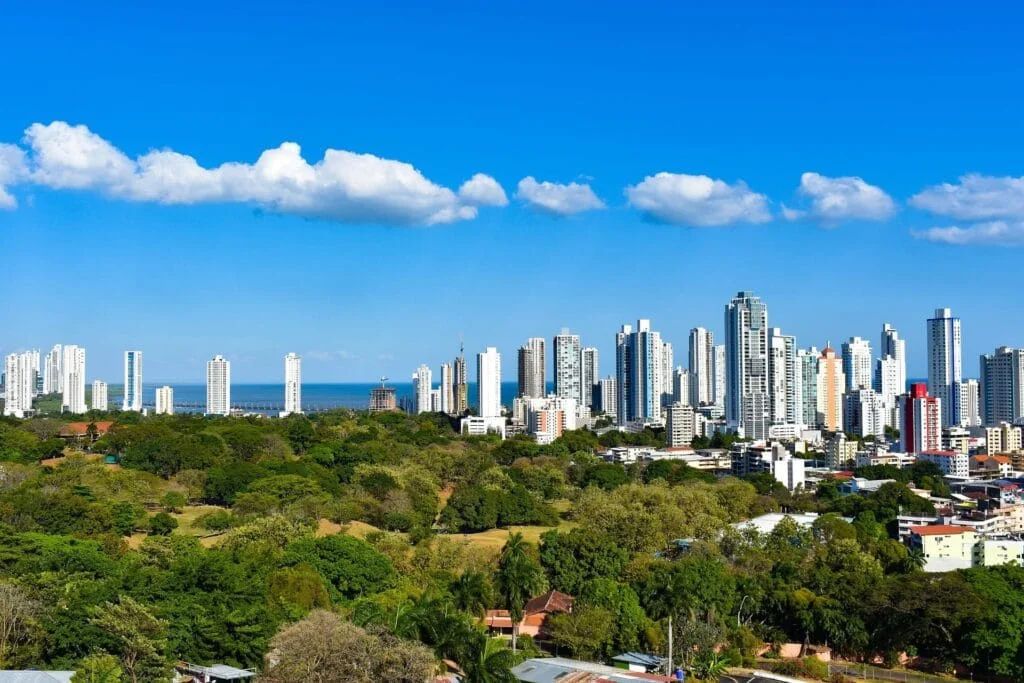
Panama City is a modern metropolis that offers a striking contrast between ultra-modern skyscrapers and historic colonial architecture. The city is divided into several distinctive districts: Casco Viejo (Old Town) with its colorful colonial buildings, Panamá Viejo with historic ruins, the Panamanian financial district with upscale hotels and restaurants, and the Amador Causeway, which is ideal for relaxed walks with views of the Pacific Ocean and the entrance to the Panama Canal.
Just as important as the architecture is the presence of nature right in the heart of the city – Panama City is the only world metropolis with a rainforest reaching directly into the urban area. The Metropolitan Natural Park (Parque Natural Metropolitano) with the Canopy Tower station is a fantastic spot for birdwatching and observing wildlife.
Casco Viejo: The soul of history in colorful streets
Casco Viejo is the beating heart of Panama and is listed as a UNESCO World Heritage Site. In the 17th century, after pirate attacks, the original city of Panama was moved to a peninsula, where it was rebuilt on a more secure site with defensive fortifications. Today, Casco Viejo serves as a living museum that takes you back in time.
Every building in Casco Viejo tells a story – from the Metropolitan Cathedral (Catedral Metropolitana) with its stunning interior to the churches, palaces, and former warehouses. The traditional fortifications that once marked the edge of Casco Viejo are now known as Paseo de Las Bóvedas – a beautiful promenade overlooking the Pacific Ocean.
One of the most enchanting spots is Paseo Esteban Huertas, a lovely palm-lined promenade with arches covered in bougainvillea. From here, you get views of Panama City’s modern skyscrapers in the background, sharply contrasting with the old architecture.
Panama Canal: An engineering marvel
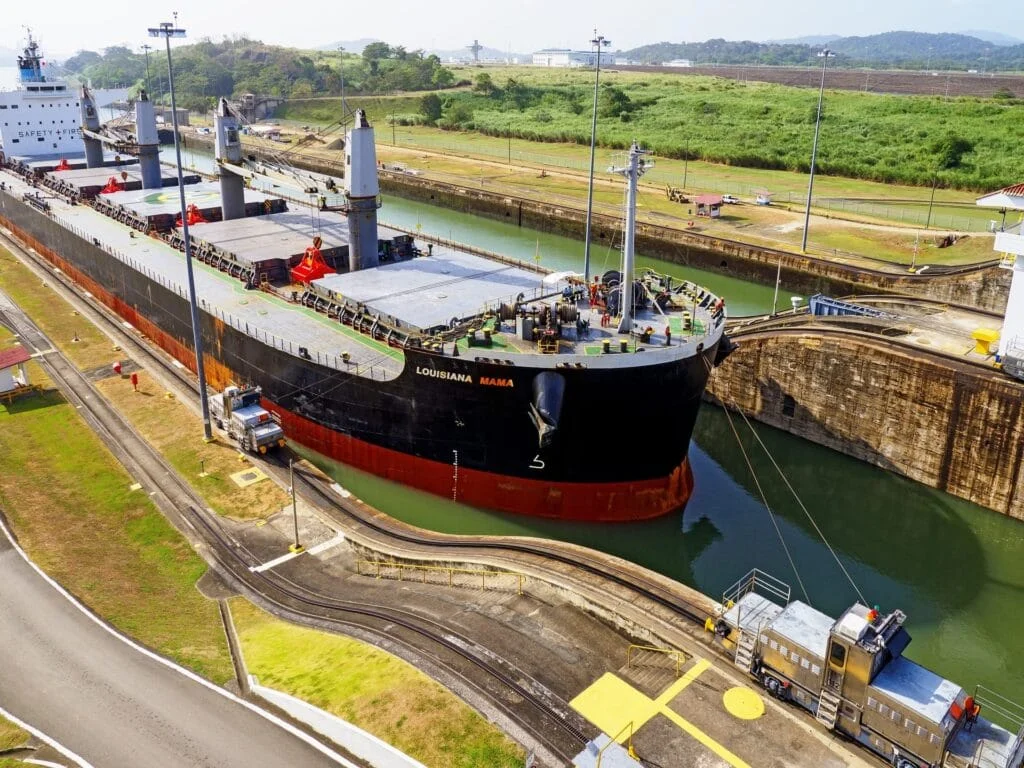
The Panama Canal is without a doubt the most iconic experience for visitors to Panama. This 82-kilometer-long canal connects the Atlantic Ocean (or more precisely, the Caribbean Sea) with the Pacific Ocean and allows ships to travel between continents without having to sail around Cape Horn. The canal operates using a system of three lock complexes – Miraflores, Pedro Miguel, and Gatún – which gradually raise or lower the water level so ships can pass through safely.
The Miraflores Locks are the closest to Panama City and are the easiest place to visit and watch the canal in action. The Miraflores Visitor Center has an observation deck where you can see massive ships passing through the locks. The whole process takes only about eight minutes, and it’s fascinating to watch vessels move just a few centimeters from the lock walls.
An alternative way to experience it is a Panama Canal boat tour. Many travelers book a one-day or multi-day trip, during which they can actually sail through some of the locks themselves.
Most famous landmarks and cities
Portobelo: Caribbean vibes, pirates, and history
Portobelo lies on the Caribbean coast, about 80 kilometers northeast of Panama City. This small town was one of the most important ports of the colonial era. Gold and silver from Peru were loaded onto ships here, making Portobelo one of the richest cities in the Americas in the 16th and 17th centuries. Today you can see the ruins of the San Lorenzo fortress, a beautiful fortification built in 1595.
Portobelo is also known for its San Felipe Church (Iglesia de San Felipe), which houses the statue of the Black Christ – a famous figure that supposedly washed ashore in a crate. The town is now part of the UNESCO World Heritage within the colonial transisthmian route.
During the Festival Cristo Negro in October or November, thousands of pilgrims travel to Portobelo.
San Blas Islands (Guna Yala): An autonomous island paradise
The San Blas Islands, also known as Guna Yala, are an autonomous territory of the Kuna people – one of the oldest and most influential Indigenous communities in Panama. This archipelago is made up of more than 300 islands, only 49 of which are inhabited. Over 50,000 Kuna live here in close-knit communities, preserving their traditions, language, and culture.
What makes Guna Yala truly unique is that no project can go ahead without the approval of the local community. Guna Yala is effectively a state within a state, with its own anthem and flag (which features a symbol similar to a swastika, but for the Guna people it is an ancient sign representing the four cardinal directions and the paths of the spiritual world).
The busiest island, Isla Colón, is the gateway to the rest of the archipelago. The diverse island communities are ready to welcome travelers: you can stay in traditional huts made from bamboo and palm leaves, swim in crystal-clear turquoise water, stargaze at night, and get to know Kuna traditions up close.
Traditional molas are the most famous expression of Guna culture – intricate, colorful textile panels featuring sacred animals and cosmological symbols. The best place to buy molas is directly on the islands, straight from the women who create them.
Boquete: A cool mountain escape
Boquete sits at an altitude of around 1,200 meters in the mountainous Chiriquí province in western Panama. This small highland town feels completely different from the tropical lowlands – average temperatures range between 16–27 °C, making it an ideal refuge from the tropical heat. Boquete is famous for growing high-quality coffee, especially the Geisha variety, one of the most expensive and sought-after coffees in the world.
The town is surrounded by stunning nature: Barú Volcano, the dominant peak in the region, is visible from all sides and, on a clear day, its summit offers a breathtaking view of both oceans. The Lost Waterfalls, the crystal-clear Caldera River, and vast coffee plantations create a landscape that feels more like the Andean highlands than Central America.
A stay in Boquete can include walks along the Pipeline Trail, a favorite among birdwatchers thanks to more than 200 bird species, river trips, visits to coffee farms, or simply relaxing and unwinding in the pleasant mountain climate.
Bocas del Toro: A Caribbean island full of cultural diversity
Bocas del Toro is a northwestern province that includes an archipelago of the same name. The capital, Bocas Town on Isla Colón, is a lively, colorful community with a great Caribbean vibe, bright wooden houses, and streets filled with the sounds of reggae and Latin music. The island has just one paved road network; everywhere else you get around by boat or on foot.
Isla Bastimentos, the second-largest island, is home to the Isla Bastimentos National Marine Park, Panama’s first marine park, often called the “Galápagos of the Caribbean.” The island features Red Frog Beach, famous for its bright red poison dart frogs and unforgettable snorkeling. Playa Larga is an important nesting site for endangered sea turtles.
Natural beauty and national parks
Darién National Park: The last wild frontier
Darién National Park is one of the largest national parks in Panama and one of the most biodiverse places on Earth. This 579,000-hectare park is home to several endangered species, including the harpy eagle (Panama’s national bird), jaguars, tapirs, and giant anteaters. The region is also home to the Indigenous communities of the Emberá and Wounaan.
Darién is considered one of the most remote areas in Central America and is ideal for experienced travelers looking for real adventure. Because of its isolation and certain safety concerns, it’s best to visit Darién on a well-organized tour.
Coiba National Park: A Pacific Ocean gem
Coiba National Park is a UNESCO World Heritage Site in the Pacific Ocean. The largest island in Central America, Isla de Coiba, is surrounded by one of the richest marine ecosystems in the region. The park has become a refuge for species that have disappeared from the rest of Panama – including the scarlet macaw, with the largest wild population in Central America, endangered eagles, and colorful parrots.
Coiba is a diver’s dream – its waters are home to sharks, rays, sea turtles, and countless brightly colored tropical fish. The coral reefs are stunning and largely untouched.
Volcán Barú National Park: The roof of Panama
Volcán Barú National Park is home to the highest peak in Panama (3,475 meters), an active stratovolcano. On clear days you can see both oceans from the summit – the Pacific Ocean to the south and the Caribbean Sea to the north.
The hike up Volcán Barú is one of the most popular treks in Panama and usually starts in Boquete. The ascent takes roughly 5–7 hours one way.
Isla Bastimentos National Marine Park: A coral paradise
One of the first marine parks in the Americas, Isla Bastimentos National Marine Park covers more than 13,200 hectares. It includes mangroves, coral reefs, and white-sand beaches. The most famous spots are the Zapatilla Islands, which are pristine oases with no human development.

Best beaches
Starfish Beach (Bocas del Toro)
Named after the abundance of starfish you can see in the shallow, crystal-clear water, Starfish Beach is a beautiful, peaceful beach on Isla Colón. The water is clear, the sand is soft and golden. It’s perfect for relaxing and light snorkeling.
Red Frog Beach (Isla Bastimentos)
This beach is famous for its poisonous red dart frogs and the stunning rainforest access trail. The frogs are toxic but beautiful and not aggressive. The beach offers great snorkeling and is quieter than Starfish Beach.
Playa Blanca (Coclé Province)
Playa Blanca boasts white sand and clear turquoise water. It sits on the Pacific side and is one of the most beautiful beaches in Panama. Gentle waves make it ideal for swimming.
Playa Venao (Azuero Peninsula)
Playa Venao is a surfer’s paradise with consistent waves all year round. The sand is dark due to its volcanic origin, the water is clear and a bit cooler. You’ll find hostels, cafés, and small restaurants nearby.
Coronado Beach
A long stretch of coast that combines white sand with black volcanic sand, Coronado Beach is about an hour from Panama City on the Pacific side. The beach is well developed, with luxury resorts and golf courses, yet it’s still accessible for travelers on all budgets.
Activities and things to do
Panama offers an incredible range of activities for every type of traveler. Panama Canal cruises are an absolute must – whether you choose a one-day trip or a once-in-a-lifetime transit experience. Birdwatching in the rainforest is unbeatable for birders and nature lovers – Panama’s rainforest is home to more than 970 bird species.
Trekking and hiking are available at all difficulty levels: from an easy walk along the Pipeline Trail in Panama City to a demanding climb up the Barú volcano. Diving and snorkeling are the main draws in Bocas del Toro and Coiba National Park, where you can explore the vibrant life of marine ecosystems.
Rafting and tubing are popular in Boquete and the surrounding area. Visits to indigenous villages let you experience the culture of the Emberá, Wounaan, and Kuna peoples. Shopping and art in Casco Viejo bring together local crafts, art, and fashion design. Bocas del Toro offers a lively nightlife scene with bars and clubs.
Gastronomy and culture
Typical food and drinks
Panamanian cuisine is a vibrant mix of influences: Spanish, indigenous, and African traditions come together in every dish. Sancocho is Panama’s national dish – a hearty chicken soup with sweet potatoes, corn, plantain, and cilantro. Every family has its own recipe, and sancocho is cooked for all major celebrations.
Ceviche is raw fish or shrimp marinated in lime juice with onion and cilantro – one of the freshest and lightest dishes you can try. Panamanian ceviche is usually served with crackers or fried plantains.
Patacones are fried, flattened plantains – served as a side dish, often with salt and garlic sauce. Empanadas are small baked or fried pastries filled with meat, cheese, or vegetables, perfect as a snack.
Ropa Vieja is a traditional dish made from shredded beef cooked in a rich tomato sauce with onions and peppers, served with rice and beans. Arroz con Guandú y Coco is rice cooked in coconut milk with pigeon peas – light, filling, and full of flavor.
Carimañolas are special pastries made from cassava (yuca) dough filled with meat – they are shaped like a torpedo and make an excellent snack. Pescado Frito is a whole fried fish, usually served with patacones and salad.
A traditional drink is Chicha, a sweet beverage made from various crops (corn, banana, or rice). On the coast, you can enjoy Coco Loco – a fresh coconut filled with rum and served with a straw. Cerveza (beer) is a popular choice, with local brands like Balboa and Atlas.
Dining tips
Meals in Panama usually start early – breakfast is between 6–8 a.m., lunch between 12–2 p.m., and dinner between 6–8 p.m. In restaurants, it’s normal to wait longer for your food than in many parts of Europe.
In restaurants, a standard tip is 10–15% of the bill, unless it’s already included. If you are vegetarian, make this clear to the staff, as Panamanian cuisine is largely meat-based.
Cultural customs and festivals
Panamanian culture is a rich blend of Spanish, African, and Indigenous traditions. Carnival is the biggest festival – it takes place 40 days before Easter and brings dance parties, music, and colorful costumes. The Carnival in Las Tablas, a small town on the Azuero Peninsula, is especially famous and celebrated in the most spectacular way, highlighted by the charm of the Pollera – the traditional women’s skirt.
The Festival de la Mejorana is held in Guararé and celebrates traditional folklore, music, and dance. The Boquete Jazz and Blues Festival in March features world‑class musicians in a stunning mountain setting.
During Semana Santa (Holy Week), celebrations take place across the country. Independence Day is celebrated on November 28, when Panamanians mark their independence from Spain.
Key practical information
Currency and payments
In Panama, the official currency is the balboa (PAB), which is pegged to the US dollar at a 1:1 rate. Interestingly, the US dollar (USD) is legal tender and is often used more than balboa coins. When you receive balboa coins, it’s best to spend them before you leave, as foreign banks usually do not accept them.
Panama has plenty of ATMs, especially in Panama City. It’s best to use ATMs located in banks or stores. Credit cards (Visa, MasterCard, American Express) are accepted in hotels, restaurants, and shops in cities and popular tourist areas. In smaller towns and rural regions, it’s a good idea to carry cash.
Entry requirements and visas
Czech citizens can travel to Panama with a valid Czech passport without a visa for up to 180 days. Your passport must be valid for at least 6 months from the date of entry.
When entering Panama, you will need to fill out an arrival form, which you will receive during the flight or at the airport. You must also show proof of sufficient funds – usually a minimum of $500 per person (in cash or as an account balance).
When leaving, make sure you have not overstayed the allowed period of stay, as Panamanian authorities may charge penalties for this.
Safety and local customs
Panama is generally a safe country for travelers, but as in any country, there are areas where you should avoid going alone, especially at night. The city of Colón and some outlying neighborhoods of Panama City have higher crime rates – here it’s best to avoid walking alone and after dark.
General safety tips:
- Do not wear valuables visibly such as expensive watches, cameras, or designer sunglasses.
- Avoid walking alone at night, especially in unfamiliar areas.
- Use only official taxis or Uber.
- Keep an eye on your bags and luggage on buses and in crowded places.
- Avoid driving at night off the main roads.
Panamanians are generally friendly and welcoming to visitors. Basic politeness and respect for the local culture are always appreciated.
Healthcare and vaccinations
Healthcare in Panama is fairly good, especially in Panama City, where you will find quality private clinics and hospitals. In smaller towns, the standard of care can vary.
Recommended vaccinations include: tetanus, diphtheria, whooping cough (Tdap), hepatitis A and B, and typhoid fever. Vaccination against yellow fever is recommended if you are traveling east of the Panama Canal.
A yellow fever vaccination certificate may be required for travelers arriving from areas with a risk of transmission.
Travelers with allergies should bring a medical certificate and a list of the medications they take. Good travel insurance is absolutely essential to cover any medical treatment you might need.
Fauna and flora
Panama is home to an incredible variety of wildlife. More than 970 bird species – including the harpy eagle (the national bird), scarlet macaw, and resplendent quetzal – make Panama a paradise for birdwatchers.
Mammals include three species of sloths (two-toed and three-toed). Monkeys – including the mantled howler monkey, white-faced capuchin, and Geoffroy’s tamarin – are common in the rainforests. Big cats also live here: jaguar, puma, ocelot, and jaguarundi, although they are very shy.
Other animals include otters, coatis, agoutis, tapirs, anteaters, porcupines, and countless others.
Reptiles include iguanas, boa constrictors, fer-de-lance (a dangerous snake), and crocodiles. There are more than 200 species of amphibians, including beautiful but poisonous poison dart frogs.
Basic vocabulary
| Czech phrase | Translation into Spanish |
|---|---|
| Dobrý den | Buenos días (morning), Buenas tardes (afternoon), Buenas noches (evening) |
| Dobrou noc | Buenas noches |
| Jak se máte? | ¿Cómo está? (formal) / ¿Cómo estás? (informal) |
| Výborně, děkuji | Muy bien, gracias |
| Prosím | Por favor |
| Děkuji | Gracias |
| Děkuji mnohokrát | Muchas gracias |
| Kolik to stojí? | ¿Cuánto cuesta? |
| Je to příliš drahé | Es muy caro |
| Mluvíte anglicky? | ¿Habla inglés? |
| Jmenuji se... | Me llamo... |
| Těší mě | Mucho gusto / Encantado(a) |
| Pomoc! | ¡Ayuda! |
| Nemocnice | Hospital |
| Policie | Policía |
| Kde je? | ¿Dónde está? |
| Restaurace | Restaurante |
| Hotel | Hotel |
| Voda | Agua |
| Pivo | Cerveza |
| Rozumím | Entiendo |
Transport and logistics
How to get to the country
Tocumen International Airport (PTY), the main international airport in Panama, is located about 24 kilometers from Panama City. It is the closest entry point for Czech travelers.
Airlines offer flights from Prague with a layover (usually in Paris, Amsterdam, or Madrid). The journey usually takes 12–16 hours.
From the airport to the city, you can take a taxi (it’s best to agree on the price in advance, usually $25–35), Uber (a cheaper option, prices vary depending on the time), or a bus (inexpensive, but less comfortable).
Getting around the country
The Panama City Metro is a modern rapid transit system with two lines. The metro is clean, safe, and cheap (a ride with a reloadable card costs 35 cents).
MetroBus (MiBus) is a bus network that covers all of Panama City and the surrounding areas. Fares are low (25 cents) and you pay with the same card you use for the metro.
Uber is available in Panama City and major towns. It is often a cheaper and safer alternative to regular taxis.
Car rental is available in Panama City and at the airport, but driving in Panama City is chaotic and aggressive. Panamanian drivers often ignore the rules: they don’t give way, don’t use turn signals, and run stop signs. Outside the city, driving is safer, but never drive at night off the main roads – roads are dark and have no lighting.
Intercity buses are a cheap and fairly safe way to get around. The Albrook Terminal in Panama City is the main bus station, with routes to every part of the country. Longer journeys (e.g. Panama City – Boquete, Panama City – Bocas del Toro) can also be done by domestic flights, which take 1–2 hours and are relatively affordable (50–100 USD).
Ferries are available for trips to the islands – San Blas, Bocas del Toro and the Pearl Islands. Timetables and prices vary depending on the destination.
Prices and travel budget
Panama is a mid-range destination, price-wise similar to Costa Rica. Costs vary a lot depending on where you travel – Panama City and Bocas del Toro are more expensive than Boquete or rural areas.
Budget categories
Low-cost / backpacker budget: If you stay in hostels (dorm beds for 10–20 USD per night), cook for yourself, travel by bus and eat in cheap local eateries (“fondas”), you can get by on 30–45 USD per day. Local meals will cost you 3–7 USD per serving.
Mid-range budget: A mix of hostels and private rooms (25–60 USD per night), occasional guided tours (snorkeling, trekking – 40–80 USD), the odd visit to nicer restaurants (8–14 USD per meal) and domestic flights for longer distances will come to about 60–100 USD per day.
Luxury budget: If you go for 4–5-star hotels (150–300 USD per night), upscale dining (20–40 USD per meal), private guides and tours and you are happy to fly instead of taking the bus, you can easily spend 150 USD or more per day.
Indicative prices
- Hostels: Shared dorm 10–20 USD, private room 25–50 USD
- Hotels: Budget 30–60 USD, mid-range 70–150 USD, luxury 150–300+ USD
- Local food: 3–7 USD per meal
- Restaurants: 8–17 USD per meal
- Street food: 1–3 USD
- Beer: 1–2 USD for a local brand
- City bus: 0.25 USD
- Metro: 0.35 USD
- Taxi/Uber: 3–10 USD depending on distance
- Entrance to Miraflores Locks: 17 USD
- Canal cruise (partial): 60–80 USD
- Snorkeling trip in Bocas del Toro: 40–60 USD
- Hiking/coffee farm tour in Boquete: 30–50 USD
How to plan the perfect trip
For different types of travelers
For first-timers: Start in Panama City (2–3 days) to see the canal and Casco Viejo. Then head to Bocas del Toro (2–3 days) for island vibes and snorkeling. If you have time, add Boquete (2 days) for mountain calm and great coffee. In total, plan for 7–9 days.
For families: Panama City (2 days) – kids will love the Biomuseum and watching ships on the canal. San Blas Islands (2 days) – simple and safe. Boquete (2 days) – peaceful, with easy walks. In total, 6–7 days.
For solo travelers: Panama City (1–2 days). Bocas del Toro (3–4 days) – lively social scene in the hostels. San Blas Islands (2–3 days) – easy to reach, stunning sea. Boquete (2 days). In total, 10–12 days.
For seniors / less active travelers: Panama City (2 days) – easy walks and a Canal Tour. Coronado Beach (2–3 days) – quiet beach stay. Boquete (2 days) – cooler climate and a relaxed pace. In total, 7–8 days.
Common planning mistakes
- Underestimating time in Panama City: Think one day is enough? The Canal, Casco Viejo and the surrounding area will take at least 2 days.
- Overpacked itinerary: Getting around Panama often takes longer than you expect. Allow extra time for transport and the generally slower pace.
- Not understanding the currency: Even though the US dollar is used, prices are often shown in balboa. Always double‑check the actual price.
- Not booking trips in advance: Popular tours (snorkeling, Bocas) can sell out quickly. Reserve them ahead of time.
- Forgetting about vaccinations: Yellow fever vaccination is important, especially if you’re heading east of the Canal.
Ideal itineraries
7 days:
- Day 1–2: Panama City (Casco Viejo, Canal, Biomuseum)
- Day 3–5: Bocas del Toro (Starfish Beach, snorkeling, Bastimentos)
- Day 6–7: Boquete (relaxation, coffee, walks)
10 days:
- Day 1–3: Panama City (Canal, Casco, Panamá Viejo)
- Day 4–6: San Blas Islands (Guna islands, snorkeling, local culture)
- Day 7–8: Bocas del Toro (Red Frog Beach, marine park)
- Day 9–10: Boquete (views from Barú volcano, coffee tour)
14 days:
- Day 1–3: Panama City
- Day 4–5: Coronado Beach (Pacific coast)
- Day 6–8: San Blas Islands
- Day 9–10: Bocas del Toro
- Day 11–13: Boquete
- Day 14: Return to Panama City + departure
Summary and final tip
Panama is a country of striking variety – from a futuristic, high‑rise capital to untouched island communities and quiet mountain towns. The Panama Canal is not only an engineering marvel, but also a symbol of the country as a global gateway. Whether you go for the urban edge of Panama City, the island paradise of Bocas del Toro, the mountain calm of Boquete or the cultural authenticity of the San Blas Islands, Panama will deliver a trip you’ll remember for a long time.
The key thing to keep in mind is that Panama is a country of transitions and connections – not only geographically (two continents, two oceans), but also culturally (Spanish, African, and Indigenous traditions). Every region has its own spirit and charm. Travelers often make the mistake of not allowing enough time and rushing through – slow down, take your time, and you’ll be rewarded with a deeper and more authentic experience.
People in Panama are generally warm and welcoming. Basic politeness, respect for local culture, and a willingness to adapt to local customs will open both doors and hearts. Whichever region or style of trip you choose, the main thing is that it helps you relax, discover new things, and grow personally.
Kategorie: